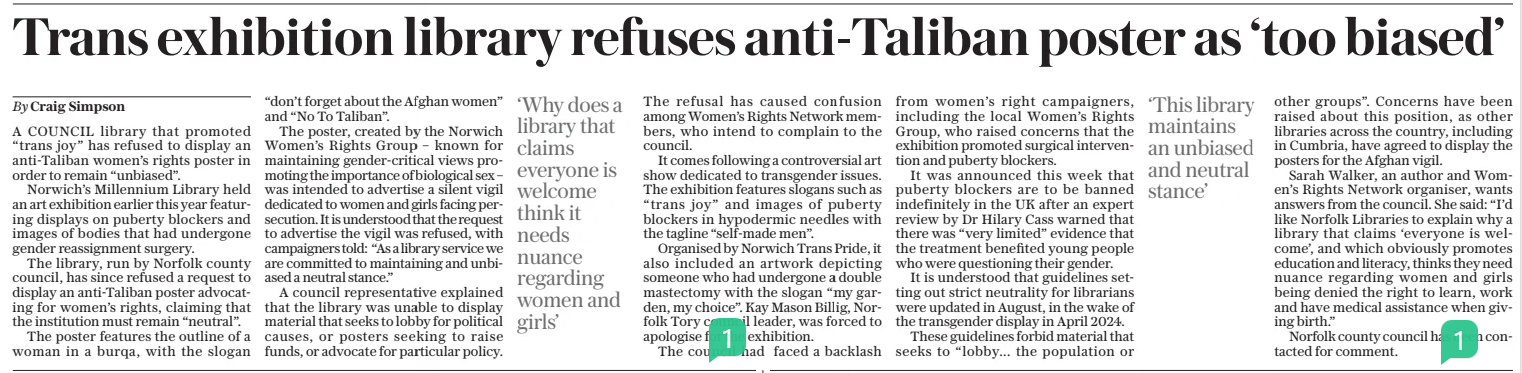
News you need, the perspective you won’t find anywhere else. The trans community’s guide to UK news, media and politics and our place in it.

The Trans Agenda

[15 December 2024]

From the start of 2025, the Trans Agenda will be going live early for subscribers. I’ll also be opening up the comments for subscribers at all levels, so make sure you sign up. It’s free but every paid subscription helps me pay for access to the papers and look for stories.

Follow me on Bluesky – @HLeeHurley.substack.com

UK NEWS

UK bans puberty blockers ‘indefinitely’

  • Wes Streeting has permanently banned puberty blockers for under-18s in the United Kingdom, ignoring all expert evidence and advice to push forward the views of some of the worst anti-trans groups in the UK. The decision will be reviewed again in October 2027.

    The ban, championed by Streeting, prevents private clinics from prescribing puberty blockers and limits NHS access to those enrolled in clinical trials.

    The Northern Ireland Executive unanimously approved Health Minister Mike Nesbitt‘s indefinite ban on the private prescription of puberty blockers the day before the UK ban was announced in Parliament in order to close a loophole that allowed NI to be used to circumvent the ban. This was something not even the Tories did.

    Despite Sinn Féin supporting puberty blockers in the Republic of Ireland, they backed the ban, alongside the DUP and Alliance Party. Alliance sought assurances for clinical trial participation, despite the Council of Europe calling such trials potentially “unethical.” I will be meeting with the Northern Ireland Justice Minister and Alliance leader, Naomi Long regarding how she has been hoodwinked.

    While consultations with parents, trans children, and advocacy groups raised urgent concerns about trans youth safety, their desperate pleas were disregarded.

    The ban, decided behind closed doors, was predetermined and driven by anti-trans agendas, leaving trans children and their families in panic. Discussions are reportedly underway to address an expected rise in suicidality linked to the decision.

Hilary Cass accuses critics of “shroud-waving” over trans youth harm [Trans Writes]

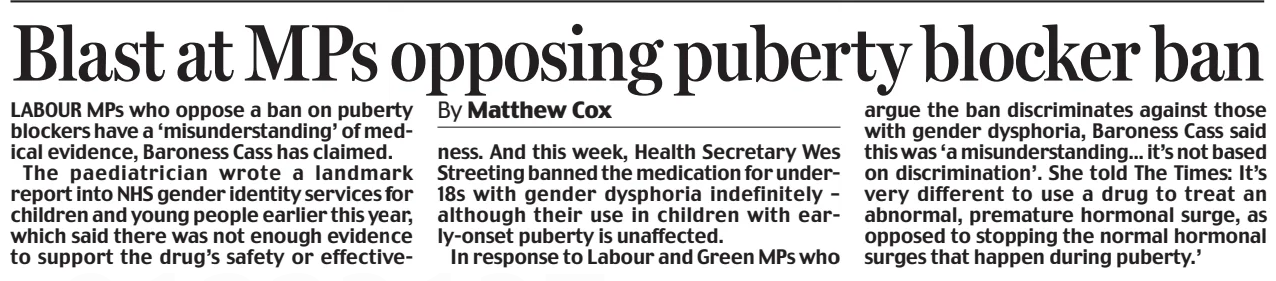
  • Hilary Cass faces mounting criticism for dismissing concerns about the impact of banning puberty blockers for trans youth. In an interview with The Times, she branded critics “shroud-wavers” and erroneously claimed there was no evidence that denying these medications leads to increased suicide risk, sparking outrage among all decent-minded people.

    Cass accused Labour and Green MPs opposing the ban of misunderstanding medical evidence, despite her own fraud of a report not recommending the indefinite ban imposed by Health Secretary Wes Streeting. Her framing—claiming that we are saying all trans kids will die if they don’t have access to puberty blockers—is disingenuous and ignores the reality that some vulnerable children will absolutely suffer severe mental health consequences.

    Cass defended the selective ban, trying to claim it is not discriminatory and is based on science, pointing to the drug’s licensed use for early-onset puberty as distinct from its application in gender dysphoria. However, such claims fail to justify the exclusion of trans children from treatment options available to cisgender peers, nor explain how the drug knows the difference between the conditions it is treating.

UK Government’s puberty blocker ban consultation influenced by anti-trans groups [UK Government]

  • The UK government’s indefinite ban on puberty blockers for under-18s followed a targeted consultation, which notably included responses from anti-trans organisations such as LGB Alliance, Sex Matters, Transgender Trend, CAN_SG, and Bayeswater Support while ignoring key data and voices that highlight the harm caused by such policies. The consultation, issued on 20 August 2024, sought feedback from select groups, including patients, clinicians, charities, academics, and public bodies. However, the inclusion of groups with a known anti-trans stance – who seem to be the only ones who were listened to – raises yet more serious questions about the consultation’s impartiality and intent.

    The ban, built on the recommendations of the Cass Review, a report already heavily criticised globally for its flawed evidence base and narrow framing, prevents non-NHS prescribing of puberty blockers and blocks prescriptions from non-UK providers. Despite claims that the ban addresses safety concerns, trans people argue, with evidence, the consultation overlooked data pointing to the mental health crisis among trans youth, exacerbated by reduced access to care.

    Consultation responses were shared with the Commission on Human Medicines (CHM), which provided advice to the government. Of the 120 organisations approached, just 51 responded—a response rate of only 42.5%, raising concerns over the thoroughness and representation of the process. Notably, the voices of trans healthcare advocates and affected families, who were by far the majority, have been sidelined while groups with ideological biases disproportionately influenced the outcomes.

    The ban, coupled with the Cass Review’s disingenuous conclusions, reflects a broader governmental targeting of trans youth. By dismissing evidence of increased suicides and declining mental health, the government’s decision prioritises political motives over the urgent healthcare needs of vulnerable young people.

Trans youth protest Wes Streeting’s puberty blocker ban extension [Trans Writes]

  • Trans youth activists from the group Trans Kids Deserve Better camped outside Health Secretary Wes Streeting‘s office in protest against the indefinite ban on puberty blockers for trans children in the UK. The group has been targeting Streeting since August, delivering paper coffins representing lost lives and those at risk. They emphasise that this issue extends beyond trans kids, posing a broader threat to the trans community’s healthcare rights.

    They released the following statement; “The occupation has now ended, but the space we created for grief and love brought light in this terrifying moment. We showed Streeting that we will not stop fighting despite the horrific treatment we receive from him and his government.

    Wes Streeting refused to show his face at his offices this morning, and refused to face the community he is doing his best (and failing) to destroy. He saw us standing in community in our grief and he treated it as a threat, as the government and media continually do. Because in reality, we are so powerful together, and we will keep living and thriving and fighting out of love, and out of spite. And that makes them afraid.

    Trans kids deserve healthcare, dignity, and to be treated like human beings. We will fight for that until we have the future we need, and deserve. Trans kids deserve better.”

DHSC report on trans kids’ suicide doesn’t excludes some trans kids [Caroline Litman]

Father Ted writer Graham Linehan among campaigners suing Belfast pub over alleged bias

  • It has been confirmed that Graham Linehan is a lead claimant in a lawsuit brought by 23 anti-trans activists against Wine Inns Ltd, who own Robinson’s Bar in Belfast. The group, including ‘feminist’ academic Dr Julia Long, alleges they were discriminated against and unlawfully refused service due to their gender-critical beliefs after going for drinks following a Let Women Speak rally led by Kellie-Jay Keen on April 16, 2022. Other, seemingly more reliable reports allege they were abusive to staff in the bar before being asked to leave.

    One individual alleges assault and is seeking £20,000, while two witnesses are claiming £8,000 each.

    Wine Inns Ltd, the pub’s owner, denies all allegations, arguing any differences in treatment were unrelated to political opinions. They counterclaim that staff felt concerned about one activist’s behaviour.

    Belfast County Court has proposed eight test cases, with legal representatives seeking consolidation under a single judge. The defence has requested further details before agreeing to lead cases, with the trial adjourned to February.

Trans artist Brogan Bertie named Portrait Artist of the Year [Yahoo! News]

  • Brogan Bertie, a trans artist from Margate, has won Sky Arts Portrait Artist of the Year 2024, earning a £10,000 commission to paint trans ally Lorraine Kelly. The portrait, now displayed at the National Galleries of Scotland, highlights Kelly’s “strength, warmth, and humour.”

    Bertie credited his transition with enhancing his artistry, saying it allowed him greater openness and authenticity in connecting with his sitters. Known for his intimate and energetic portraits, Bertie’s win celebrates identity, artistry, and self-expression.

MUST READ

The Cass Scandal: Labour’s Section 28 moment [Feminist Gender Equality Network]

  • In an article written by Dr Natacha Kennedy, the Feminist Gender Equality Network criticises Labour for its support of the Cass Review’s fraudulent findings and Wes Streeting’s decision to ban puberty blockers for trans youth. The article draws parallels to Section 28, warning that the move reinforces harmful narratives about trans people. It accuses the Labour Party of enabling discrimination, eroding LGBTQ+ rights, and failing to support trans youth under the guise of safeguarding. The review’s lack of evidence-based recommendations and its potential long-term harm to the trans community are highlighted as key concerns.

‘Wes Streeting’s Regressive Ban on Puberty Blockers is a Betrayal of Trans People’ [Byline Times]

  • Trans Actual’s Helen Belcher in the Byline Times criticises Wes Streeting‘s indefinite ban on puberty blockers for trans youth, calling it a betrayal of trans rights and a regression in LGBTQ+ equality. The article argues the move ignores expert advice, including that of the fraudulent Cass Review, which did not recommend an outright ban. Critics highlight the discriminatory nature of allowing the drugs for cisgender children with precocious puberty while denying access to trans youth. The ban is described as a politically motivated act that undermines trans healthcare, exacerbates stigma, and leaves vulnerable young people without essential support.

AROUND THE WORLD

Enoch Burke’s anti-trans crusade continues with court appeal [Irish Central]

  • Self-styled martyr Enoch Burke, dismissed for refusing to respect a transgender student’s pronouns, continues to argue baseless claims of bias against him. The former teacher, who has spent over 450 days in contempt of court, claimed educators are “afraid to state their beliefs” while railing against policies fostering respect for trans students. Despite his attempts to paint himself as a victim, his actions highlight his refusal to respect others’ identities and his obsessive push to prioritise personal dogma over inclusivity.
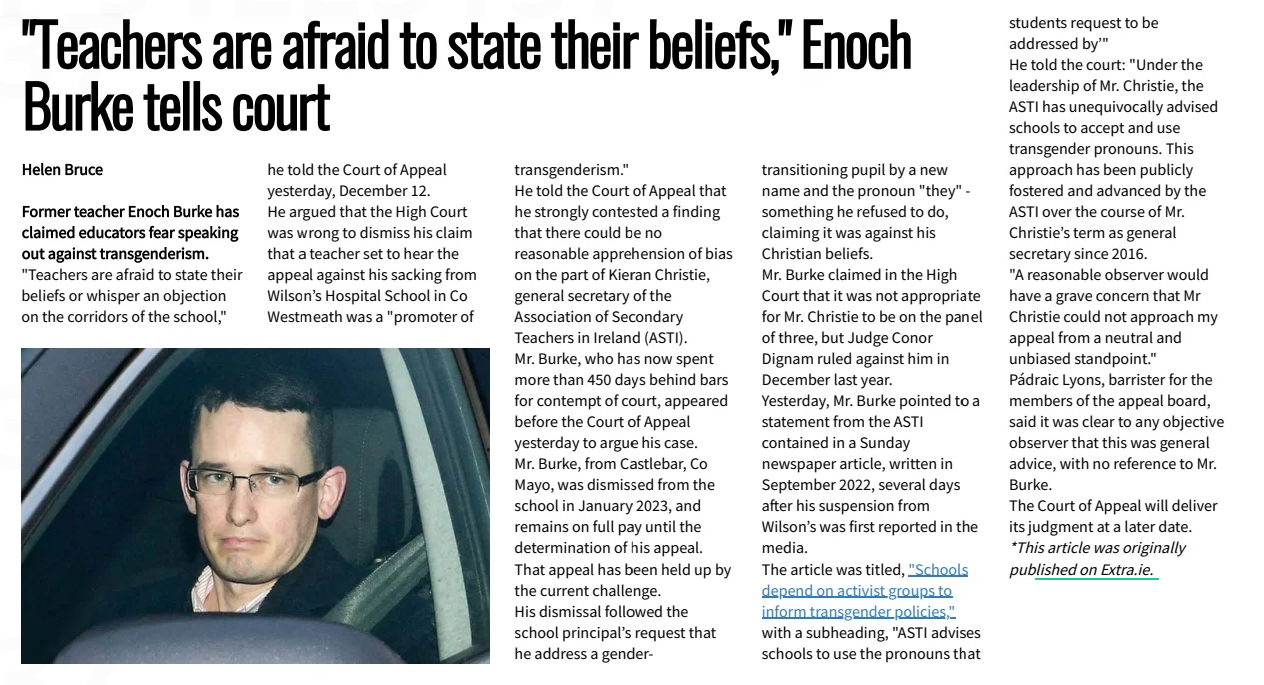
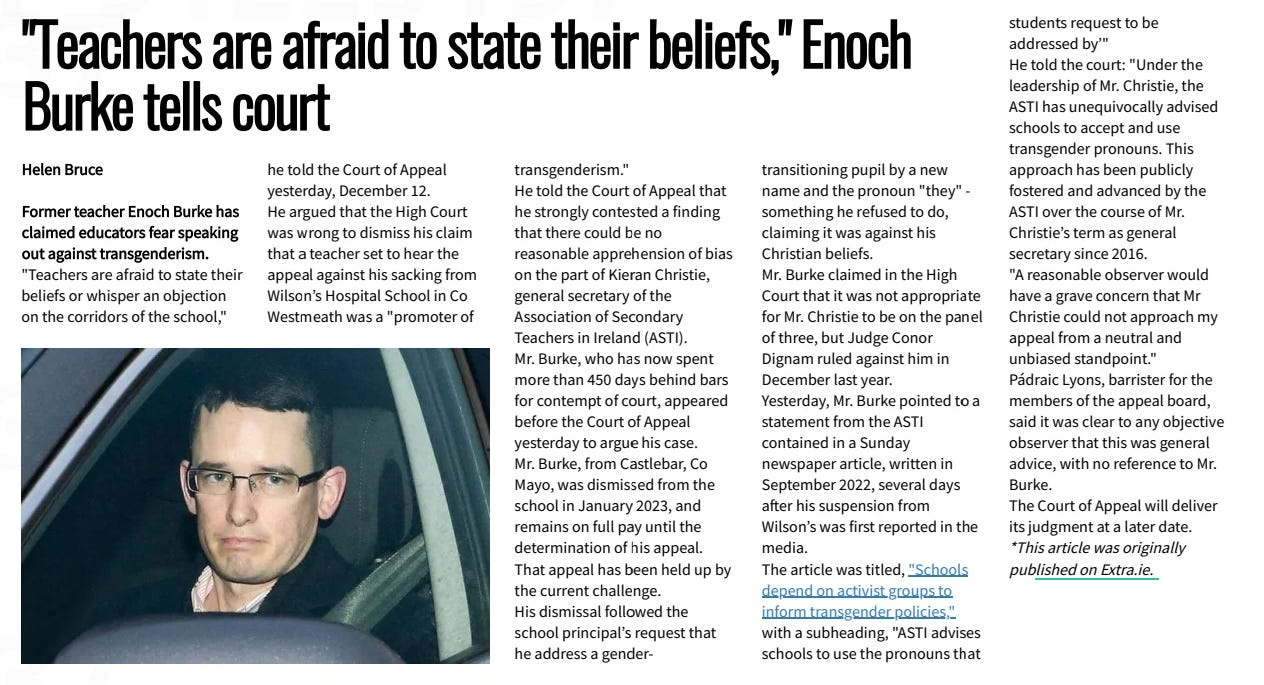
    "Teachers are afraid to state their beliefs," Enoch Burke tells court Irish Central14 Dec 2024  Helen Bruce  Former teacher Enoch Burke has claimed educators fear speaking out against transgenderism. "Teachers are afraid to state their beliefs or whisper an objection on the corridors of the school," he told the Court of Appeal yesterday, December 12. He argued that the High Court was wrong to dismiss his claim that a teacher set to hear the appeal against his sacking from Wilson’s Hospital School in Co Westmeath was a "promoter of transgenderism."  He told the Court of Appeal that he strongly contested a finding that there could be no reasonable apprehension of bias on the part of Kieran Christie, general secretary of the Association of Secondary Teachers in Ireland (ASTI).  Mr. Burke, who has now spent more than 450 days behind bars for contempt of court, appeared before the Court of Appeal yesterday to argue his case. Mr. Burke, from Castlebar, Co Mayo, was dismissed from the school in January 2023, and remains on full pay until the determination of his appeal. That appeal has been held up by the current challenge.  His dismissal followed the school principal’s request that he address a gendertransitioning pupil by a new name and the pronoun "they" - something he refused to do, claiming it was against his Christian beliefs.  Mr. Burke claimed in the High Court that it was not appropriate for Mr. Christie to be on the panel of three, but Judge Conor Dignam ruled against him in December last year. Yesterday, Mr. Burke pointed to a statement from the ASTI contained in a Sunday newspaper article, written in September 2022, several days aftfter his suspension from Wilson’s was first reported in the media.  The article was titled, "Schools depend on activist groups to inform transgender policies," with a subheading, "ASTI advises schools to use the pronouns that students request to be addressed by’"  He told the court: "Under the leadership of Mr. Christie, the ASTI has unequivocally advised schools to accept and use transgender pronouns. This approach has been publicly fostered and advanced by the ASTI over the course of Mr. Christie’s term as general secretary since 2016. "A reasonable observer would have a grave concern that Mr Christie could not approach my appeal from a neutral and unbiased standpoint." Pádraic Lyons, barrister for the members of the appeal board, said it was clear to any objective observer that this was general advice, with no reference to Mr. Burke.  The Court of Appeal will deliver its judgment at a later date. *Thisarticlewasoriginally pub lishedonExtra.ie.  Article Name:"Teachers are afraid to state their beliefs," Enoch Burke tells court Publication:Irish Central Start Page:8 End Page:8

Montana gender-affirming care ban remains blocked by Supreme Court [Las Vegas Review-Journal]

  • The Montana Supreme Court has upheld a temporary block on the state’s ban of gender-affirming care for transgender minors, citing likely violations of constitutional privacy rights. The lead plaintiff, a 17-year-old trans child, criticised lawmakers for targeting transgender youth, while the attorney general vowed to defend the law in court.

US House defence bill passes with ban on trans medical care for minors [Las Vegas Review-Journal]

  • The US House of Representatives approved an $895 billion defence bill that includes a ban on gender-affirming care for transgender minors of military families if it could result in sterilisation. Despite bipartisan support for the overall bill, some (note not all) Democrats opposed the inclusion of the trans care ban, which now moves to the Senate for further debate.

LGBTQ+ groups challenge Alberta’s transgender law in court [Edmonton Journal]

  • LGBTQ+ advocacy groups, including Egale Canada and Skipping Stone, have filed a legal injunction to prevent Alberta‘s newly passed law banning gender-affirming care for youth under 16 from taking effect. The law prohibits puberty blockers, hormone therapy, and gender-affirming surgeries for minors, sparking immediate legal challenges. The groups argue that the legislation violates the Canadian Charter of Rights and Freedoms, citing Section 7 (security of the person), Section 12 (freedom from cruel treatment), and Section 15 (equality), as well as the Alberta Bill of Rights.

    A court hearing on December 16 will determine the next steps in the legal process.

Social rejection drives high depression rates among transwomen, study finds [Deccan Chronicle]

  • A study by the George Institute for Global Health, Hyderabad, highlights systemic discrimination as a key driver of depression, anxiety, and suicidal thoughts among trans women. Conducted in collaboration with Kolkata Rista, the research reveals rejection begins at home, worsens in schools through bullying, and forces many into survival work like begging and sex work. The study calls for mental health interventions, safe spaces, and structural changes in education and employment to combat the stigma trans women face.

Art festival highlights transgender history, literature, and resilience [The Hindu]

  • A two-day ‘Transgender Literary, Heritage and Cultural Festival’ in Madurai celebrated trans identities through art, literature, and live performances.
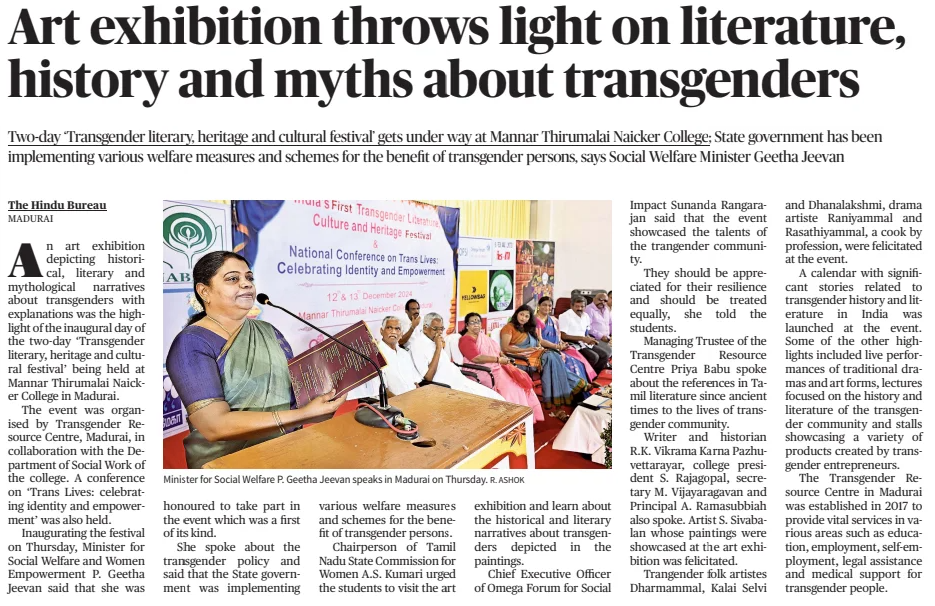
Art exhibition throws light on literature, history and myths about transgenders Twoday ‘ Transgender literary, heritage and cultural festival’ gets under way at Mannar Thirumalai Naicker College; State government has been implementing various welfare measures and schemes for the benefit of transgender persons, says Social Welfare Mi The Hindu (Madurai)13 Dec 2024 R. ASHOK Minister for Social Welfare P. Geetha Jeevan speaks in Madurai on Thursday. An art exhibition depicting historical, literary and mythological narratives about transgenders with explanations was the highlight of the inaugural day of the twoday ‘Transgender literary, heritage and cultural festival’ being held at Mannar Thirumalai Naicker College in Madurai.  The event was organised by Transgender Resource Centre, Madurai, in collaboration with the Department of Social Work of the college. A conference on ‘Trans Lives: celebrating identity and empowerment’ was also held.  Inaugurating the festival on Thursday, Minister for Social Welfare and Women Empowerment P. Geetha Jeevan said that she was honoured to take part in the event which was a first of its kind.  She spoke about the transgender policy and said that the State government was implementing various welfare measures and schemes for the benefit of transgender persons.  Chairperson of Tamil Nadu State Commission for Women A.S. Kumari urged the students to visit the art exhibition and learn about the historical and literary narratives about transgenders depicted in the paintings.  Chief Executive Officer of Omega Forum for Social  Impact Sunanda Rangarajan said that the event showcased the talents of the trangender community.  They should be appreciated for their resilience and should be treated equally, she told the students.  Managing Trustee of the Transgender Resource Centre Priya Babu spoke about the references in Tamil literature since ancient times to the lives of transgender community.  Writer and historian R.K. Vikrama Karna Pazhuvettarayar, college president S. Rajagopal, secretary M. Vijayaragavan and Principal A. Ramasubbiah also spoke. Artist S. Sivabalan whose paintings were showcased at the art exhibition was felicitated.  Trangender folk artistes Dharmammal, Kalai Selvi and Dhanalakshmi, drama artiste Raniyammal and Rasathiyammal, a cook by profession, were felicitated at the event.  A calendar with significant stories related to transgender history and literature in India was launched at the event. Some of the other highlights included live performances of traditional dramas and art forms, lectures focused on the history and literature of the transgender community and stalls showcasing a variety of products created by transgender entrepreneurs.  The Transgender Resource Centre in Madurai was established in 2017 to provide vital services in various areas such as education, employment, selfemployment, legal assistance and medical support for transgender people.  Article Name:Art exhibition throws light on literature, history and myths about transgenders Publication:The Hindu (Madurai) Start Page:2 End Page:2

Miss Netherlands scrapped after trans woman wins it [Philippine Daily Inquirer]

  • The Miss Netherlands beauty pageant has been scrapped just a year after Rikkie Kolle became its first transgender winner in 2023. Organisers cited a “changing” world and announced the competition will be replaced by a platform focused on mental health and combating unrealistic beauty standards. Director Monica van Ee said the move reflects modern priorities, shifting from crowns to stories that inspire, while creating a space for women to share authentic experiences.

SPORT

Noa-Lynn van Leuven triumphs over hate to play at World Darts Championship

  • Dutch trans woman Noa-Lynn van Leuven will defy relentless hate and discrimination to become the first trans competitor at the prestigious World Darts Championship. Van Leuven qualified through the Women’s Series, demonstrating her exceptional skill amid an onslaught of abuse and death threats. Despite criticism from some competitors and media-fuelled backlash, she remains steadfast, with support from the PDC, former world champion Michael van Gerwen, and defending champion Luke Humphries. She plays on Tuesday, 17 December in Round 1 against Kevin Doets.

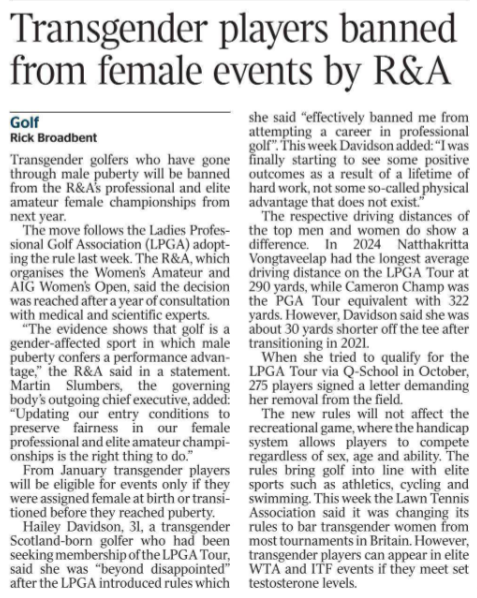
Lawn Tennis Association bans transgender players from women’s game

  • The Lawn Tennis Association (LTA) has announced a ban on transgender women competing in women’s tennis at national tournaments in the UK, going beyond the restrictions of international policies. While international rules permit trans women to compete if testosterone levels are reduced, the LTA cited evidence they haven’t produced indicating significant physical advantages for men in racket sports. ‘Discretion’ is permitted at the club level, and international tournaments like Wimbledon remain governed by global rules.

Golf – R&A ban trans women

  • The R&A will ban transgender athletes who have undergone male puberty from competing in women’s tournaments from 2025, citing extensive medical and scientific consultation which they also have not yet provided.

MEDIA

Associated Press report UK puberty blocker ban accurately

  • In a report sent to newsrooms around the globe, AP not only nails the headline but also calls puberty blockers a ‘common approach’ to treatment for trans kids and highlights how the UK ban goes against ‘standards held by medical groups elsewhere, including the European and World Professional Associations for Transgender Health, as well as the American Medical Association’.
BRITAIN BANS BLOCKERS FOR SOME The Sun Times (Owen Sound)12 Dec 2024 The British government on Wednesday indefinitely banned puberty blockers for children with gender dysphoria after independent experts found there was an unacceptable safety risk in prescribing the medication. The decision, which will be revisited in 2027, effectively bans a common approach to medical gender transitions for youths. It also goes against standards held by medical groups elsewhere, including the European and World Professional Associations for Transgender Health, as well as the American Medical Association. The announcement comes after a judge this summer upheld an emergency ban in a ruling that said the treatment was potentially harmful. The ban applies across the United Kingdom after consultation with the Scottish and Welsh governments, and an agreement with Northern Ireland. It does not apply to those already receiving puberty blockers for gender dysphoria, to their use in clinical studies or in treatment of children with precocious puberty, an uncommon medical condition that causes puberty to begin abnormally early. “We need to act with caution and care when it comes to this vulnerable group of young people, and follow the expert advice,” Health Secretary Wes Streeting said. The Associated Press  Article Name:BRITAIN BANS BLOCKERS FOR SOME Publication:The Sun Times (Owen Sound) Start Page:B1 End Page:B1

Daily Star do trans coverage the right way
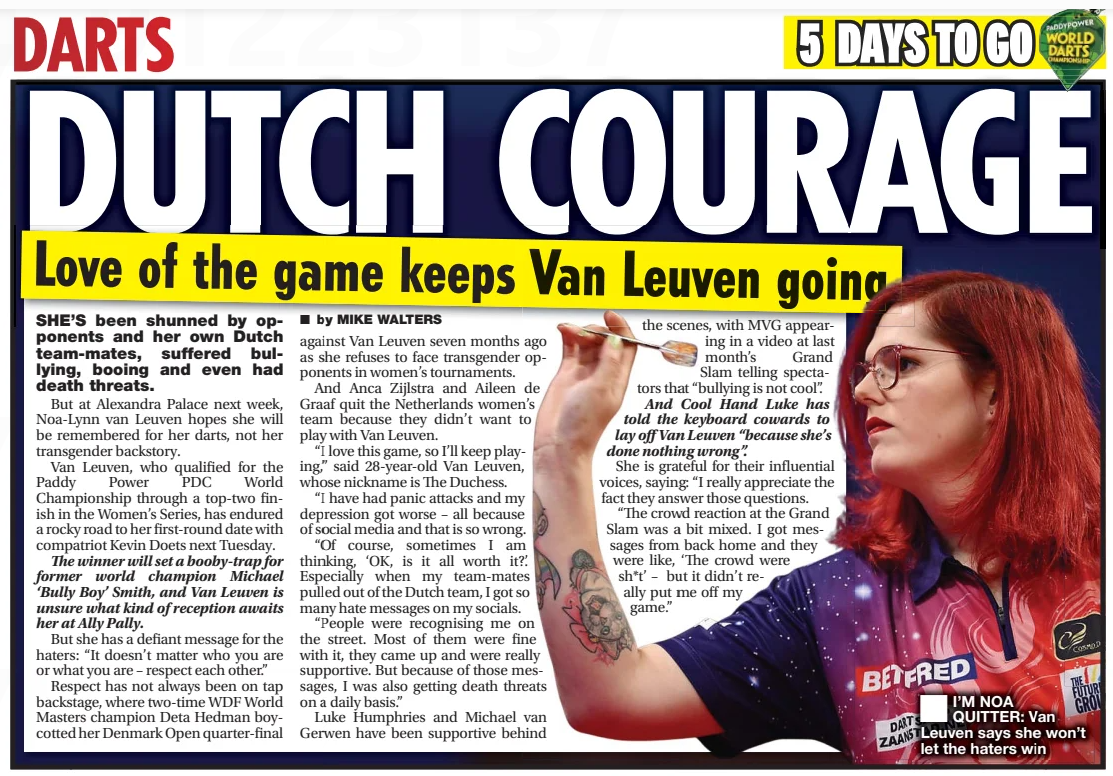
DUTCH COURAGE Love of the game keeps Van Leuven going Daily Star11 Dec 2024■ by MIKE WALTERS  ■ I’M NOA QUITTER: Van Leuven says she won’t let the haters win SHE’S been shunned by opponents and her own Dutch team-mates, suffered bullying, booing and even had death threats.  But at Alexandra Palace next week, Noa-Lynn van Leuven hopes she will be remembered for her darts, not her transgender backstory.  Van Leuven, who qualified for the Paddy Power PDC World Championship through a top-two finish in the Women’s Series, has endured a rocky road to her first-round date with compatriot Kevin Doets next Tuesday.  The winner will set a booby-trap for former world champion Michael ‘Bully Boy’ Smith, and Van Leuven is unsure what kind of reception awaits her at Ally Pally.  But she has a defiant message for the haters: “It doesn’t matter who you are or what you are – respect each other.”  Respect has not always been on tap backstage, where two-time WDF World Masters champion Deta Hedman boycotted her Denmark Open quarter-final against Van Leuven seven months ago as she refuses to face transgender opponents in women’s tournaments.  And Anca Zijlstra and Aileen de Graaf quit the Netherlands women’s team because they didn’t want to play with Van Leuven.  “I love this game, so I’ll keep playing,” said 28-year-old Van Leuven, whose nickname is The Duchess.  “I have had panic attacks and my depression got worse – all because of social media and that is so wrong.  “Of course, sometimes I am thinking, ‘OK, is it all worth it?.’ Especially when my team-mates pulled out of the Dutch team, I got so many hate messages on my socials.  “People were recognising me on the street. Most of them were fine with it, they came up and were really supportive. But because of those messages, I was also getting death threats on a daily basis.”  Luke Humphries and Michael van Gerwen have been supportive behind the scenes, with MVG appearing in a video at last month’s Grand Slam telling spectators that “bullying is not cool”.  And Cool Hand Luke has told the keyboard cowards to lay off Van Leuven “because she’s done nothing wrong”.  She is grateful for their influential voices, saying: “I really appreciate the fact they answer those questions.  “The crowd reaction at the Grand Slam was a bit mixed. I got messages from back home and they were like, ‘The crowd were sh*t’ – but it didn’t really put me off my game.”  Article Name:DUTCH COURAGE Publication:Daily Star Author:■ by MIKE WALTERS Start Page:34 End Page:34

Judge rejects sale of Alex Jones’ Infowars to The Onion [Huff Post]

  • A Texas federal judge has rejected the sale of Alex JonesInfowars to satirical news outlet The Onion, citing flaws in the auction process. The Onion’s $1.75 million bid, backed by families of Sandy Hook victims, aimed to relaunch Infowars as a parody and help address Jones’ $1.5 billion defamation debt. However, Judge Christopher Lopez ruled the auction lacked transparency and “left a lot of money on the table” for the families, though he found no bad faith in the process. The Onion expressed disappointment, while Jones celebrated the decision, calling the auction “fraudulent.” The ruling leaves Infowars under Jones’ control for now, delaying compensation to the families still seeking accountability.

WHAT’S ON IN PARLIAMENT

Select business. Full House business can be viewed here.

Monday, 16 December

  • House of Commons, 2.30pm+ Adjournment, Court delays and victims of sexual violence. More here.

  • Westminster Hall debate, 4.30pm, e-petitions 653509 and 652949 relating to Israel and Palestine. More here.

Wednesday, 18 December

  • 🚨 House of Commons, 11.30am, Women and Equalities questions including, What steps she is taking to ban conversion practices (asked by two MPs). More here.

  • House of Commons, 12pm, final Prime Minister’s Questions of 2024.

Parliament will go into recess from Friday. It will return 6 January 2025.

ANY OTHER BUSINESS

PinkNews bosses accused of sexual misconduct and bullying

  • More than 30 current and former PinkNews staff have accused CEO Benjamin Cohen and COO Anthony James of sexual misconduct and bullying, according to a BBC report. Allegations include James kissing and groping an intoxicated junior colleague at a company event, with witnesses saying the individual was “unable to consent.”

    Staff also reported feeling unsafe due to bullying and misconduct, but feared retaliation if complaints were made. Internal complaints were reportedly shared with senior leadership, but it is unclear if any action was taken.

    Downing Street, whom the media presumably contacted because queers were involved, described the allegations as “very concerning,” while Cohen and James have denied the claims but declined to comment.

UK compensates LGBT veterans dismissed under military ban

  • The UK has launched a £75m scheme to compensate veterans dismissed for their sexuality under a ban from 1967–2000. Eligible individuals can receive up to £70,000, with payments reflecting mistreatment. Defence Secretary John Healey called the policy a “moral stain” and pledged to “right past wrongs.”

    The Labour government expanded the scheme from £50m, following a review revealing systemic homophobia and victimisation. Veterans can also seek restoration of rank and corrected discharge records. The announcement comes nearly 25 years after the discriminatory policy ended.

Abortion complications reporting call ‘a smokescreen’ to limit access, peer says [Independent]

  • A proposed law in England aims to mandate annual government reports on abortion complications. Critics, including Liberal Democrat peer Baroness Barker, argue that this initiative serves as a “smokescreen” to restrict abortion access through selective data presentation. They contend that the bill’s proponents intend to use “statistical jiggery pokery” to undermine reproductive rights. The bill’s supporters assert that it seeks to enhance transparency and patient safety. However, opponents fear it could lead to increased stigma and barriers for individuals seeking abortions.

Britain among global leaders in cracking down on climate activism [Guardian]

  • British police arrest environmental and climate protesters at nearly three times the global average rate, second only to Australia, a new study reveals. The research highlights increasing criminalisation of climate protests worldwide, particularly in the global north. In the UK, arrests spiked following laws like the Police, Crime, Sentencing and Courts Act 2021, which granted police expanded powers to curb dissent. While rich nations suppress non-violent climate action, the global south sees lower arrest rates but greater police violence, exposing a troubling global crackdown on environmental activism.

THIS WEEK

Monday, 16 December

  • Woman who pled guilty to Nigel Farage milkshake incident sentenced

Tuesday, 17 December

  • Noa-Lynn van Leuven makes history as the first trans person to play in the World Darts Championship

Wednesday, 18 December

  • Indiana, USA, scheduled to conduct first execution in 15 years

Thursday 19, December

  • Report: Statistics on effects of taxes and benefits on household incomes

  • Turning Point’s AmericaFest event begins

Friday, 20 December

  • Verdict expected in Gisele Pelicot trial

Saturday, 21 December

  • Deadline to apply for Pension Credit for Winter Fuel Payment eligibility

  • Winter solstice

THE PAPERS

There were 25 articles about trans people this week and, by Saturday, it looked like it was going to be the busiest week since August. Then, something very strange happened on Sunday – there were no articles. None.

I was expecting to drown in a sea of shite opinion columns, droning on about how Wes Streeting had finally defeated the evil child-abusing transes with his puberty blocker ban. Perhaps they hate him more than they hate trans people and didn’t want to give him any credit?

Seems unlikely.

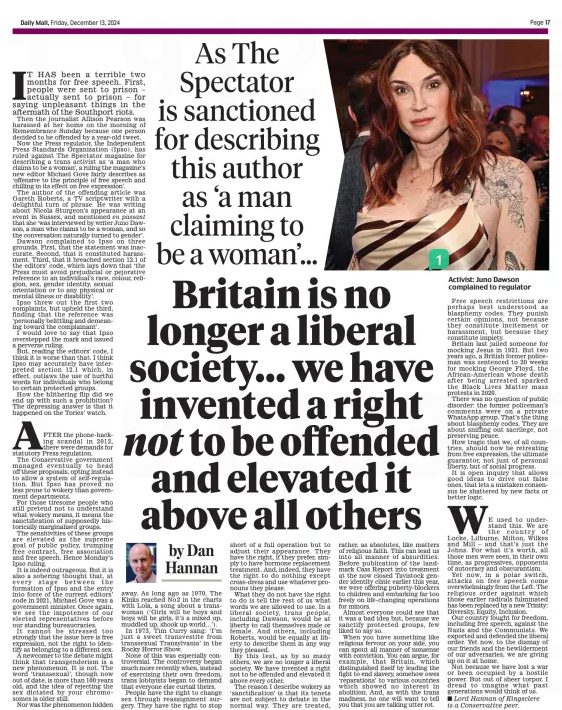
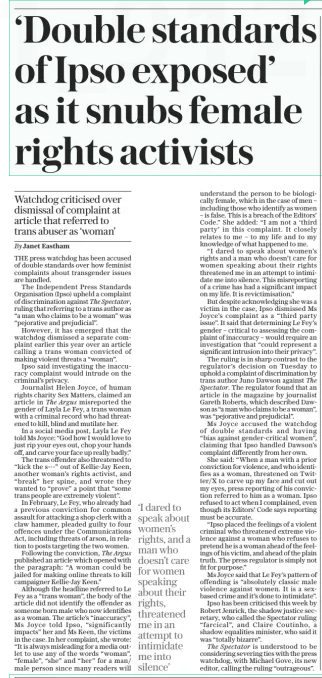
The puberty blocker ban was undoubtedly the biggest story of the week in terms of trans news, but not in terms of coverage. The reaction to it in the papers was all very muted compared to what we have come to expect. They were much more excised that IPSO had dared rule (partially) against the Spectator for calling a trans woman a man, so they set about spending a week doing the same thing to the same woman who had won the ruling. This is what ‘winning’ is like if you are trans in the UK.

The Telegraph was the clear leader this week, accounting for more than 50% of the articles (13) while the Times had seven, the Mail just three and the Guardian two, although they were both small and straight news reports.

More than 50% of the Telegraph’s articles (7) were about the IPSO ruling.

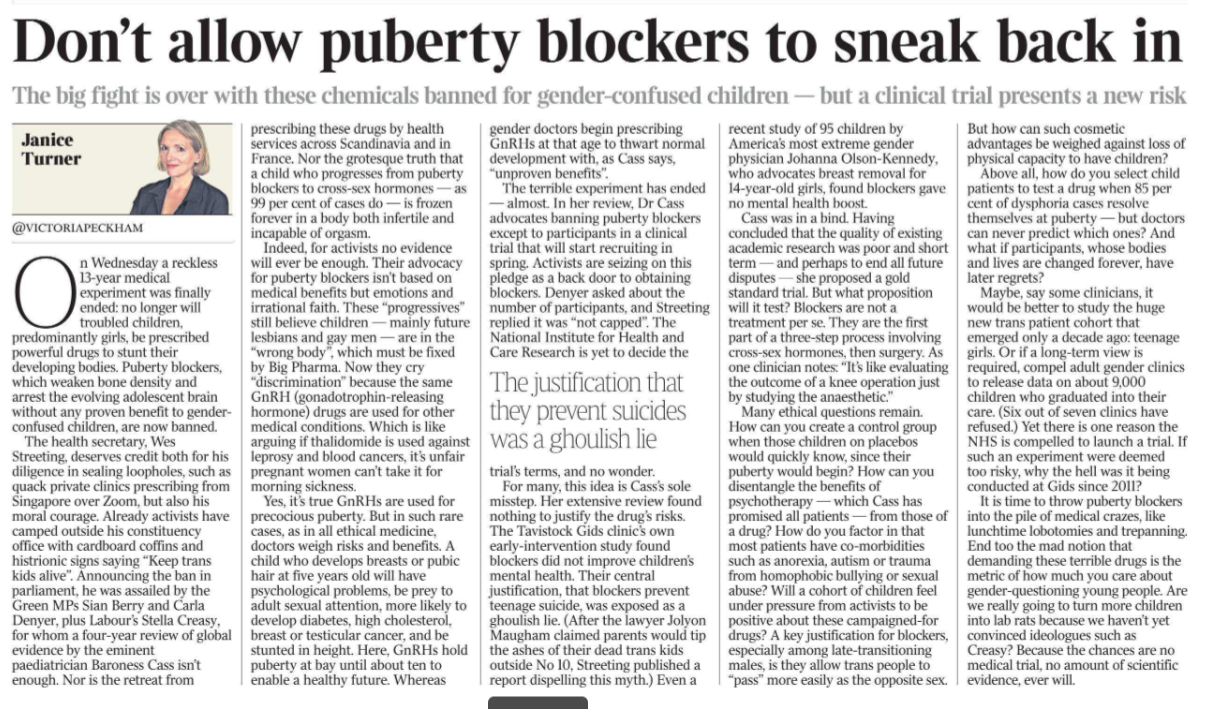
Weirdly, there was only one opinion piece on the banning of puberty blockers, and that came from Janice Turner in the Times in a piece that lies about everything. Did you know, for instance, that puberty blockers are only usually given to girls – who have been the victim of a 13-year medical experiment (should have lots of data, then) — and are not able to orgasm in later life? That’s right folks, puberty blockers are so smart they can tell if they are being given to stop puberty because it’s too early, to stop puberty because the person is trans, or to help with cancer treatment and can then switch off orgasms for trans people alone. Isn’t modern medicine a marvel?

Quoted or mentioned this week:

  • Judy Murray, complaining about trans athletes without mentioning that a trans surgeon saved her son’s career.

  • Maya Forstater and Rosie Duffield as ‘free speech campaigners’ defending the rights of publications to call trans women ‘men’.

  • Adjudicated non-expert Helen Joyce on puberty blockers and, yes, IPSO.

How many times was JK Rowling featured or mentioned? 3

How many GCs had a byline? 1 – Julie Bindel claiming, “The trans cult is crumbling here – now the US must catch up”

How many trans people were quoted or got a byline? lol

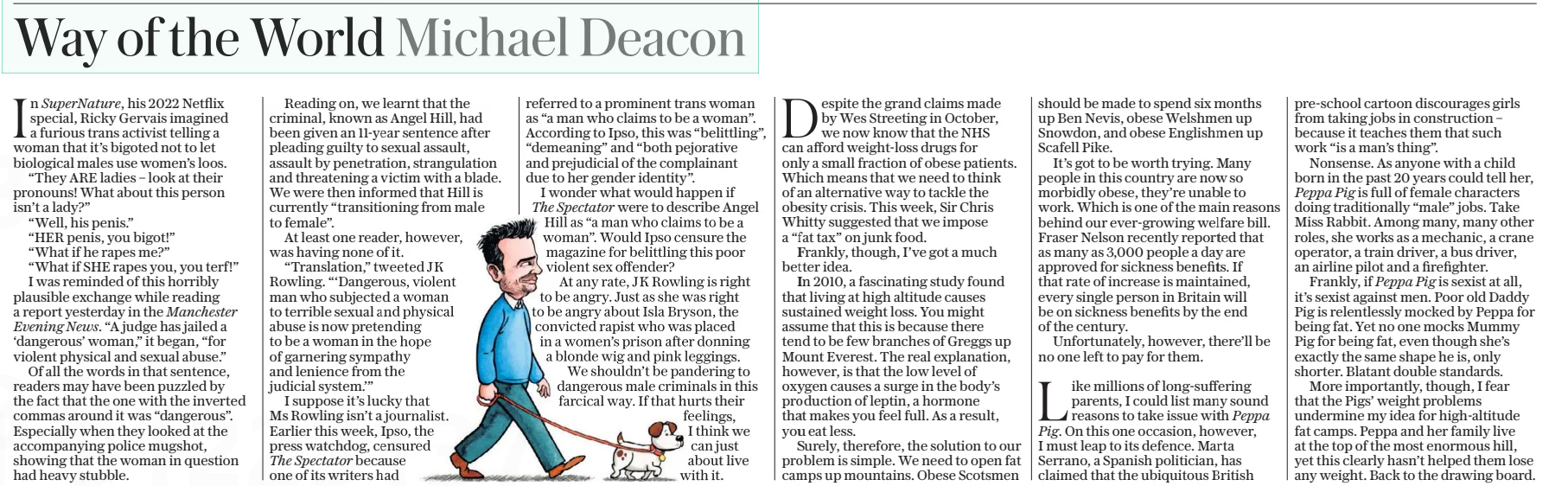
How many times did Michael Deacon write about trans people in the Telegraph? 3

Spotted or know something you think I should include in the Trans Agenda?

THE PAPERS Monday 9 December – Sunday 15 December

Monday Total: 1

The Guardian [0]
The Times [0]
Daily Mail [0]
Telegraph [1]
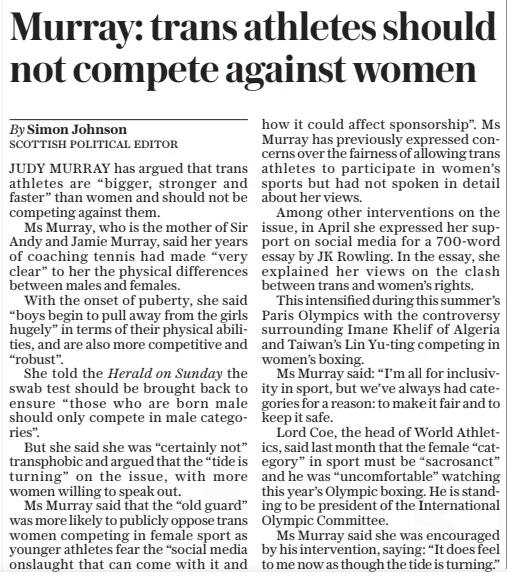
Murray: trans athletes should not compete against women The Daily Telegraph9 Dec 2024By Simon Johnson scottish Political editor JUDY MURRAY has argued that trans athletes are “bigger, stronger and faster” than women and should not be competing against them.  Ms Murray, who is the mother of Sir Andy and Jamie Murray, said her years of coaching tennis had made “very clear” to her the physical differences between males and females.  With the onset of puberty, she said “boys begin to pull away from the girls hugely” in terms of their physical abilities, and are also more competitive and “robust”.  She told the Herald on Sunday the swab test should be brought back to ensure “those who are born male should only compete in male categories”.  But she said she was “certainly not” transphobic and argued that the “tide is turning” on the issue, with more women willing to speak out.  Ms Murray said that the “old guard” was more likely to publicly oppose trans women competing in female sport as younger athletes fear the “social media onslaught that can come with it and how it could affect sponsorship”. Ms Murray has previously expressed concerns over the fairness of allowing trans athletes to participate in women’s sports but had not spoken in detail about her views.  Among other interventions on the issue, in April she expressed her support on social media for a 700-word essay by JK Rowling. In the essay, she explained her views on the clash between trans and women’s rights.  This intensified during this summer’s Paris Olympics with the controversy surrounding Imane Khelif of Algeria and Taiwan’s Lin Yu-ting competing in women’s boxing.  Ms Murray said: “I’m all for inclusivity in sport, but we’ve always had categories for a reason: to make it fair and to keep it safe.  Lord Coe, the head of World Athletics, said last month that the female “category” in sport must be “sacrosanct” and he was “uncomfortable” watching this year’s Olympic boxing. He is standing to be president of the International Olympic Committee.  Ms Murray said she was encouraged by his intervention, saying: “It does feel to me now as though the tide is turning.”  Article Name:Murray: trans athletes should not compete against women Publication:The Daily Telegraph Author:By Simon Johnson scottish Political editor Start Page:13 End Page:13

Tuesday Total: 0

Wednesday Total: 3

The Guardian [0]
The Times [0]
Daily Mail [0]
Telegraph [3]
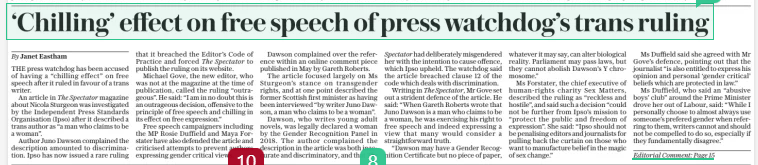
‘Chilling’ effect on free speech of press watchdog’s trans ruling The Daily Telegraph11 Dec 2024By Janet Eastham THE press watchdog has been accused of having a “chilling effect” on free speech after it ruled in favour of a trans writer.  An article in The Spectator magazine about Nicola Sturgeon was investigated by the Independent Press Standards Organisation (Ipso) after it described a trans author as “a man who claims to be a woman”.  Author Juno Dawson complained the description amounted to discrimination. Ipso has now issued a rare ruling that it breached the Editor’s Code of Practice and forced The Spectator to publish the ruling on its website.  Michael Gove, the new editor, who was not at the magazine at the time of publication, called the ruling “outrageous”. He said: “I am in no doubt this is an outrageous decision, offensive to the principle of free speech and chilling in its effect on free expression.”  Free speech campaigners including the MP Rosie Duffield and Maya Forstater have also defended the article and criticised attempts to prevent authors expressing gender critical views.  Dawson complained over the reference within an online comment piece published in May by Gareth Roberts.  The article focused largely on Ms Sturgeon’s stance on transgender rights, and at one point described the former Scottish first minister as having been interviewed “by writer Juno Dawson, a man who claims to be a woman”.  Dawson, who writes young adult novels, was legally declared a woman by the Gender Recognition Panel in 2018. The author complained the description in the article was both inaccurate and discriminatory, and that The Spectator had deliberately misgendered her with the intention to cause offence, which Ipso upheld. The watchdog said the article breached clause 12 of the code which deals with discrimination.  Writing in The Spectator, Mr Gove set out a strident defence of the article. He said: “When Gareth Roberts wrote that Juno Dawson is a man who claims to be a woman, he was exercising his right to free speech and indeed expressing a view that many would consider a straightforward truth.  “Dawson may have a Gender Recognition Certificate but no piece of paper, whatever it may say, can alter biological reality. Parliament may pass laws, but they cannot abolish Dawson’s Y chromosome.”  Ms Forstater, the chief executive of human-rights charity Sex Matters, described the ruling as “reckless and hostile”, and said such a decision “could not be further from Ipso’s mission to “protect the public and freedom of expression”. She said: “Ipso should not be penalising editors and journalists for pulling back the curtain on those who want to manufacture belief in the magic of sex change.”  Ms Duffield said she agreed with Mr Gove’s defence, pointing out that the journalist “is also entitled to express his opinion and personal ‘gender critical’ beliefs which are protected in law.”  Ms Duffield, who said an “abusive boys’ club” around the Prime Minister drove her out of Labour, said: “While I personally choose to almost always use someone’s prefered gender when referring to them, writers cannot and should not be compelled to do so, especially if they fundamentally disagree.”  Central to the freedom of the press is the ability to express strongly-worded opinions and to push back on received wisdom. Yesterday’s Independent Press Standards Organisation (Ipso) ruling against The Spectator appears to have undermined this ability.  The article at the centre of the dispute focused on Nicola Sturgeon and her stance on transgender rights in Scotland. The author, Gareth Roberts, stated that Ms Sturgeon “was interviewed by writer Juno Dawson, a man who claims to be a woman, and so the conversation naturally turned to gender”.  Dawson complained that this language breached provisions in the Editor’s Code relating to accuracy, harassment and discrimination, claiming that it was deliberate misgendering, intended to offend.  The complaints relating to harassment and accuracy were not upheld; the complaint regarding discrimination was. Ipso ruled that referring to Dawson “as a man ‘claiming’ to be a woman” was “pejorative and prejudicial of the complainant due to her gender identity”, and “not justified by the columnist’s right to express his views on the broader issues of a person’s sex and gender identity”.  This is a regrettable overstep. The issue of gender identity is highly contested, and Roberts should have been entitled to express his view. By deciding to rule in favour of Dawson on this matter, Ipso risks a chilling effect on the ability of gender critical voices to express their views and make the strongest arguments available to them, including the argument that a legal change of gender does not alter biological reality. It would have been far better if the regulator had chosen to remain above the fray rather than weighing in.  Article Name:‘Chilling’ effect on free speech of press watchdog’s trans ruling Publication:The Daily Telegraph Author:By Janet Eastham Start Page:1 End Page:1
‘Chilling’ effect on free speech of press watchdog’s trans ruling The Daily Telegraph11 Dec 2024By Janet Eastham THE press watchdog has been accused of having a “chilling effect” on free speech after it ruled in favour of a trans writer.  An article in The Spectator magazine about Nicola Sturgeon was investigated by the Independent Press Standards Organisation (Ipso) after it described a trans author as “a man who claims to be a woman”.  Author Juno Dawson complained the description amounted to discrimination. Ipso has now issued a rare ruling that it breached the Editor’s Code of Practice and forced The Spectator to publish the ruling on its website.  Michael Gove, the new editor, who was not at the magazine at the time of publication, called the ruling “outrageous”. He said: “I am in no doubt this is an outrageous decision, offensive to the principle of free speech and chilling in its effect on free expression.”  Free speech campaigners including the MP Rosie Duffield and Maya Forstater have also defended the article and criticised attempts to prevent authors expressing gender critical views.  Dawson complained over the reference within an online comment piece published in May by Gareth Roberts.  The article focused largely on Ms Sturgeon’s stance on transgender rights, and at one point described the former Scottish first minister as having been interviewed “by writer Juno Dawson, a man who claims to be a woman”.  Dawson, who writes young adult novels, was legally declared a woman by the Gender Recognition Panel in 2018. The author complained the description in the article was both inaccurate and discriminatory, and that The Spectator had deliberately misgendered her with the intention to cause offence, which Ipso upheld. The watchdog said the article breached clause 12 of the code which deals with discrimination.  Writing in The Spectator, Mr Gove set out a strident defence of the article. He said: “When Gareth Roberts wrote that Juno Dawson is a man who claims to be a woman, he was exercising his right to free speech and indeed expressing a view that many would consider a straightforward truth.  “Dawson may have a Gender Recognition Certificate but no piece of paper, whatever it may say, can alter biological reality. Parliament may pass laws, but they cannot abolish Dawson’s Y chromosome.”  Ms Forstater, the chief executive of human-rights charity Sex Matters, described the ruling as “reckless and hostile”, and said such a decision “could not be further from Ipso’s mission to “protect the public and freedom of expression”. She said: “Ipso should not be penalising editors and journalists for pulling back the curtain on those who want to manufacture belief in the magic of sex change.”  Ms Duffield said she agreed with Mr Gove’s defence, pointing out that the journalist “is also entitled to express his opinion and personal ‘gender critical’ beliefs which are protected in law.”  Ms Duffield, who said an “abusive boys’ club” around the Prime Minister drove her out of Labour, said: “While I personally choose to almost always use someone’s prefered gender when referring to them, writers cannot and should not be compelled to do so, especially if they fundamentally disagree.”  Central to the freedom of the press is the ability to express strongly-worded opinions and to push back on received wisdom. Yesterday’s Independent Press Standards Organisation (Ipso) ruling against The Spectator appears to have undermined this ability.  The article at the centre of the dispute focused on Nicola Sturgeon and her stance on transgender rights in Scotland. The author, Gareth Roberts, stated that Ms Sturgeon “was interviewed by writer Juno Dawson, a man who claims to be a woman, and so the conversation naturally turned to gender”.  Dawson complained that this language breached provisions in the Editor’s Code relating to accuracy, harassment and discrimination, claiming that it was deliberate misgendering, intended to offend.  The complaints relating to harassment and accuracy were not upheld; the complaint regarding discrimination was. Ipso ruled that referring to Dawson “as a man ‘claiming’ to be a woman” was “pejorative and prejudicial of the complainant due to her gender identity”, and “not justified by the columnist’s right to express his views on the broader issues of a person’s sex and gender identity”.  This is a regrettable overstep. The issue of gender identity is highly contested, and Roberts should have been entitled to express his view. By deciding to rule in favour of Dawson on this matter, Ipso risks a chilling effect on the ability of gender critical voices to express their views and make the strongest arguments available to them, including the argument that a legal change of gender does not alter biological reality. It would have been far better if the regulator had chosen to remain above the fray rather than weighing in.  Article Name:‘Chilling’ effect on free speech of press watchdog’s trans ruling Publication:The Daily Telegraph Author:By Janet Eastham Start Page:15 End Page:15
The trans cult is crumbling here – now the US must catch up The Daily Telegraph11 Dec 2024Suzanne Moore  Whoever would have thought that chopping off the healthy breast tissue of 14-year-old girls could land you in court?  Well, anyone who has been paying attention to the gender madness of the past decade, actually. In the US, where the practice of medicine is particularly connected to the practice of law, I predict a deluge of court cases over what has been done to children in the name of “gender-affirming care”.  Last week, a 20-year-old, Clementine Breen, filed a medical negligence claim against a Los Angeles-based doctor, Johanna Olson-Kennedy, claiming she was rushed into irreversible treatment when she was 12. Olson-Kennedy is the medical director of the Centre for Transyouth Health and Development at the Children’s Hospital in LA. Claim documents say that Breen saw a school counsellor when she was 12, and was unsure whether she was gay, bisexual or trans. She had experienced sexual abuse at six. It is claimed that Olson-Kennedy did not perform any mental health evaluation of Breen herself, yet said she met the criteria for the commencement of puberty blockers.  Within a year, she was put on testosterone, and at 14 underwent a double mastectomy. No one, it appears, was monitoring her mental health and she began to feel worse and started cutting herself. Olson-Kennedy has also refused to publish the findings of a $10million (£7.8million) taxpayerfunded study showing that puberty blockers did not improve the mental health of children.  Breen says she may be infertile, and claims she was never evaluated properly. Her parents tried to intervene, but Olson-Kennedy told them that this young girl might be suicidal, even though she had never expressed such thoughts.  After all, this is the script, isn’t it? That without mutilating the bodies of teenagers, these kids will all kill themselves. That there is no evidence for this doesn’t appear to matter. Until it gets to court and then it does.  This is where we and many other European countries are far ahead of America. When evidence of the harmful effects of puberty blockers began to come in through longitudinal studies, the NHS stopped routinely prescribing them to under-18s. Finland, Sweden, Norway and Holland have also stopped prescribing blockers and cross-sex hormones to minors.  We have the whistleblowers at the Tavistock Gender Identity Development Service and the four years of research led by Dr Hilary Cass to thank for bringing puberty blockers to a halt in the UK. Though I note that Cass is not on the BBC Women of the Year list, but someone called Brigitte  Baptiste, a transgender scientist who says that trees can change sex – I am not making this up – is.  The BBC remains in thrall to this guff, but more people are seeing through it at least. No one wants trans people’s lives to be miserable, but fewer and fewer people will kowtow to abject nonsense. When Judy Murray says that, in sport, “those who are born male should only compete in male categories”, most of us would agree.  Indeed, sport was surely one of the issues that Donald Trump was able to utilise in his election campaign. Most parents are not being transphobic in not wanting their girls to have to compete against natal males. To describe these people as illiberal fascists is simply wrong. When polled, they support gay rights and reproductive rights on the whole.  Turning this into a partisan issue, as the Democrats did, has been disastrous for them. Gradually, though, the veil is lifting and when the trans mythology is examined, it evaporates.  No one can ever explain what gender identity is beyond “a feeling”, a notion that seems to coincide absolutely with 1950s gender stereotypes of pink and blue, trucks and dolls, frills and beards.  Another important case at the US Supreme Court – the United States v Skrmetti – is a challenge to Tennessee’s SB1 law, which prohibits gender medicalisation of minors. In this, more is being exposed. Chase Strangio, a trans man (that is, a natal female) and lawyer for the American Civil Liberties Union, has made a number of contradictory statements about whether biological sex is immutable. Strangio has also said that two-year-olds can know that they are trans.  Thankfully, the Supreme Court  For Hollywood, the trans cult with the cute boy in a dress is the new Scientology  justices referred to Dr Cass’s report, as well as research from Sweden, to break down some of this nonsense.  How has it come to this? Well, cult thinking is a powerful thing. When she was addressing supporters outside the Skrmetti court, Annette Bening said that having “a transgender child has made me so much more interesting, so much more wise”. So that’s fantastic, isn’t it? Are you interesting enough as a parent without one?  Charlize Theron knew that one of the black children she adopted was trans at three, apparently, so clearly this is a must-have accessory. For Hollywood, the trans cult with the cute boy in a dress is the new Scientology. The sheer creepiness of middle-aged activists who went through male puberty now declaring themselves women but arguing to block the puberty of pre-teens never fails to shock me.  Each court case, though, brings us back to reality: that in the end sex cannot be changed. The medicalisation and mutilation of children’s bodies is not a sign of being fashionable, it is a sign that many are in denial about children being gay.  The cult is crumbling in the UK. It will take longer in America while there is still so much money to be made in harming children. No child is in the wrong body, but the fact that their bodies are put in the hands of some very wrong doctors is a terrible violation.  Article Name:The trans cult is crumbling here – now the US must catch up Publication:The Daily Telegraph Author:Suzanne Moore Start Page:3 End Page:3

Thursday Total: 10

The Guardian [1]
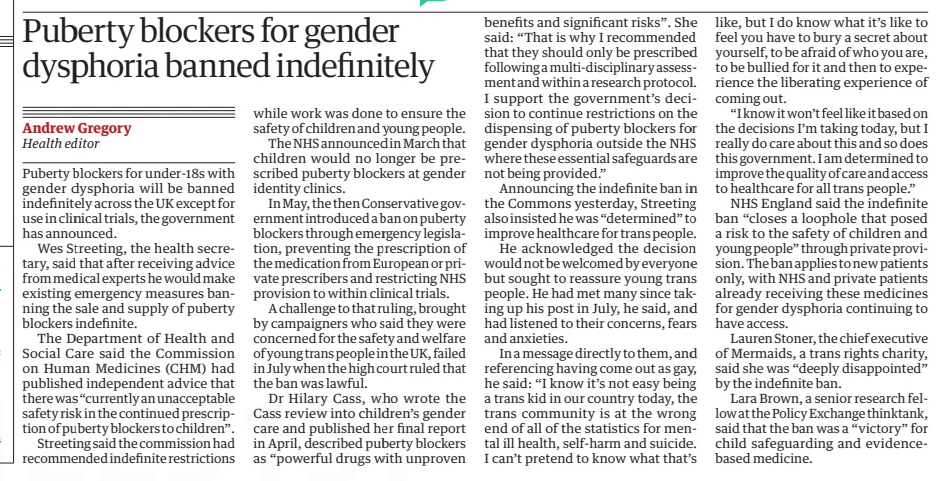
Puberty blockers for gender dysphoria banned indefinitely The Guardian12 Dec 2024Andrew Gregory Health editor Puberty blockers for under-18s with gender dysphoria will be banned indefinitely across the UK except for use in clinical trials, the government has announced.  Wes Streeting, the health secretary, said that after receiving advice from medical experts he would make existing emergency measures banning the sale and supply of puberty blockers indefinite.  The Department of Health and Social Care said the Commission on Human Medicines (CHM) had published independent advice that there was “currently an unacceptable safety risk in the continued prescription of puberty blockers to children”.  Streeting said the commission had recommended indefinite restrictions while work was done to ensure the safety of children and young people.  The NHS announced in March that children would no longer be prescribed puberty blockers at gender identity clinics.  In May, the then Conservative government introduced a ban on puberty blockers through emergency legislation, preventing the prescription of the medication from European or private prescribers and restricting NHS provision to within clinical trials.  A challenge to that ruling, brought by campaigners who said they were concerned for the safety and welfare of young trans people in the UK, failed in July when the high court ruled that the ban was lawful.  Dr Hilary Cass, who wrote the Cass review into children’s gender care and published her final report in April, described puberty blockers as “powerful drugs with unproven benefits and significant risks”. She said: “That is why I recommended that they should only be prescribed following a multi-disciplinary assessment and within a research protocol. I support the government’s decision to continue restrictions on the dispensing of puberty blockers for gender dysphoria outside the NHS where these essential safeguards are not being provided.”  Announcing the indefinite ban in the Commons yesterday, Streeting also insisted he was “determined” to improve healthcare for trans people.  He acknowledged the decision would not be welcomed by everyone but sought to reassure young trans people. He had met many since taking up his post in July, he said, and had listened to their concerns, fears and anxieties.  In a message directly to them, and referencing having come out as gay, he said: “I know it’s not easy being a trans kid in our country today, the trans community is at the wrong end of all of the statistics for mental ill health, self-harm and suicide. I can’t pretend to know what that’s like, but I do know what it’s like to feel you have to bury a secret about yourself, to be afraid of who you are, to be bullied for it and then to experience the liberating experience of coming out.  “I know it won’t feel like it based on the decisions I’m taking today, but I really do care about this and so does this government. I am determined to improve the quality of care and access to healthcare for all trans people.”  NHS England said the indefinite ban “closes a loophole that posed a risk to the safety of children and young people” through private provision. The ban applies to new patients only, with NHS and private patients already receiving these medicines for gender dysphoria continuing to have access.  Lauren Stoner, the chief executive of Mermaids, a trans rights charity, said she was “deeply disappointed” by the indefinite ban.  Lara Brown, a senior research fellow at the Policy Exchange thinktank, said that the ban was a “victory” for child safeguarding and evidencebased medicine.  Article Name:Puberty blockers for gender dysphoria banned indefinitely Publication:The Guardian Author:Andrew Gregory Health editor Start Page:2 End Page:2
The Times [3]
Puberty blocker ban is made permanent Eleanor Hayward - Health Editor Puberty blockers have been indefinitely banned as they pose an “unacceptable safety risk” for children wanting to change gender, the government has announced.  Wes Streeting, the health secretary, said the decision was based on the advice of independent medical experts, adding that “we do not yet know the risks of stopping pubertal hormones at this critical life stage”. Private clinics will not be able to prescribe or supply the drugs, although a clinical trial of puberty blockers in children at NHS clinics will go ahead next year.  The blockers suppress the release of sex hormones, which are naturally produced by the body to start puberty, between the ages of 8 and 14. The drugs pause the physical changes of puberty such as breast growth or facial hair.  They were given to thousands of children at the Tavistock and Portman NHS Foundation Trust’s gender identity development service clinic from 2011. In May the NHS banned their use after a review by Dr Hilary Cass found a lack of evidence that they were safe or effective, and warned they may permanently damage fertility and brain development.  The government introduced temporary legislation banning the sale and supply of puberty blockers, amid concerns patients were using a loophole to get them privately after the NHS ban. Streeting told the Commons yesterday that he would make the ban indefinite, with the legislation reviewed in 2027.  He said: “The independent expert Commission on Human Medicines found that the current prescribing and care pathway for gender dysphoria and incongruence presents an unacceptable safety risk for children and young people.  “Dr Cass’s review also raised safety concerns around the lack of evidence for these medical treatments. We need to act with caution and care when it comes to this vulnerable group of young people, and follow the expert advice. We are working with NHS England to open new gender identity services, so people can access holistic health and wellbeing support.  “We are setting up a clinical trial into the use of puberty blockers next year, to establish a clear evidence base for the use of this medicine.”  Streeting had asked the Commission on Human Medicines to conduct a review, which advised a “statutory indefinite ban”. The commission took evidence from clinical experts, consultant paediatric endocrinologists and patient representatives.  James Palmer, NHS medical director for specialised services, said an offer of “targeted support to anyone affected by the banning order from their local mental health services” would be extended.
Watchdog ruling denies free speech and fair comment Michael Gove  When I was a young journalist, one of my heroes was Christopher Hitchens. Not because I agreed with his politics — my own views are rather closer to those of his brother, Peter — but because he articulated so brilliantly what all journalists know in their hearts: “The only thing that should be upheld at all costs and without qualification is the right of free expression, because if that goes, then so do all other claims of right as well.”  Without qualification. Because when any individual is told what they should and should not say, liberty dies by a thousand censor’s cuts.  When I was a minister and appeared before the Leveson inquiry, I defended the right to free expression and argued against state regulation of the press. I believed it was wrong then, and it is wrong now, for any “superior” body to arbitrate on the rightness or wrongness of what is written, whether in a newspaper or a magazine, on a website or on social media.  Which is why now, as editor of The Spectator, I was outraged that the body set up in the wake of Leveson, the Independent Press Standards Organisation (Ipso), decreed that we had broken its code by publishing a journalist’s fair comment on a matter of public interest.  Gareth Roberts, reporting on a literary festival, referred to the author Juno Dawson as “a man claiming to be a woman”. Ipso decreed that while Gareth’s words were not inaccurate, they still broke their rules because his commentary was prejudicial and pejorative.  Dawson, a biological male, has chosen to live as a trans woman. I respect that choice. But Gareth was writing as he saw. And it is vital that journalists are able to tell the truth about gender issues. Without brave reporting on this question, including from The Times’s Janice Turner, we would still have children being mutilated by NHS clinicians at the Tavistock clinic.  Whatever position one takes on gender questions, or indeed any subject of contention, adults should be able to debate matters robustly and without fear of being censured by watchdogs. If speech is policed, tough questions remain unasked.  And the vulnerable find their case goes unmade.  At The Spectator, we will continue to defend those who tell uncomfortable truth, whomever is offended. Or, as Christopher Hitchens put it, “My own opinion is enough for me, and I claim the right to have it defended against any consensus, any majority, anywhere, any place, any time. And anyone who disagrees with this can pick a number, get in line, and kiss my ass.”
After all the mudslinging, there’s dirt on PinkNews Notebook Janice Turner  Janice Turner For the past decade, PinkNews has deliberately damaged the standing of countless women.  If you were an athlete defending fairness in female sport, an MP questioning how self-ID might affect equality law or a journalist simply calling for public debate, you could guarantee a vicious one-sided story in PinkNews.  The consequences were not just virtual — we all dealt with X pile-ons — but very real. When PinkNews compared Rachel Rooney’s children’s book My Body is Me! to “terrorist propaganda”, she lost her publisher.  Feminists branded “anti-trans campaigners” had events cancelled and lost earnings from organisations terrified of being targeted too. The same fear of the mob, I suspect, drove prime ministers, from Theresa May to Sir Keir Starmer, to attend its annual awards.  PinkNews even implied that the lesbian author Julie Bindel was a cult leader and bride trafficker. Once she had stopped laughing, she sued them and won. In 2018, when I received a journalism prize, it published a scree of outrage. It has run a stalkerish 758 stories attacking JK Rowling.  The plan was quite simply to shut women up. So, it’s no surprise that a BBC investigation has revealed that as an employer, the website run by Benjamin Cohen and his husband, Dr Anthony James, was rife with sexual misconduct, including against junior staff allegedly too drunk to consent.  Yet again an organisation that brands women Terfs and bigots for caring about safeguarding is found to have … no regard for safeguarding. Thirty former staff interviewed by the BBC report a misogynistic office culture, with the two owners asking female staff to carry their surrogate baby — which is a new one. Predatory bosses usually have designs on women’s outer bodies, not their internal organs.  However, it’s good to see Cohen, who recited the mantra “trans women are women” with such fervour, knows the difference after all.
Daily Mail [1]
All puberty blockers banned for under-18s Daily Mail12 Dec 2024By Sam Merriman Social Affairs Correspondent PUBERTY blockers will be banned indefinitely due to the ‘unacceptable safety risk’ they pose to children, the Health Secretary announced yesterday.  Wes Streeting said the decision was being taken following the ‘scandal’ of thousands of children being handed the life-altering medication without proof it is safe.  He told the Commons yesterday the decision to ban puberty blockers for under-18s was not due to ‘political pressure’ but made on the advice of clinicians at the Commission on Human Medicines, which found there was ‘an unacceptable safety risk in the continued prescription of  ‘Powerful drugs must be safe’  puberty blockers to children’. It comes after the Cass Review concluded earlier this year that there is ‘remarkably weak evidence’ that puberty blockers are safe or effective and raised concerns they may permanently damage fertility.  Dr Hilary Cass – now Baroness Cass – welcomed the move to restrict the supply of ‘powerful drugs with unproven benefits and significant risks’ to children.  Mr Streeting said: ‘It is a scandal that medicine was given to vulnerable young children without the proof that it is safe or effective, or through the rigorous safeguards of a clinical trial.’  He added the NHS was setting up a clinical trial into the use of puberty blockers next year to ‘establish a clear evidence base’, and that new clinics would open.  Article Name:All puberty blockers banned for under-18s Publication:Daily Mail Author:By Sam Merriman Social Affairs Correspondent Start Page:4 End Page:4
Telegraph [5]
LTA bans transgender tennis players from women’s game The Daily Telegraph12 Dec 2024By Tom Morgan The Lawn Tennis Association is to ban transgender players from the women’s game in measures that go further than international rules.  After a review of the balance between inclusion and fairness, the authorities sided with evidence showing men had a clear advantage in racket sports.  The approach – which will apply to national tournaments in tennis and padel – goes further than the international policy, which allows trans women to compete if testosterone levels are reduced.  The LTA’S decision comes after swimming, cycling and athletics aligned with similar policies prioritising fairness over inclusion.  “As the national governing body for tennis and padel, the LTA has had to balance two potentially conflicting responsibilities,” the LTA said. “There is responsibility to ensure competition in our sport is fair and a responsibility to make sure tennis is welcoming and inclusive for everyone.  “In order to do this, we have considered the evidence available, in particular taking into account work carried out by the Sports Councils’ Equality Group, as well as listening to those who are directly affected.  “The [new] policy attempts to balance these two responsibilities appropriately but in the knowledge that different people will reasonably have different views as to where that balance should lie.”  Club tennis will continue to be allowed discretion to allow trans women to compete, but at higher levels – from county to national – such players will be allowed only to compete alongside men. The change in rules will not apply to tournaments such as those at Wimbledon or Queen’s, which fall within the international rule-making guidelines on gender.  “It is clear that tennis and padel are gender-affected sports – the average man has an advantage when playing against the average woman,” the LTA said.  “This includes longer levers with which to reach and hit the ball and increased cardio-vascular capacity means being able to get around the court more easily.  “The current broad consensus, including the conclusion of the review carried out by the Sports Councils’ Equality Group, is that this advantage is likely to be retained to a significant degree in trans women, making competition potentially unfair.”  Article Name:LTA bans transgender tennis players from women’s game Publication:The Daily Telegraph Author:By Tom Morgan Start Page:9 End Page:9
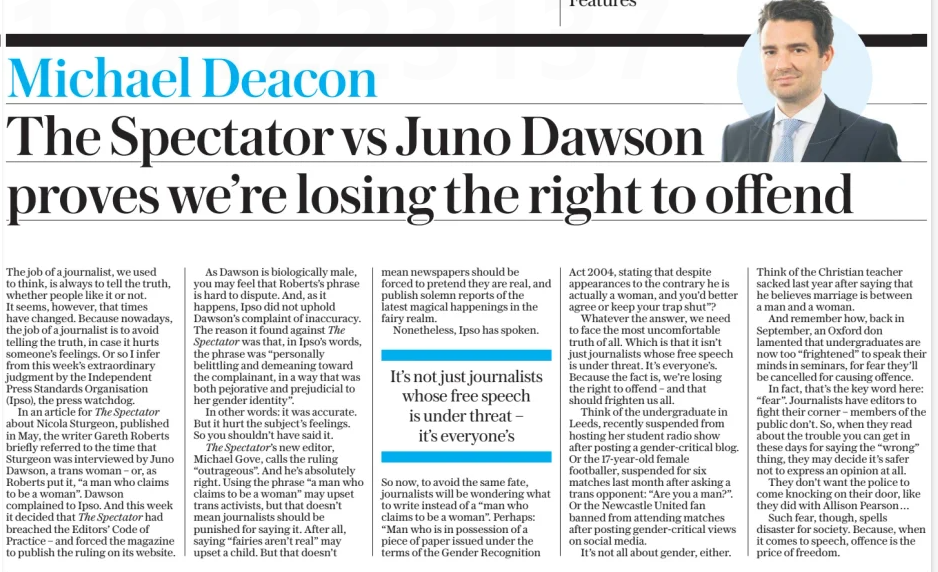
The job of a journalist, we used to think, is always to tell the truth, whether people like it or not. It seems, however, that times have changed. Because nowadays, the job of a journalist is to avoid telling the truth, in case it hurts someone’s feelings. Or so I infer from this week’s extraordinary judgment by the Independent Press Standards Organisation (Ipso), the press watchdog.  In an article for The Spectator about Nicola Sturgeon, published in May, the writer Gareth Roberts briefly referred to the time that Sturgeon was interviewed by Juno Dawson, a trans woman – or, as Roberts put it, “a man who claims to be a woman”. Dawson complained to Ipso. And this week it decided that The Spectator had breached the Editors’ Code of Practice – and forced the magazine to publish the ruling on its website.  As Dawson is biologically male, you may feel that Roberts’s phrase is hard to dispute. And, as it happens, Ipso did not uphold Dawson’s complaint of inaccuracy. The reason it found against The Spectator was that, in Ipso’s words, the phrase was “personally belittling and demeaning toward the complainant, in a way that was both pejorative and prejudicial to her gender identity”.  In other words: it was accurate. But it hurt the subject’s feelings. So you shouldn’t have said it.  The Spectator’s new editor, Michael Gove, calls the ruling “outrageous”. And he’s absolutely right. Using the phrase “a man who claims to be a woman” may upset trans activists, but that doesn’t mean journalists should be punished for saying it. After all, saying “fairies aren’t real” may upset a child. But that doesn’t mean newspapers should be forced to pretend they are real, and publish solemn reports of the latest magical happenings in the fairy realm.  Nonetheless, Ipso has spoken.  It’s not just journalists whose free speech is under threat – it’s everyone’s  So now, to avoid the same fate, journalists will be wondering what to write instead of a “man who claims to be a woman”. Perhaps: “Man who is in possession of a piece of paper issued under the terms of the Gender Recognition  Act 2004, stating that despite appearances to the contrary he is actually a woman, and you’d better agree or keep your trap shut”?  Whatever the answer, we need to face the most uncomfortable truth of all. Which is that it isn’t just journalists whose free speech is under threat. It’s everyone’s. Because the fact is, we’re losing the right to offend – and that should frighten us all.  Think of the undergraduate in Leeds, recently suspended from hosting her student radio show after posting a gender-critical blog. Or the 17-year-old female footballer, suspended for six matches last month after asking a trans opponent: “Are you a man?”. Or the Newcastle United fan banned from attending matches after posting gender-critical views on social media.  It’s not all about gender, either.  Think of the Christian teacher sacked last year after saying that he believes marriage is between a man and a woman.  And remember how, back in September, an Oxford don lamented that undergraduates are now too “frightened” to speak their minds in seminars, for fear they’ll be cancelled for causing offence.  In fact, that’s the key word here: “fear”. Journalists have editors to fight their corner – members of the public don’t. So, when they read about the trouble you can get in these days for saying the “wrong” thing, they may decide it’s safer not to express an opinion at all.  They don’t want the police to come knocking on their door, like they did with Allison Pearson…  Such fear, though, spells disaster for society. Because, when it comes to speech, offence is the price of freedom.
Puberty blockers banned throughout UK The Daily Telegraph12 Dec 2024By Michael Searles HEALTH CORRESPONDENT PUBERTY blockers are to be banned indefinitely in the UK after an expert review warned that the drugs posed an “unacceptable safety risk” to children.  The drugs had been routinely given to children questioning their gender, but will now only be available through a clinical trial run by the NHS.  The Cass Review, led by paediatrician Dr Hilary Cass, concluded that there was “remarkably weak” evidence to support the drugs’ use in children with gender dysphoria, and put them on an affirmative pathway that “may change the trajectory of psychosexual and gender identity development”.  Wes Streeting, the Health Secretary, told the Commons that he had “asked the Commission on Human Medicines to look at the current environment for prescribing puberty blockers, and we launched a targeted consultation”. He said: “After thoroughly examining all the available evidence, they have concluded that prescribing puberty blockers to children for the purposes of gender dysphoria in the current prescribing environment represents, and I quote, ‘an unacceptable safety risk’.”  He said that “of particular concern to  ‘It marks another step to puberty blockers being relegated to a shameful chapter of history’  the Commission was whether these children and their families were provided with enough time and information to give their full and informed consent”.  It means there is now an indefinite ban restricting the sale or supply of puberty blockers for under-18s through a prescription issued either by a UK doctor or someone registered abroad.  The ban applies to England, Wales and Scotland, as well as Northern Ireland, which has agreed to stay in line with the rest of the UK to prevent it being a “back door” to the mainland.  Dr Cass, who published her report back in April, described puberty blockers as “powerful drugs with unproven benefits and significant risks”.  She said: “That is why I recommended that they should only be prescribed following a multi-disciplinary assessment and within a research protocol.”  Helen Joyce, the director of advocacy at the charity Sex Matters, said: “It marks another step towards puberty blockers being relegated to a shameful chapter of history, in which parents and health professionals were emotionally blackmailed into harming children in the name of ‘progress’.”  Article Name:Puberty blockers banned throughout UK Publication:The Daily Telegraph Author:By Michael Searles HEALTH CORRESPONDENT Start Page:11 End Page:11
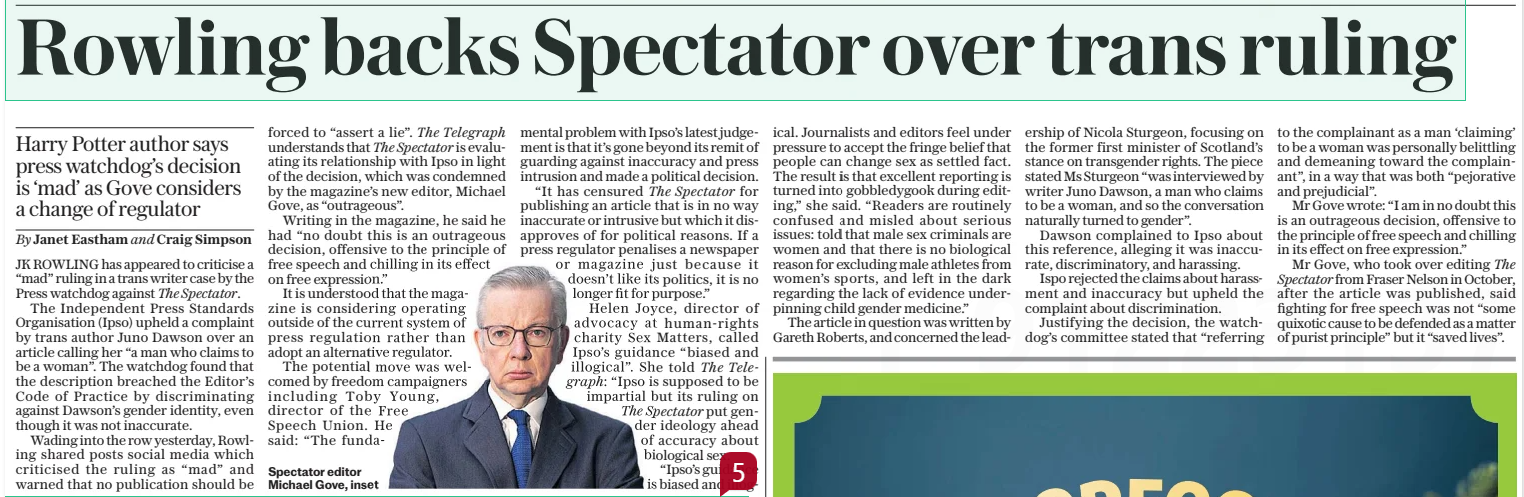
Rowling backs Spectator over trans ruling Harry Potter author says press watchdog’s decision is ‘mad’ as Gove considers a change of regulator The Daily Telegraph12 Dec 2024By Janet Eastham and Craig Simpson Spectator editor Michael Gove, inset  JK ROWLING has appeared to criticise a “mad” ruling in a trans writer case by the Press watchdog against The Spectator.  The Independent Press Standards Organisation (Ipso) upheld a complaint by trans author Juno Dawson over an article calling her “a man who claims to be a woman”. The watchdog found that the description breached the Editor’s Code of Practice by discriminating against Dawson’s gender identity, even though it was not inaccurate.  Wading into the row yesterday, Rowling shared posts social media which criticised the ruling as “mad” and warned that no publication should be forced to “assert a lie”. The Telegraph understands that The Spectator is evaluating its relationship with Ipso in light of the decision, which was condemned by the magazine’s new editor, Michael Gove, as “outrageous”.  Writing in the magazine, he said he had “no doubt this is an outrageous decision, offensive to the principle of free speech and chilling in its effect on free expression.”  It is understood that the magazine is considering operating outside of the current system of press regulation rather than adopt an alternative regulator.  The potential move was welcomed by freedom campaigners including Toby Young, director of the Free  Speech Union. He said: “The fundamental problem with Ipso’s latest judgement is that it’s gone beyond its remit of guarding against inaccuracy and press intrusion and made a political decision. “It has censured The Spectator for publishing an article that is in no way inaccurate or intrusive but which it disapproves of for political reasons. If a press regulator penalises a newspaper or magazine just because it doesn’t like its politics, it is no longer fit for purpose.” Helen Joyce, director of advocacy at human-rights charity Sex Matters, called Ipso’s guidance “biased and illogical”. She told The Telegraph: “Ipso is supposed to be impartial but its ruling on The Spectator put gender ideology ahead of accuracy about biological sex. “Ipso’s guidance is biased and illogical. Journalists and editors feel under pressure to accept the fringe belief that people can change sex as settled fact. The result is that excellent reporting is turned into gobbledygook during editing,” she said. “Readers are routinely confused and misled about serious issues: told that male sex criminals are women and that there is no biological reason for excluding male athletes from women’s sports, and left in the dark regarding the lack of evidence underpinning child gender medicine.”  The article in question was written by Gareth Roberts, and concerned the leadership of Nicola Sturgeon, focusing on the former first minister of Scotland’s stance on transgender rights. The piece stated Ms Sturgeon “was interviewed by writer Juno Dawson, a man who claims to be a woman, and so the conversation naturally turned to gender”.  Dawson complained to Ipso about this reference, alleging it was inaccurate, discriminatory, and harassing.  Ispo rejected the claims about harassment and inaccuracy but upheld the complaint about discrimination.  Justifying the decision, the watchdog’s committee stated that “referring to the complainant as a man ‘claiming’ to be a woman was personally belittling and demeaning toward the complainant”, in a way that was both “pejorative and prejudicial”.  Mr Gove wrote: “I am in no doubt this is an outrageous decision, offensive to the principle of free speech and chilling in its effect on free expression.”  Mr Gove, who took over editing The Spectator from Fraser Nelson in October, after the article was published, said fighting for free speech was not “some quixotic cause to be defended as a matter of purist principle” but it “saved lives”.  Article Name:Rowling backs Spectator over trans ruling Publication:The Daily Telegraph Author:By Janet Eastham and Craig Simpson Spectator editor Michael Gove, inset Start Page:11 End Page:11
Trainee firefighter ‘became a woman to pass exam with lower mark’ The Daily Telegraph12 Dec 2024By Graham Keeley in Madrid A FIREFIGHTER has been accused of jumping the queue to qualify by becoming a woman during exams to take advantage of lower pass marks required by female candidates.  Named only as David L Y, the firefighter initially failed to pass the examinations when they were a man but then said they were changing gender. David was later admitted as a woman by Madrid city council. Under rules in Spain, women can achieve a lower threshold in physical tests in order to qualify owing to strength differences between the sexes.  Raul Asenjo, who was another applicant, initially qualified to become a firefighter, which usually signifies a job for life. However, when David was moved from 201st place to 101st in the ranking of candidates, it meant Mr Asenjo failed to qualify.  Mr Asenjo has claimed that this was a case of fraud and is considering taking legal action against Madrid council, which is responsible for recruitment.  He pointed out that before changing sex, David had been part of a Whatsapp group for Men Who Go Their Own Way, an anti-feminist and misogynist group that advocates men separate themselves from women.  It is the latest case involving Spain’s controversial so-called “Trans Law”, which was passed last year in an initiative pioneered by the far-left Podemos party, the junior partner in Spain’s Leftwing coalition government. Under the law, anyone can switch their legal sex classification without having to justify the change on any psychological or lifestyle grounds.  Critics of the law among feminist groups and conservatives have claimed it has been exploited by some men who were accused of domestic violence by their female partners but changed sex to avoid legal action.  Mr Asenjo claimed he lost out on a chance to become a firefighter once David said they were changing sex, having failed the theory and practical tests as a man.  Mr Asenjo, 21, from Madrid, said in a statement released to Spanish media: “I was candidate 126, the last one in the list to qualify. However, I have been moved to position 127 so out of the running as the result of the allegedly unfair and fraudulent use of the rules by one of the candidates who has been moved from position 201 to 101. This candidate has claimed his status as a woman with the sole purpose of benefiting from more flexible rules [for women] and as such they advance 100 people in the selection process.”  A spokesman for Madrid council said: “The authority warned that this situation could occur after the implementation of the Trans Law. The investigation may verify that no fraud took place if this person was legally listed as a woman at the start of the process. If this is not the case, then appropriate measures will be taken.”  Article Name:Trainee firefighter ‘became a woman to pass exam with lower mark’ Publication:The Daily Telegraph Author:By Graham Keeley in Madrid Start Page:15 End Page:15

Friday Total: 6

The Guardian [1]
R&A transgender ban for women’s events The Guardian13 Dec 2024 Transgender athletes will be barred from competing in women’s tournaments from the start of next year after the R&A issued new guidelines following what it said was an “extensive consultation” with medical and scientific experts. In a statement the R&A said: “Players assigned male at birth and who have experienced male puberty are ineligible to compete in [R&A] events, but can enter male professional and elite amateur championships.”  Article Name:R&A transgender ban for women’s events Publication:The Guardian Start Page:23 End Page:23
The Times [2]
Mother fights to stop daughter taking cross-sex hormones Jonathan Ames - Legal Editor A mother who is battling in court to pause cross-sex hormone treatment for her teenage daughter says she is “bereft” and “frightened” for her.  In an attempt to overturn an earlier ruling, the mother went to the Court of Appeal to ask three senior judges to order that “masculinising” treatment of the girl, 16, be stopped.  Neither the mother nor the child has been identified by the court, which refers to them only as O and Q, respectively. The proceedings have pitted Q’s parents against each other, as the father has supported the teenager’s wish for gender dysphoria treatment.  The appeal hearing opened days after ministers announced that the government was to ban indefinitely the use of puberty blockers on children wanting treatment for gender dysphoria, on the grounds that the drugs posed an “unacceptable safety risk”.  However, cross-sex hormone treatment is not covered by that edict.  Sitting in the High Court in May, Mrs Justice Judd had ruled that an interim order preventing Q from receiving cross-sex hormone treatment should be lifted. She took the decision on the basis that the father had agreed that he would not fund or facilitate treatment from an “offshore body”.  In that ruling, Judd noted that against the backdrop of the Cass Review — which in its final report highlighted serious concerns about gender dysphoria treatment for those younger than 18 — “any doctor will have to exercise great caution before prescribing hormones to a minor”. However, the judge made no further declaration, leaving it open for the child and her father to seek treatment in the UK.  In a statement issued as her appeal opened yesterday, the mother said: “My job as a mother is to protect my child. I am told by social workers and doctors that I can’t. I am told that at 16 she understands all the risks of this irreversible medical intervention and the consequences for the rest of her life.”  Lawyers for the mother argued that the Cass Review had “demonstrated quite clearly that the doctors to whom this kind of decision-making had been entrusted — in particular whether the individual was capable of giving informed consent to treatment —– were not to be relied on”.  The woman’s solicitor, Paul Conrathe, said that she was appealing the ruling “so that this highly controversial treatment, which has very poor evidence for its effectiveness and has lifelong consequences, should be subject to careful scrutiny by the courts before it is given”.
Transgender players banned from female events by R&A Golf Rick Broadbent Transgender golfers who have gone through male puberty will be banned from the R&A’s professional and elite amateur female championships from next year.  The move follows the Ladies Professional Golf Association (LPGA) adopting the rule last week. The R&A, which organises the Women’s Amateur and AIG Women’s Open, said the decision was reached after a year of consultation with medical and scientific experts.  “The evidence shows that golf is a gender-affected sport in which male puberty confers a performance advantage,” the R&A said in a statement.  Martin Slumbers, the governing body’s outgoing chief executive, added: “Updating our entry conditions to preserve fairness in our female professional and elite amateur championships is the right thing to do.”  From January transgender players will be eligible for events only if they were assigned female at birth or transitioned before they reached puberty.  Hailey Davidson, 31, a transgender Scotland-born golfer who had been seeking membership of the LPGA Tour, said she was “beyond disappointed” after the LPGA introduced rules which she said “effectively banned me from attempting a career in professional golf”. This week Davidson added: “I was finally starting to see some positive outcomes as a result of a lifetime of hard work, not some so-called physical advantage that does not exist.”  The respective driving distances of the top men and women do show a difference. In 2024 Natthakritta Vongtaveelap had the longest average driving distance on the LPGA Tour at 290 yards, while Cameron Champ was the PGA Tour equivalent with 322 yards. However, Davidson said she was about 30 yards shorter off the tee after transitioning in 2021.  When she tried to qualify for the LPGA Tour via Q-School in October, 275 players signed a letter demanding her removal from the field.  The new rules will not affect the recreational game, where the handicap system allows players to compete regardless of sex, age and ability. The rules bring golf into line with elite sports such as athletics, cycling and swimming. This week the Lawn Tennis Association said it was changing its rules to bar transgender women from most tournaments in Britain. However, transgender players can appear in elite WTA and ITF events if they meet set testosterone levels.
Daily Mail [1]
Britain is no longer a liberal society... we have invented a right not to be offended and elevated it above all others As The Spectator is sanctioned for describing this author as ‘a man claiming to be a woman’… Daily Mail13 Dec 2024by Dan Hannan ■ Lord Hannan of Kingsclere is a Conservative peer.  Activist: Juno Dawson complained to regulator IT HAS been a terrible two months for free speech. First, people were sent to prison – actually sent to prison – for saying unpleasant things in the aftermath of the Southport riots.  Then the journalist Allison Pearson was harassed at her home on the morning of Remembrance Sunday because one person decided to be offended by a year-old tweet.  Now the Press regulator, the Independent Press Standards Organisation (Ipso), has ruled against The Spectator magazine for describing a trans activist as ‘a man who claims to be a woman’, a ruling the magazine’s new editor Michael Gove fairly describes as ‘offensive to the principle of free speech and chilling in its effect on free expression’.  The author of the offending article was Gareth Roberts, a TV scriptwriter with a delightful turn of phrase. He was writing about Nicola Sturgeon’s appearance at an event in Sussex, and mentioned en passant that she ‘was interviewed by writer Juno Dawson, a man who claims to be a woman, and so the conversation naturally turned to gender’.  Dawson complained to Ipso on three grounds. First, that the statement was inaccurate. Second, that it constituted harassment. Third, that it breached section 12.1 of the editors’ code, which lays down that ‘the Press must avoid prejudicial or pejorative reference to an individual’s race, colour, religion, sex, gender identity, sexual orientation or to any physical or mental illness or disability’.  Ipso threw out the first two complaints, but upheld the third, finding that the reference was ‘personally belittling and demeaning toward the complainant’.  I would love to say that Ipso overstepped the mark and issued a perverse ruling.  But, reading the editors’ code, I think it is worse than that. I think Ipso may accurately have interpreted section 12.1 which, in effect, outlaws the use of hurtful words for individuals who belong to certain protected groups.  How the blithering flip did we end up with such a prohibition? The depressing answer is that it happened on the Tories’ watch.  AFTER the phone-hacking scandal in 2012, there were demands for statutory Press regulation. The Conservative government managed eventually to head off these proposals, opting instead to allow a system of self-regulation. But Ipso has proved no less prone to wokery than government departments.  For those tiresome people who still pretend not to understand what wokery means, it means the sanctification of supposedly historically marginalised groups.  The sensitivities of these groups are elevated as the supreme goal of public policy, trumping free contract, free association and free speech. Hence Monday’s Ipso ruling.  It is indeed outrageous. But it is also a sobering thought that, at every stage between the formation of Ipso and the entry into force of the current editors’ code in 2021, Michael Gove was a government minister. Once again, we see the impotence of our elected representatives before our standing bureaucracies.  It cannot be stressed too strongly that the issue here is free expression, not the right to identify as belonging to a different sex.  A newcomer to the debate might think that transgenderism is a new phenomenon. It is not. The word ‘transsexual’, though now out of date, is more than 100 years old, and the idea of rejecting the sex dictated by your chromosomes is older still.  Nor was the phenomenon hidden away. As long ago as 1970, The Kinks reached No2 in the charts with Lola, a song about a transwoman (‘Girls will be boys and boys will be girls, it’s a mixed up, muddled up, shook up world…’).  In 1973, Tim Curry sang: ‘I’m just a sweet transvestite from transsexual Transylvania’ in the Rocky Horror Show.  None of this was especially controversial. The controversy began much more recently when, instead of exercising their own freedom, trans lobbyists began to demand that everyone else curtail theirs.  People have the right to change sex through reassignment surgery. They have the right to stop short of a full operation but to adjust their appearance. They have the right, if they prefer, simply to have hormone replacement treatment. And, indeed, they have the right to do nothing except cross-dress and use whatever pronouns they please.  What they do not have the right to do is tell the rest of us what words we are allowed to use. In a liberal society, trans people, including Dawson, would be at liberty to call themselves male or female. And others, including Roberts, would be equally at liberty to describe them in any way they pleased.  By this test, as by so many others, we are no longer a liberal society. We have invented a right not to be offended and elevated it above every other.  The reason I describe wokery as ‘sanctification’ is that its tenets are not subject to debate in the normal way. They are treated, rather, as absolutes, like matters of religious faith. This can lead us into all manner of absurdities. Before publication of the landmark Cass Report into treatment at the now closed Tavistock gender identity clinic earlier this year, we were offering puberty-blockers to children and embarking far too freely on life-changing operations for minors.  Almost everyone could see that it was a bad idea but, because we sanctify protected groups, few liked to say so.  When you have something like religious fervour on your side, you can spout all manner of nonsense with conviction. You can argue, for example, that Britain, which distinguished itself by leading the fight to end slavery, somehow owes ‘reparations’ to various countries which showed no interest in abolition. And, as with the trans madness, no one will want to tell you that you are talking utter rot.  Free speech restrictions are perhaps best understood as blasphemy codes. They punish certain opinions, not because they constitute incitement or harassment, but because they constitute impiety.  Britain last jailed someone for mocking Jesus in 1921. But two years ago, a British former policeman was sentenced to 20 weeks for mocking George Floyd, the African-American whose death after being arrested sparked the Black Lives Matter mass protests in 2020.  There was no question of public disorder: the former policeman’s comments were on a private WhatsApp group. That’s the thing about blasphemy codes. They are about sniffing out sacrilege, not preserving peace.  How tragic that we, of all countries, should now be retreating from free expression, the ultimate guarantor, not just of personal liberty, but of social progress.  It is open inquiry that allows good ideas to drive out false ones, that lets a mistaken consensus be shattered by new facts or better logic.  WE used to understand this. We are the country of Locke, Lilburne, Milton, Wilkes and Mill – and that’s just the Johns. For what it’s worth, all those men were seen, in their own time, as progressives, opponents of autocracy and obscurantism.  Yet now, in a polar switch, attacks on free speech come overwhelmingly from the Left. The religious order against which those earlier radicals fulminated has been replaced by a new Trinity: Diversity, Equity, Inclusion.  Our country fought for freedom, including free speech, against the Nazis and the Communists. We exported and defended the liberal order. Yet now, to the dismay of our friends and the bewilderment of our adversaries, we are giving up on it at home.  Not because we have lost a war or been occupied by a hostile power. But out of sheer torpor. I dread to imagine what past generations would think of us.  Article Name:Britain is no longer a liberal society... we have invented a right not to be offended and elevated it above all others Publication:Daily Mail Author:by Dan Hannan ■ Lord Hannan of Kingsclere is a Conservative peer. Start Page:17 End Page:17
Telegraph [2]
Trans exhibition library refuses anti-taliban poster as ‘too biased’ The Daily Telegraph13 Dec 2024By Craig Simpson A COUNCIL library that promoted “trans joy” has refused to display an anti-taliban women’s rights poster in order to remain “unbiased”.  Norwich’s Millennium Library held an art exhibition earlier this year featuring displays on puberty blockers and images of bodies that had undergone gender reassignment surgery.  The library, run by Norfolk county council, has since refused a request to display an anti-taliban poster advocating for women’s rights, claiming that the institution must remain “neutral”.  The poster features the outline of a woman in a burqa, with the slogan “don’t forget about the Afghan women” and “No To Taliban”.  The poster, created by the Norwich Women’s Rights Group – known for maintaining gender-critical views promoting the importance of biological sex – was intended to advertise a silent vigil dedicated to women and girls facing persecution. It is understood that the request to advertise the vigil was refused, with campaigners told: “As a library service we are committed to maintaining and unbiased a neutral stance.”  A council representative explained that the library was unable to display material that seeks to lobby for political causes, or posters seeking to raise funds, or advocate for particular policy.  ‘Why does a library that claims everyone is welcome think it needs nuance regarding women and girls’  The refusal has caused confusion among Women’s Rights Network members, who intend to complain to the council.  It comes following a controversial art show dedicated to transgender issues. The exhibition features slogans such as “trans joy” and images of puberty blockers in hypodermic needles with the tagline “self-made men”.  Organised by Norwich Trans Pride, it also included an artwork depicting someone who had undergone a double mastectomy with the slogan “my garden, my choice”. Kay Mason Billig, Norfolk Tory council leader, was forced to apologise for the exhibition.  The council had faced a backlash from women’s right campaigners, including the local Women’s Rights Group, who raised concerns that the exhibition promoted surgical intervention and puberty blockers.  It was announced this week that puberty blockers are to be banned indefinitely in the UK after an expert review by Dr Hilary Cass warned that there was “very limited” evidence that the treatment benefited young people who were questioning their gender.  It is understood that guidelines setting out strict neutrality for librarians were updated in August, in the wake of the transgender display in April 2024.  These guidelines forbid material that seeks to “lobby... the population or  ‘This library maintains an unbiased and neutral stance’  other groups”. Concerns have been raised about this position, as other libraries across the country, including in Cumbria, have agreed to display the posters for the Afghan vigil.  Sarah Walker, an author and Women’s Rights Network organiser, wants answers from the council. She said: “I’d like Norfolk Libraries to explain why a library that claims ‘everyone is welcome’, and which obviously promotes education and literacy, thinks they need nuance regarding women and girls being denied the right to learn, work and have medical assistance when giving birth.”  Norfolk county council has been contacted for comment.  Article Name:Trans exhibition library refuses anti-taliban poster as ‘too biased’ Publication:The Daily Telegraph Author:By Craig Simpson Start Page:7 End Page:7
The poster was designed by the anti-trans activist group, the Women’s Rights Network. Note how the Telegraph do not reproduce the poster.
Ipso’s trans ruling was ‘blatantly political’ Shadow minister says press watchdog is ‘censoring free speech’ after it upholds author’s gender complaint The Daily Telegraph13 Dec 2024By Janet Eastham and Charles Hymas A PRESS watchdog has been accused of “blatant political activism” for backing a trans author in a row over gender ideology. The Independent Press Standards  Organisation (Ipso) faces sustained criticism after upholding a complaint by Juno Dawson, a trans author, over a Spectator article calling Dawson “a man who claims to be a woman”.  The watchdog found that the magazine breached the Editor’s Code of Practice by discriminating against Dawson’s gender identity, even though the article was not inaccurate.  Politicians have followed author JK Rowling, who called the ruling “mad”, in criticising the watchdog. Yesterday, Robert Jenrick, the shadow justice secretary, described the ruling as “farcical”, and Claire Coutinho, a shadow equalities minister, said Ipso should not “police legally held views on gender and biological sex”.  The Telegraph revealed on Wednesday that The Spectator is understood to be considering splitting from the watchdog, with Michael Gove, its editor, calling the ruling “outrageous”.  Executives are understood to be exploring operating without an external regulator, a move that could signal the beginning of the end for Ipso.  The opinion article at the centre of the row was written by Gareth Roberts – a gender-critical journalist – focusing on the stance of Nicola Sturgeon, the former Scottish first minister, on transgender rights. Mr Roberts wrote: “[Ms Sturgeon] was interviewed by writer Juno Dawson, a man who claims to be a woman, and so the conversation naturally turned to gender”.  In a rare decision under Clause 12 of the Editor’s Code, which covers discrimination, the watchdog ruled that, despite being factually accurate, Mr Roberts’ language was “personally belittling and demeaning” towards Ms Dawson “in a way that was both pejorative and prejudicial” about her gender identity.  The watchdog’s committee said this concern superseded Mr Roberts’ “right to express his views on the broader issues of a person’s sex and gender identity”.  Nick Timothy, a Conservative MP, tabled a written question last night to call on Lisa Nandy, the Culture Secretary, to respond to the controversial ruling.  Mr Jenrick told The Telegraph: “This farcical Ipso ruling is a blatant piece of political activism that will censor free speech. The press regulator must return to its original remit or it will lose the confidence of the public and the industry.”  Ms Coutinho described the decision to uphold Ms Dawson’s complaint as “totally bizarre”.  Article Name:Ipso’s trans ruling was ‘blatantly political’ Publication:The Daily Telegraph Author:By Janet Eastham and Charles Hymas Start Page:9 End Page:9

Saturday Total: 5

The Guardian [0]
The Times [2]
MPs misunderstand evidence, says Cass Eleanor Hayward - Health Editor  Baroness Cass said there was no evidence puberty blockers improved mental health Labour MPs who oppose the ban on puberty blockers have a “misunderstanding” of medical evidence, Baroness Cass has said.  On Wednesday Wes Streeting, the health secretary, announced an indefinite ban on puberty blockers for children wanting to change gender because they pose an “unacceptable safety risk”.  Several backbench Labour and Green Party MPs criticised the move in a Commons debate, saying it was an attack on transgender children that amounted to a “breach of young people’s human rights”.  Cass, who wrote a landmark report on the treatment of children with gender dysphoria, said a lot of “misinformation” was being spread. This included a claim that denying access to puberty blockers could lead to suicides, when evidence has suggested that the drugs do not improve mental health.  She said: “What is worrying is when people say that if children don’t get these drugs, they will die, because clearly that’s not true.” It was “irresponsible for people to shroud-wave in that way”.  Puberty blockers are drugs which suppress the release of sex hormones to halt the physical changes of puberty such as the growth of breasts or facial hair, which typically occur between 8 and 14. The drugs are licensed for use in young children with precocious puberty, a condition in which these changes start before the age of eight.  Since 2011 they have also been widely used “off-label” in the treatment of children at the gender identity clinic at the Tavistock and Portman NHS Foundation Trust. Under the terms of the indefinite ban, the drugs — a type of medication called Gonadotrophin-releasing hormone analogues — will still be prescribed for the conditions they are licensed for, including early puberty and some cancer treatment.  Politicians including Alex Sobel, the Labour MP, and Siân Berry, the Green Party MP, suggested it was discriminatory to allow the drugs to be used for children with early-onset puberty but not for children questioning their gender identity.  Cass, who took her seat in the House of Lords in October, said this was “a misunderstanding … it’s not based on discrimination. It’s based on science and certainty about safety and effectiveness”. She said there was a “very long track record of safety” in using the drugs for early puberty, and had been licensed for that reason, but were not approved for gender dysphoria. “It’s very different to use a drug to treat an abnormal, premature hormonal surge, as opposed to stopping the normal hormonal surges that happen during puberty,” she said.  Cass, a former president of the Royal College of Paediatrics and Child Health, led a review of care for children with gender dysphoria which warned that puberty blockers may harm brain development, bone density, fertility and development of sexual function.  Critics of the ban, including Nadia Whittome, the Labour MP, have said that it could have grave consequences for children’s mental health.  However, the only UK study into puberty blockers, published in the journal Plos One, found that the drugs did not improve mental health, or alleviate psychological distress or self-harm.  Cass said: “The evidence has not supported the idea that getting on to puberty blockers improves mental health. People used to say, [when arguing for puberty blockers] ‘Do you want a dead son or a live daughter?’ There isn’t evidence that getting people onto puberty blockers is going to help with their dysphoria, body image or their mood.”  She said there were other, effective ways to support mental health including talking therapies. The NHS is also extending an offer of targeted mental health support to young people affected by the puberty blocker ban. Cass added: “We want to bring these young people into the NHS. It’s important that if they’re just in a state of distress, they shouldn’t struggle by themselves.”  Cass said the “single biggest piece of misinformation” is that puberty blockers can provide a one-size-fits-all solution to children in distress about their gender, who instead need holistic and multidisciplinary support. “That’s the biggest misunderstanding, that this is one group of young people that all need the same answer.”  While puberty blockers were banned on the NHS in March, they will be available at some NHS clinics next year as part of a clinical trial. However, private clinics, including those such as GenderGP who issue prescriptions from overseas, will be banned from prescribing the drugs.  Cass said this was essential because puberty blockers should only be given after comprehensive assessments, with support and monitoring in place.
Don’t allow puberty blockers to sneak back in The big fight is over with these chemicals banned for gender-confused children — but a clinical trial presents a new risk Janice Turner - @victoriapeckham  On Wednesday a reckless 13-year medical experiment was finally ended: no longer will troubled children, predominantly girls, be prescribed powerful drugs to stunt their developing bodies. Puberty blockers, which weaken bone density and arrest the evolving adolescent brain without any proven benefit to genderconfused children, are now banned.  The health secretary, Wes Streeting, deserves credit both for his diligence in sealing loopholes, such as quack private clinics prescribing from Singapore over Zoom, but also his moral courage. Already activists have camped outside his constituency office with cardboard coffins and histrionic signs saying “Keep trans kids alive”. Announcing the ban in parliament, he was assailed by the Green MPs Sian Berry and Carla Denyer, plus Labour’s Stella Creasy, for whom a four-year review of global evidence by the eminent paediatrician Baroness Cass isn’t enough. Nor is the retreat from prescribing these drugs by health services across Scandinavia and in France. Nor the grotesque truth that a child who progresses from puberty blockers to cross-sex hormones — as 99 per cent of cases do — is frozen forever in a body both infertile and incapable of orgasm.  Indeed, for activists no evidence will ever be enough. Their advocacy for puberty blockers isn’t based on medical benefits but emotions and irrational faith. These “progressives” still believe children — mainly future lesbians and gay men — are in the “wrong body”, which must be fixed by Big Pharma. Now they cry “discrimination” because the same GnRH (gonadotrophin-releasing hormone) drugs are used for other medical conditions. Which is like arguing if thalidomide is used against leprosy and blood cancers, it’s unfair pregnant women can’t take it for morning sickness.  Yes, it’s true GnRHs are used for precocious puberty. But in such rare cases, as in all ethical medicine, doctors weigh risks and benefits. A child who develops breasts or pubic hair at five years old will have psychological problems, be prey to adult sexual attention, more likely to develop diabetes, high cholesterol, breast or testicular cancer, and be stunted in height. Here, GnRHs hold puberty at bay until about ten to enable a healthy future. Whereas gender doctors begin prescribing GnRHs at that age to thwart normal development with, as Cass says, “unproven benefits”.  The terrible experiment has ended — almost. In her review, Dr Cass advocates banning puberty blockers except to participants in a clinical trial that will start recruiting in spring. Activists are seizing on this pledge as a back door to obtaining blockers. Denyer asked about the number of participants, and Streeting replied it was “not capped”. The National Institute for Health and Care Research is yet to decide the trial’s terms, and no wonder.  The justification that they prevent suicides was a ghoulish lie  For many, this idea is Cass’s sole misstep. Her extensive review found nothing to justify the drug’s risks.  The Tavistock Gids clinic’s own early-intervention study found blockers did not improve children’s mental health. Their central justification, that blockers prevent teenage suicide, was exposed as a ghoulish lie. (After the lawyer Jolyon Maugham claimed parents would tip the ashes of their dead trans kids outside No 10, Streeting published a report dispelling this myth.) Even a recent study of 95 children by America’s most extreme gender physician Johanna Olson-Kennedy, who advocates breast removal for 14-year-old girls, found blockers gave no mental health boost.  Cass was in a bind. Having concluded that the quality of existing academic research was poor and short term — and perhaps to end all future disputes — she proposed a gold standard trial. But what proposition will it test? Blockers are not a treatment per se. They are the first part of a three-step process involving cross-sex hormones, then surgery. As one clinician notes: “It’s like evaluating the outcome of a knee operation just by studying the anaesthetic.”  Many ethical questions remain.  How can you create a control group when those children on placebos would quickly know, since their puberty would begin? How can you disentangle the benefits of psychotherapy — which Cass has promised all patients — from those of a drug? How do you factor in that most patients have co-morbidities such as anorexia, autism or trauma from homophobic bullying or sexual abuse? Will a cohort of children feel under pressure from activists to be positive about these campaigned-for drugs? A key justification for blockers, especially among late-transitioning males, is they allow trans people to “pass” more easily as the opposite sex.  But how can such cosmetic advantages be weighed against loss of physical capacity to have children? Above all, how do you select child patients to test a drug when 85 per cent of dysphoria cases resolve themselves at puberty — but doctors can never predict which ones? And what if participants, whose bodies and lives are changed forever, have later regrets? Maybe, say some clinicians, it would be better to study the huge new trans patient cohort that emerged only a decade ago: teenage girls. Or if a long-term view is required, compel adult gender clinics to release data on about 9,000 children who graduated into their care. (Six out of seven clinics have refused.) Yet there is one reason the NHS is compelled to launch a trial. If such an experiment were deemed too risky, why the hell was it being conducted at Gids since 2011? It is time to throw puberty blockers into the pile of medical crazes, like lunchtime lobotomies and trepanning.  End too the mad notion that demanding these terrible drugs is the metric of how much you care about gender-questioning young people. Are we really going to turn more children into lab rats because we haven’t yet convinced ideologues such as Creasy? Because the chances are no medical trial, no amount of scientific evidence, ever will.
Daily Mail [1]
Blast at MPs opposing puberty blocker ban Daily Mail14 Dec 2024By Matthew Cox LABOUR MPs who oppose a ban on puberty blockers have a ‘misunderstanding’ of medical evidence, Baroness Cass has claimed.  The paediatrician wrote a landmark report into NHS gender identity services for children and young people earlier this year, which said there was not enough evidence to support the drug’s safety or effectiveness. And this week, Health Secretary Wes Streeting banned the medication for under18s with gender dysphoria indefinitely – although their use in children with early-onset puberty is unaffected.  In response to Labour and Green MPs who argue the ban discriminates against those with gender dysphoria, Baroness Cass said this was ‘a misunderstanding... it’s not based on discrimination’. She told The Times: It’s very different to use a drug to treat an abnormal, premature hormonal surge, as opposed to stopping the normal hormonal surges that happen during puberty.’  Article Name:Blast at MPs opposing puberty blocker ban Publication:Daily Mail Author:By Matthew Cox Start Page:11 End Page:11
Telegraph [2]
‘Double standards of Ipso exposed’ as it snubs female rights activists Watchdog criticised over dismissal of complaint at article that referred to trans abuser as ‘woman’ The Daily Telegraph - Saturday14 Dec 2024By Janet Eastham THE press watchdog has been accused of double standards over how feminist complaints about transgender issues are handled.  The Independent Press Standards Organisation (Ipso) upheld a complaint of discrimination against The Spectator, ruling that referring to a trans author as “a man who claims to be a woman” was “pejorative and prejudicial”.  However, it has emerged that the watchdog dismissed a separate complaint earlier this year over an article calling a trans woman convicted of making violent threats a “woman”.  Ipso said investigating the inaccuracy complaint would intrude on the criminal’s privacy.  Journalist Helen Joyce, of human rights charity Sex Matters, claimed an article in The Argus misreported the gender of Layla Le Fey, a trans woman with a criminal record who had threatened to kill, blind and mutilate her.  In a social media post, Layla Le Fey told Ms Joyce: “God how I would love to just rip your eyes out, chop your hands off, and carve your face up really badly.”  The trans offender also threatened to “kick the s---” out of Kellie-Jay Keen, another woman’s rights activist, and “break” her spine, and wrote they wanted to “prove” a point that “some trans people are extremely violent”.  In February, Le Fey, who already had a previous conviction for common assault for attacking a shop clerk with a claw hammer, pleaded guilty to four offences under the Communications Act, including threats of arson, in relation to posts targeting the two women.  Following the conviction, The Argus published an article which opened with the paragraph: “A woman could be jailed for making online threats to kill campaigner Kellie-Jay Keen.”  Although the headline referred to Le Fey as a “trans woman”, the body of the article did not identify the offender as someone born male who now identifies as a woman. The article’s “inaccuracy”, Ms Joyce told Ipso, “significantly impacts” her and Ms Keen, the victims in the case. In her complaint, she wrote: “It is always misleading for a media outlet to use any of the words “woman”, “female”, “she” and “her” for a man/ male person since many readers will ‘I dared to speak about women’s rights, and a man who doesn’t care for women speaking about their rights, threatened me in an attempt to intimidate me into silence’ understand the person to be biologically female, which in the case of men – including those who identify as women – is false. This is a breach of the Editors’ Code.” She added: “I am not a ‘third party’ in this complaint. It closely relates to me – to my life and to my knowledge of what happened to me.  “I dared to speak about women’s rights and a man who doesn’t care for women speaking about their rights threatened me in an attempt to intimidate me into silence. This misreporting of a crime has had a significant impact on my life. It is revictimisation.”  But despite acknowledging she was a victim in the case, Ipso dismissed Ms Joyce’s complaint as a “third party issue”. It said that determining Le Fey’s gender – critical to assessing the complaint of inaccuracy – would require an investigation that “could represent a significant intrusion into their privacy”.  The ruling is in sharp contrast to the regulator’s decision on Tuesday to uphold a complaint of discrimination by trans author Juno Dawson against The Spectator. The regulator found that an article in the magazine by journalist Gareth Roberts, which described Dawson as “a man who claims to be a woman”, was “pejorative and prejudicial”.  Ms Joyce accused the watchdog of double standards and having “bias against gender-critical women”, claiming that Ipso handled Dawson’s complaint differently from her own.  She said: “When a man with a prior conviction for violence, and who identifies as a woman, threatened on Twitter/X to carve up my face and cut out my eyes, press reporting of his conviction referred to him as a woman. Ipso refused to act when I complained, even though its Editors’ Code says reporting must be accurate.  “Ipso placed the feelings of a violent criminal who threatened extreme violence against a woman who refuses to pretend he is a woman ahead of the feelings of his victim, and ahead of the plain truth. The press regulator is simply not fit for purpose.”  Ms Joyce said that Le Fey’s pattern of offending is “absolutely classic male violence against women. It is a sexbased crime and it’s done to intimidate”.  Ipso has been criticised this week by Robert Jenrick, the shadow justice secretary, who called the Spectator ruling “farcical”, and Claire Coutinho, a shadow equalities minister, who said it was “totally bizarre”.  The Spectator is understood to be considering severing ties with the press watchdog, with Michael Gove, its new editor, calling the ruling “outrageous”.  Article Name:‘Double standards of Ipso exposed’ as it snubs female rights activists Publication:The Daily Telegraph - Saturday Author:By Janet Eastham Start Page:11 End Page:11
Way of the World Michael Deacon The Daily Telegraph - Saturday14 Dec 2024  In SuperNature, his 2022 Netflix special, Ricky Gervais imagined a furious trans activist telling a woman that it’s bigoted not to let biological males use women’s loos.  “They ARE ladies – look at their pronouns! What about this person isn’t a lady?”  “Well, his penis.”  “HER penis, you bigot!”  “What if he rapes me?”  “What if SHE rapes you, you terf!” I was reminded of this horribly plausible exchange while reading a report yesterday in the Manchester  Evening News. “A judge has jailed a ‘dangerous’ woman,” it began, “for violent physical and sexual abuse.”  Of all the words in that sentence, readers may have been puzzled by the fact that the one with the inverted commas around it was “dangerous”. Especially when they looked at the accompanying police mugshot, showing that the woman in question had heavy stubble.  Reading on, we learnt that the criminal, known as Angel Hill, had been given an 11-year sentence after pleading guilty to sexual assault, assault by penetration, strangulation and threatening a victim with a blade. We were then informed that Hill is currently “transitioning from male to female”.  At least one reader, however, was having none of it.  “Translation,” tweeted JK Rowling. “‘Dangerous, violent man who subjected a woman to terrible sexual and physical abuse is now pretending to be a woman in the hope of garnering sympathy and lenience from the judicial system.’”  I suppose it’s lucky that Ms Rowling isn’t a journalist. Earlier this week, Ipso, the press watchdog, censured  The Spectator because one of its writers had referred to a prominent trans woman as “a man who claims to be a woman”. According to Ipso, this was “belittling”, “demeaning” and “both pejorative and prejudicial of the complainant due to her gender identity”.  I wonder what would happen if  The Spectator were to describe Angel Hill as “a man who claims to be a woman”. Would Ipso censure the magazine for belittling this poor violent sex offender?  At any rate, JK Rowling is right to be angry. Just as she was right to be angry about Isla Bryson, the convicted rapist who was placed in a women’s prison after donning a blonde wig and pink leggings.  We shouldn’t be pandering to dangerous male criminals in this farcical way. If that hurts their feelings, I think we can just about live with it.  Despite the grand claims made by Wes Streeting in October, we now know that the NHS can afford weight-loss drugs for only a small fraction of obese patients. Which means that we need to think of an alternative way to tackle the obesity crisis. This week, Sir Chris Whitty suggested that we impose a “fat tax” on junk food.  Frankly, though, I’ve got a much better idea.  In 2010, a fascinating study found that living at high altitude causes sustained weight loss. You might assume that this is because there tend to be few branches of Greggs up Mount Everest. The real explanation, however, is that the low level of oxygen causes a surge in the body’s production of leptin, a hormone that makes you feel full. As a result, you eat less.  Surely, therefore, the solution to our problem is simple. We need to open fat camps up mountains. Obese Scotsmen should be made to spend six months up Ben Nevis, obese Welshmen up Snowdon, and obese Englishmen up Scafell Pike.  It’s got to be worth trying. Many people in this country are now so morbidly obese, they’re unable to work. Which is one of the main reasons behind our ever-growing welfare bill. Fraser Nelson recently reported that as many as 3,000 people a day are approved for sickness benefits. If that rate of increase is maintained, every single person in Britain will be on sickness benefits by the end of the century.  Unfortunately, however, there’ll be no one left to pay for them.  Like millions of long-suffering parents, I could list many sound reasons to take issue with Peppa Pig. On this one occasion, however, I must leap to its defence. Marta Serrano, a Spanish politician, has claimed that the ubiquitous British pre-school cartoon discourages girls from taking jobs in construction – because it teaches them that such work “is a man’s thing”.  Nonsense. As anyone with a child born in the past 20 years could tell her,  Peppa Pig is full of female characters doing traditionally “male” jobs. Take Miss Rabbit. Among many, many other roles, she works as a mechanic, a crane operator, a train driver, a bus driver, an airline pilot and a firefighter.  Frankly, if Peppa Pig is sexist at all, it’s sexist against men. Poor old Daddy Pig is relentlessly mocked by Peppa for being fat. Yet no one mocks Mummy Pig for being fat, even though she’s exactly the same shape he is, only shorter. Blatant double standards.  More importantly, though, I fear that the Pigs’ weight problems undermine my idea for high-altitude fat camps. Peppa and her family live at the top of the most enormous hill, yet this clearly hasn’t helped them lose any weight. Back to the drawing board.  Article Name:Way of the World Michael Deacon Publication:The Daily Telegraph - Saturday Start Page:20 End Page:20

Sunday Total: 0

From the start of 2025, the Trans Agenda will be going live early for subscribers. I’ll also be opening up the comments for subscribers at all levels, so make sure you sign up. It’s free but every paid subscription helps me pay for access to the papers and look for stories.

TRANSWRITES YOU MIGHT HAVE MISSED

SUPPORT THE TRANS AGENDA

Tired of the same old news narratives? Get ‘The Trans Agenda’ delivered right to your inbox – news with the trans community at the forefront. Subscribe now!

The Trans Agenda by Lee Hurley is a reader-supported publication. To receive new posts and support my work, consider becoming a free or paid subscriber.

The Trans Agenda also needs your help. Your donation powers my reporting efforts, amplifying trans voices and keeps you in the know. Support independent trans journalism. Help keep in-depth reporting in ‘The Trans Agenda’ available and accessible by donating today!

CALL FOR STORIES

Seen something newsworthy related to the trans community in the UK? Send me a tip! I’m always looking for leads and underreported stories.

Thank you for reading The Trans Agenda by Lee Hurley. This post is public so feel free to share it.

Share

Leave a Reply