News you need, the perspective you won’t find anywhere else. The trans community’s guide to UK news, media and politics and our place in it.
The Trans Agenda
[30 March 2025]
Follow me on Bluesky – @HLeeHurley.substack.com
Donate to The Trans Agenda via Paypal
Hello, and welcome back. It would have been nice to return from a few days by the sea to a quiet news cycle, but the headlines have been anything but. Chief among them is the extraordinary ruling by the Office for Students, which issued a record-breaking fine against the University of Sussex, for the offence of trying to protect trans people.
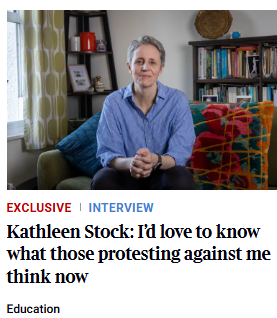
At the centre of it all, inevitably, is Kathleen Stock. Her silenced face dominated the papers, and she rounded the week off demonstrating her lack of self-awareness and typical arrogance by throwing down a public challenge to those who oppose her. She wants to know what we all think now. Sadly, she will never put herself in a position where she might actually have to hear it.
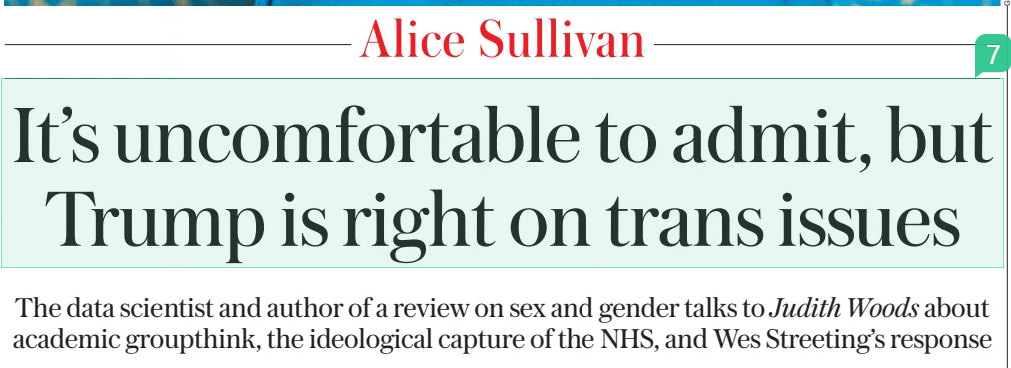
Meanwhile, the fallout from the Sullivan Review continues to gather pace. For anyone still unclear about the motivations behind that report, Alice Sullivan helpfully used the pages of the Sunday Telegraph to clarify. In large type, she declared Trump right about trans people.
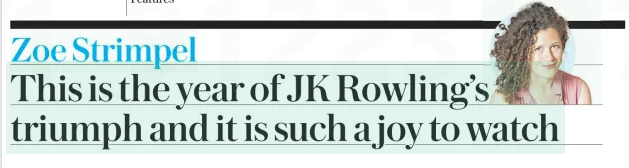
Oh, and in case you missed it, JK Rowling has defeated trans people. I am currently writing this from a dungeon somewhere near a castle in Scotland, probably in a cell close to your own where you are reading it right now.
UK & IRELAND NEWS
University of Sussex fined for protecting trans people
Kathleen Stock’s former university, that of Sussex, has been fined an astonishing £585,000 by the Office for Students (a political body) for the crime of having policies that protect trans people from harmful speech.
This is the story that dominates the papers.
The fine stems from the university’s handling of Stock’s resignation in 2021, when students peacefully protested her anti-trans views and she couldn’t handle it. Despite Stock facing no legal repercussions for her comments and alleged harassment, the OfS found that the university’s transgender inclusion policy created a “chilling effect” on others’ ability to express dissenting views. Stock never seemed to have any problem saying what she wanted. Her issue came when others exercised their freedom of speech to protest her comments.
This ruling, celebrated by anti-trans campaigners, is a worrying development for trans people and universities in general. It suggests that creating safe, inclusive environments for trans students and staff may now be framed as a violation of so-called “free speech.” As universities are pressured to accommodate views that undermine trans people’s existence, protections against discrimination are being weakened. The fine sends a clear signal: institutional support for trans inclusion could now carry a devastating financial penalty in addition to the social ones already frequently applied.
The university plans to appeal the ruling that was shamefully given the full backing of Labour’s Education and Women’s and Equalities Secretary Bridget Phillipson.
Trans patients ‘terrified’ as UK GPs withdraw from prescribing HRT [Pink News]
Dozens of UK GPs have stopped prescribing hormone replacement therapy to trans patients, citing lack of expertise and support. One Sheffield surgery told patients the work was “outside of our expertise,” while others in the East Midlands followed suit. To be clear, they are not allowed to do this and have not been officially instructed to. If this happens to you, here is some information that can help.
NHS suspends gender marker updates for under-18s after Sullivan review [Philippa East]
NHS England has suspended the ability to update gender markers for under-18s following the Sullivan Review, which claimed safeguarding risks without citing evidence. The PCSE portal has removed access to relevant forms, also affecting adoption updates. The review lacks objective data and misrepresents risks to justify a politically motivated policy that harms trans youth and erodes existing healthcare processes for adults.
The ‘impartial’ Sullivan has a full page in this week’s Sunday Telegraph, the headline of which is “It’s uncomfortable to admit, but Trump is right on trans issues.” See PAPER REVIEW for more.
NHS BDD expert’s link to anti-trans conference raises concerns for trans teens [Trans Safety Network]
Dr Amita Jassi, head of the NHS’s sole youth Body Dysmorphic Disorder service, joined a panel at an event hosted by the anti-trans Society for Evidence Based Gender Medicine, alongside prominent anti-trans activists. Her recent paper proposing criteria to “differentiate” BDD and gender dysphoria is raising fears the NHS may be developing new clinical tools to pathologise trans youth under the guise of “care”.
LGB Alliance use offices owned by man helping Russia
LGB Alliance are based in 55 Tufton Street, and I have my suspicions that Sex Matters are also operating out of the same offices.
AROUND THE WORLD
Ireland updates US travel advice, warns transgender citizens to check entry requirements [Newsweek]
Ireland has updated its travel guidance for the United States, cautioning transgender citizens to check specific entry rules due to recent US policy changes. The Department of Foreign Affairs advises those with an “X” gender marker or a gender identity that differs from their sex assigned at birth to contact the US Embassy in Dublin before travelling. The move follows similar warnings from the UK, Finland, Denmark and Germany.
US visa rule targeting trans travellers sparks legal and logistical alarm [JDSUPRA]
A new directive requires US visa applicants to declare their sex assigned at birth, granting consular staff wide discretion to deny applications. Though framed around transgender athletes, its vague scope could affect business, academic, and tourist visas. Legal experts warn of likely challenges on discrimination and human rights grounds.
Trump administration targets California over trans student protections [Mira Lazine]
The Trump administration has launched an investigation threatening to cut California school funding over AB 1955, a law protecting trans students from forced outing. Secretary of Education Linda McMahon claims it violates parental rights, despite prior court rulings upholding it.
Poll shows widespread public rejection of anti-trans federal policies [Erin Reed]
A new Data for Progress poll shows strong public opposition to the Trump administration’s sweeping anti-trans agenda, that includes censorship, healthcare bans, and a military purge. 52% oppose removing LGBTQ+ health data, and 61% reject prosecuting teachers who support trans students. Majorities also support healthcare for trans youth and oppose rewriting LGBTQ+ history. Even on sports, most favour local control over federal bans.
Montana bathroom ban becomes law
MEDIA
Gay society faces greatest danger under Trump, warns Russell T Davies [Guardian]
Russell T Davies warns LGBTQ+ communities face unprecedented danger under Donald Trump, citing rising hostility and policy rollbacks. Speaking at the Gaydio Pride Awards, the Queer as Folk creator likened the threat to a “rising darkness,” calling out Trump and Elon Musk for fuelling hate and controlling public discourse.
Davies urged defiance, vowing: “If we have to be rebels in basements again, that’s what we’ll become.”
Project 2025 Trump’s acts beyond ‘wildest dreams’ [Guardian]
![Project 2025 Trump’s acts beyond ‘wildest dreams’ The Guardian18 Mar 2025Martin Pengelly Washington Paul Dans was Project 2025 director for the rightwing Heritage Foundation The director of Project 2025, a rightwing plan to dismantle the federal government which the Democrats warned about last year, forcing Donald Trump to try to disown it, has said the president’s actions in power have proved “way beyond my wildest dreams”. Paul Dans was director of Project 2025 for the Heritage Foundation, a hard-right group that has produced such policy plans for four decades. The plan alarmed progressives with its advocacy of slashing government staffing and budgets and attacking protections for LGBTQ+ Americans as well as scrapping efforts to ensure diversity, equity and inclusion (DEI) throughout government, attempts to tackle the climate crisis and more. Democratic attacks proved effective enough for Trump to claim he had “nothing to do” with the project. Last July, as the Trump campaign scrambled to limit damage, Dans was forced out of his Heritage role. Now back in power, the president and his chief donor and ally, the billionaire Elon Musk, have mounted an assault on the federal government that has already led to thousands of firings, a bonfire of climate regulations, attacks on DEI initiatives real and imagined, and much more. “It’s actually way beyond my wildest dreams,” Dans told Politico. “It’s not going to be the easiest road to hoe going forward. The deep state is going to get its breath back here, but the way that they’ve been able to move and kind of upset the orthodoxy, and at the same time really capture the imagination of the people, I think portends a great four years.” According to rightwing activists, the “deep state” is a permanent government of bureaucrats and operatives that exists to thwart Trump. Dans, who now works as a lawyer and government relations consultant, told Politico he was “not saying” Trump’s agenda and Project 2025 were “one and the same. I’m saying that directionally, they have a lot in common … We had hoped, those of us who worked [on] Project 2025, the next conservative president would seize the day, but Trump is seizing every minute of every hour. I’m not sure you’d be able to implement Project 2025 without [his] ability to bring people together and Elon Musk’s ability to focus the direction of the work.” Article Name:Project 2025 Trump’s acts beyond ‘wildest dreams’ Publication:The Guardian Author:Martin Pengelly Washington Start Page:25 End Page:25](https://substack-post-media.s3.amazonaws.com/public/images/f34bef09-c6b6-49d8-ab03-66b98184ed65_467x725.jpeg)
Ofcom opens investigation into GB News after 71,000+ complaints because of homophobic slur
Ofcom has launched a formal investigation into GB News after the right-wing channel aired a segment suggesting that the LGBT+ community included paedophiles. The remarks, made by presenter Josh Howie on Headliners, sparked widespread outrage and prompted a wave of complaints, with over 71,000 signatures submitted by the Good Law Project calling for regulatory action.
Despite the clear breach of broadcasting standards, GB News boss Angelos Frangopoulos has attempted to frame the backlash as a “co-ordinated” attack by “far-left pressure groups,” dismissing concerns as an assault on “free speech.” In reality, watchdogs and advocacy groups, including Stop Funding Hate, are right to highlight that the channel has long been a platform for hate speech and misinformation, frequently pushing narratives designed to stir division.
SPORT
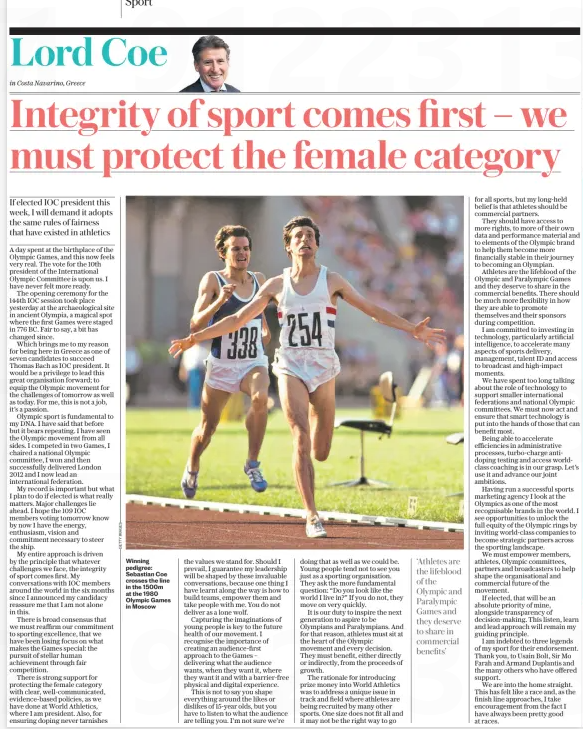
SHOT – Seb Coe humiliated in bid to become IOC President
Despite being touted as the favourite by the UK media, Coe lost to Kirsty Coventry 48-9. The election, which was expected to last five rounds of voting, was concluded in the first. Coventry becomes the first woman to lead the IOC, something the right wing papers were furious about because how can she, as a woman, be expected to know how to protect women?
While Coventry had made noises towards the anti-trans crowd, her heart never really seemed into it and has already begun walking back on what she said. Still, with the next Olympics set to be held in LA, a ban on trans women seems inevitable, no matter her wishes.
The BBC initially reported that Coe had won the election, publishing an article headlined “King Charles congratulates Coe on his election as IOC president” before swiftly deleting.
CHASER – World Athletics to introduce mandatory sex testing for women only [Sky News]
All female athletes will undergo mandatory biological sex verification, including swabs or blood tests, World Athletics confirmed. Sebastian Coe, speaking less than a week after his IOC election humiliation, says the policy protects fairness in women’s sport, but he’s lying. It revives outdated, discriminatory practices and will lead to invasive exams ahead of the 2028 Olympics. There is zero chance that Coe is unaware of this.
First ever study disproves claims of unfair advantage in DSD athletes [Kirsti Miller]
More than 15 years after Caster Semenya was targeted by World Athletics, a new study by Gollish et al. (2025) has found no evidence that women with differences in sex development (DSD) have a performance advantage over other female athletes. The researchers analysed performances from the Paris 2024 Olympics and concluded, as Kirsti Miller puts it: “They run like girls.”
Trump does not scare me, says Khelif
Imane Khelif has vowed to defend her Olympic boxing title at Los Angeles 2028 despite Donald Trump’s attempts to ban her. The Algerian, who won gold in Paris amid Russian propaganda, dismissed Trump’s policy targeting trans athletes, stating, “I am not transgender. This does not concern me, and it does not intimidate me.” She revealed the intense scrutiny had deeply affected her and her family but remains determined to claim a second gold medal.
ANY OTHER BUSINESS
Hungary bans Budapest Pride, plans AI surveillance of attendees [S Baum]
Hungary has banned its annual Pride parade and plans to use AI surveillance, facial recognition, and automatic fines to target organisers and attendees. Passed swiftly by Parliament under Prime Minister Viktor Orbán, the new law expands child protection rules to outlaw events seen to be promoting LGBT identities to minors. Despite the crackdown, Budapest Pride organisers vow to proceed, calling the ban “fascism.”
Morning-after pill to be free at pharmacies in England [BBC]
Women in England will be able to get the morning-after pill for free at pharmacies later this year, ending postcode inequalities and reducing pressure on GP services.
Lisa Nandy to be removed from Labour cabinet
It is widely expected that Lisa Nandy will lose the Culture, Media and Sport brief that she was only given because Thangam Debbonaire was too hateful to win her election. They are claiming she doesn’t work hard enough and is only interested in the ‘sport’ section of her job. Morgan McSweeney is, as usual, believed to be behind the impending ousting, with Nandy seen as being ‘too left’. To McSweeney, David Cameron is ‘too left’.
Bridget Phillipson, who has shown herself this week to be anti-trans, is also expected to be replaced.
Keir Starmer continues to be accused of having a problem with women. It is hard to see how these moves will help with that perception.
Reform UK appoints man who called Hitler ‘brilliant’ as vetting chief [Guardian]
Jack Aaron, a former Reform UK candidate who once praised Hitler’s ability to “inspire people into action,” has been appointed head of the party’s candidate vetting process. Aaron, who also described Bashar al-Assad as “gentle by nature” and defended Vladimir Putin’s use of force in Ukraine, will now be responsible for reviewing and advising on prospective candidates’ social media activity.
Reform UK has defended Aaron, highlighting his Jewish heritage and family history. Aaron previously stood by many of his comments, arguing they were made within a psychological framework rather than as endorsements.
THE WEEK AHEAD
Full parliament business can be viewed here.
Monday 31 March
Amanda Pritchard steps down as NHS England CEO
Verdict due for France’s Marine Le Pen, who is accused of embezzlement.
Tuesday 1 April
2.30pm+ House of Lords, oral questions, Office for Students: Sussex University fine for breach of free speech obligations
4.30pm, Westminster Hall debate, Relationship education in schools
Minimum wage increase takes effect
Election in Wisconsin Supreme Court race where Elon Musk is bribing voters
Report: Forbes World’s Billionaires listing
Wednesday 2 April
Prime Minister’s Questions, House of Commons, 12pm
Thursday 3 April
Friday 4 April
Five years ago: Keir Starmer became Labour leader on a manifesto of lies
Saturday 5 April
Sunday6 April
Non-dom tax status abolished
The House of Lords goes into recess until 22 April.
THE PAPERS
As I was away last weekend, we have two weeks to catch up and they were a busy two weeks.
17 March – 23 March saw 24 articles while 24 March – 30 March had 29, making it the third busiest week of 2025.
The Telegraph, of course, leads the way with 25 in total across the two weeks (13 & 12). The Times had 13 (6 & 7), the Mail 11 (4 & 7) and the Guardian/Observer four (1 & 3).
In 2025, here have been two articles in the Times, Telegraph, Mail and Guardian (out of 178) that you could call ‘positive’ when it comes to trans people and both have featured the mother of a dead trans kid.
Here are the headlines from the last two weeks:
Girls in care should share with trans boys, says Scots watchdog
Lib Dems told to stop harassing biological women and Christians
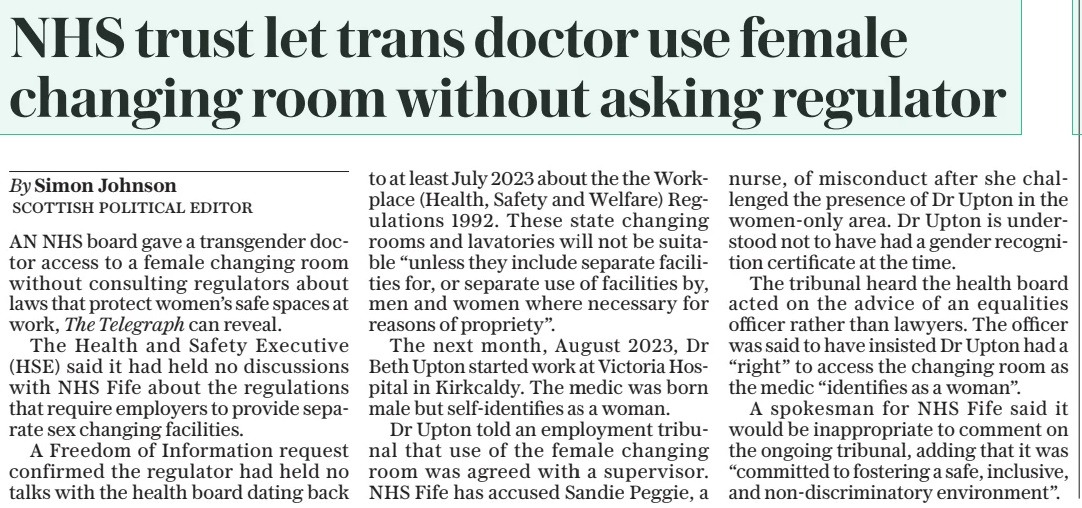
NHS Trust let trans doctor use femal changing room without asking regulator
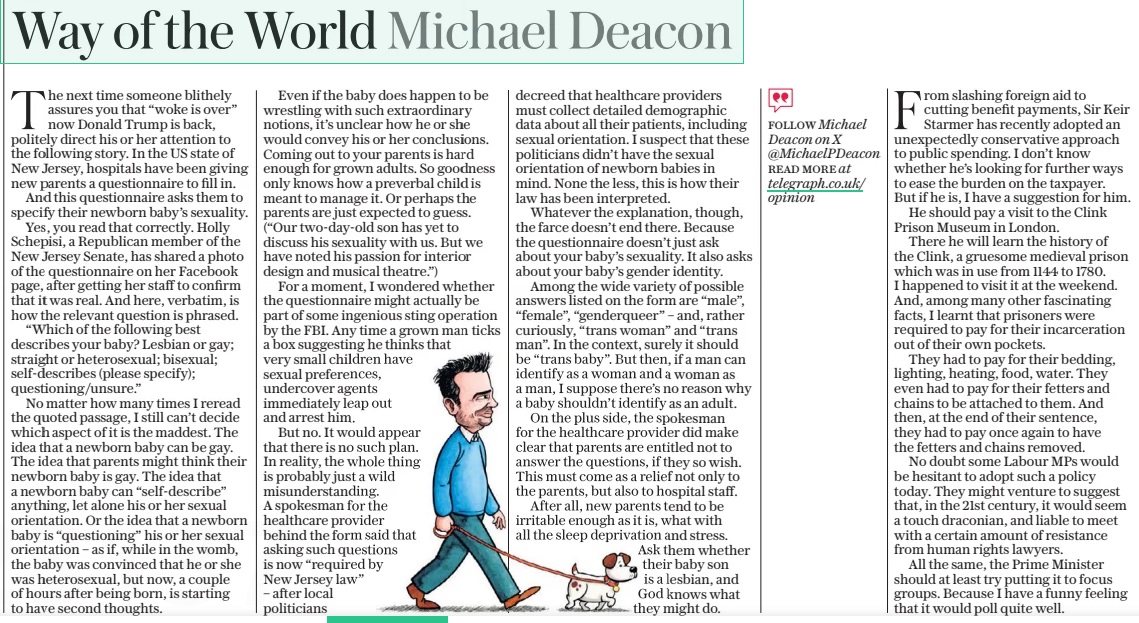
Way of the world (trans babies)
Integrity of sport comes first – we must protect the female category
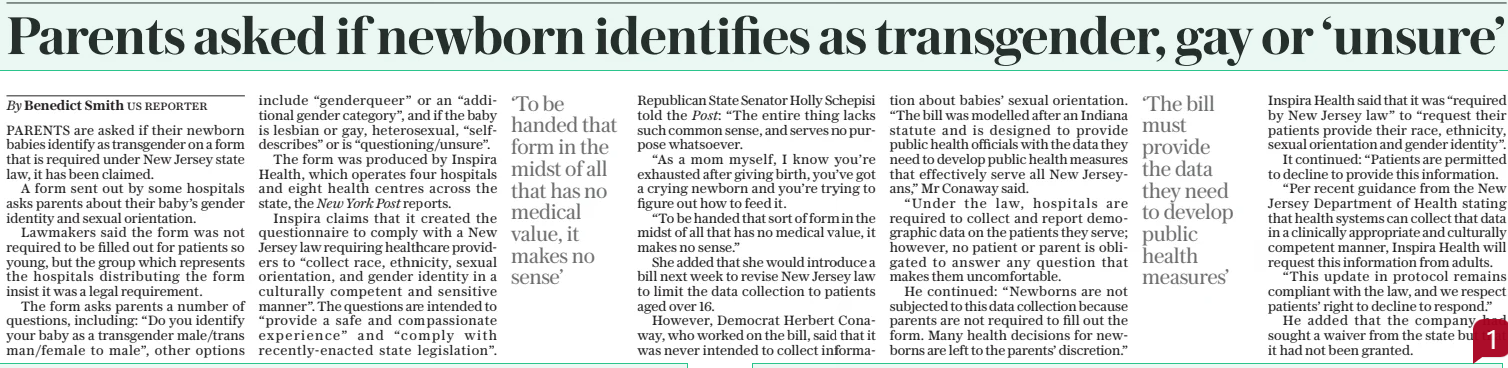
Parents asked if newborn identifies as transgender, gay or ‘unsure’
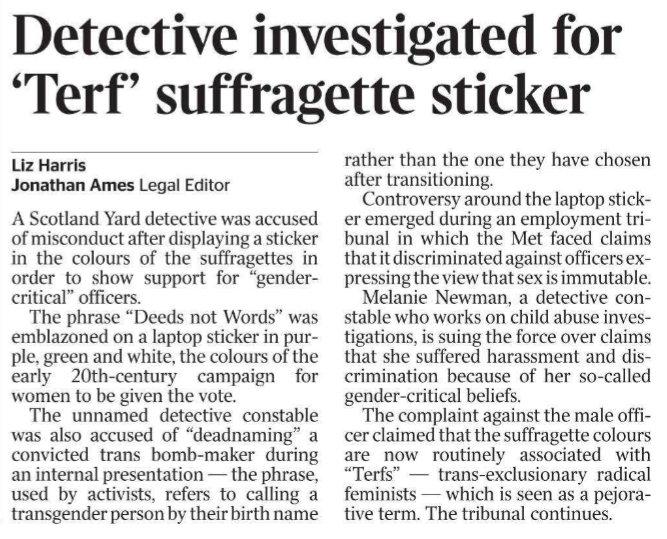
Detective investigated for ‘Terf’ suffragette sticker
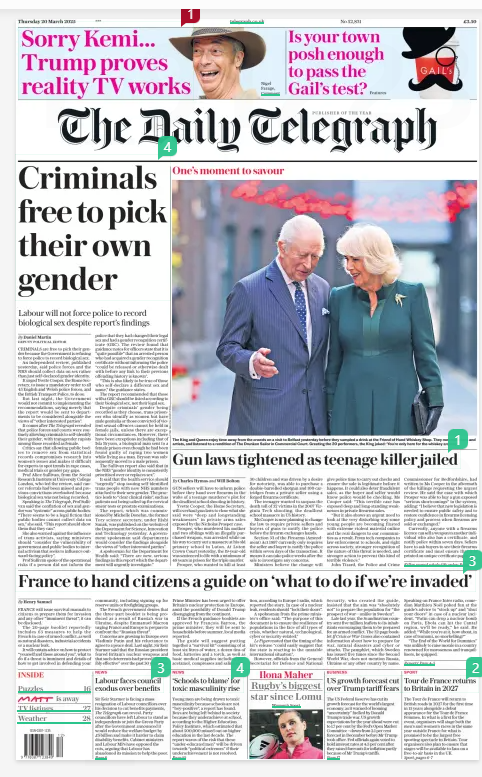
“Criminals free to pick their own gender
Labour will not force police to record biological sex despite report’s findings”
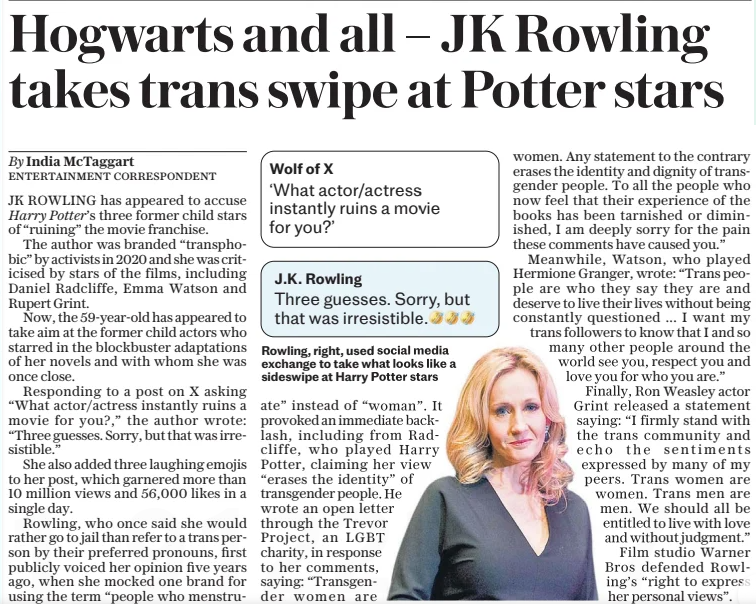
Hogwarts and all – JK Rowling takes trans swipe at Potter stars
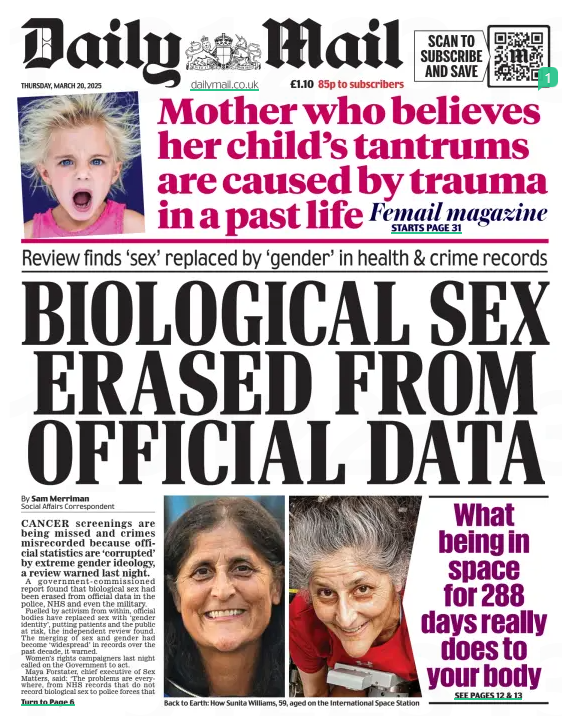
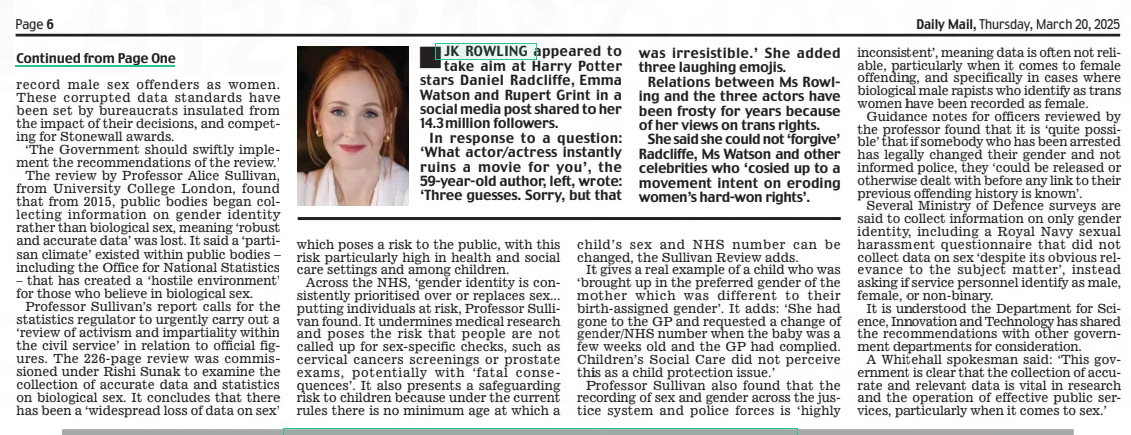
BIOLOGICAL SEX ERASED FROM OFFICIAL DATA Review finds ‘sex’ replaced by ‘gender’ in health & crime records
The Brigitte Macron conspiracy theory – False rumours about the French first lady’s gender are being circulated by Trump-supporting commentators. By Marianka Swain
Why is Starmer still giving in to a tiny minority of gender terrorists?
NHS ban on trans children altering records
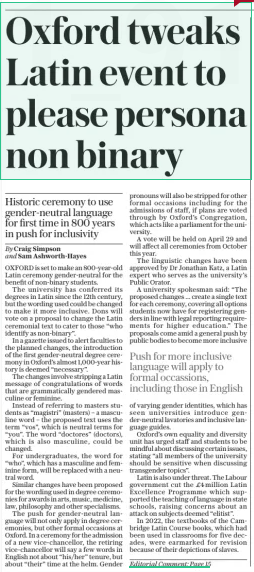
Oxford tweaks Latin event to please persona non binary
Historic ceremony to use gender-neutral language for first time in 800 years in push for inclusivity”
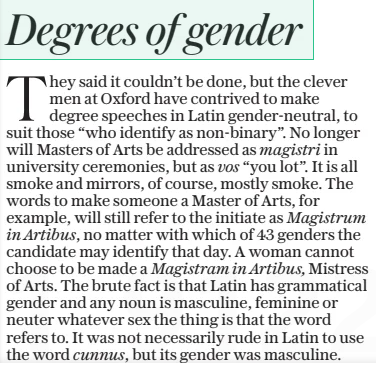
Degrees of gender
NHS told not to change children’s gender data
Wokery costs lives
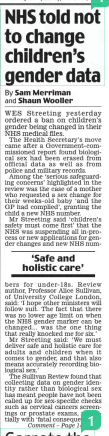
End to the changing of children’s gender on NHS medical records
Flight from Reality – The Sullivan Review has exposed the dangers of lost or absent data on biological sex
Scientist pushed out over gender beliefs – Porton Down expert said he was treated as if he had been showing support for al-Qaeda, Fiona Hamilton writes
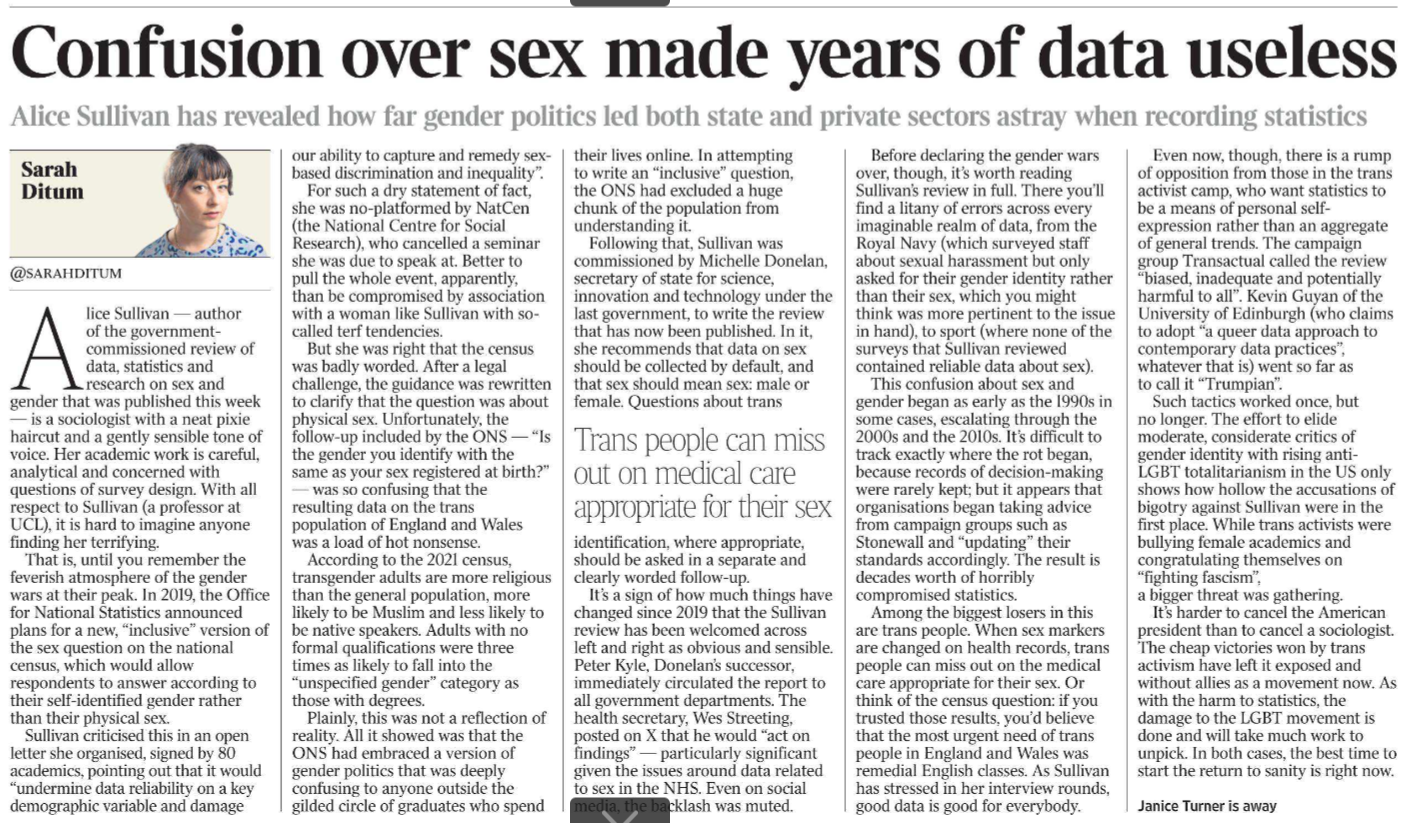
Confusion over sex made years of data useless – Alice Sullivan has revealed how far gender politics led both state and private sectors astray when recording statistics
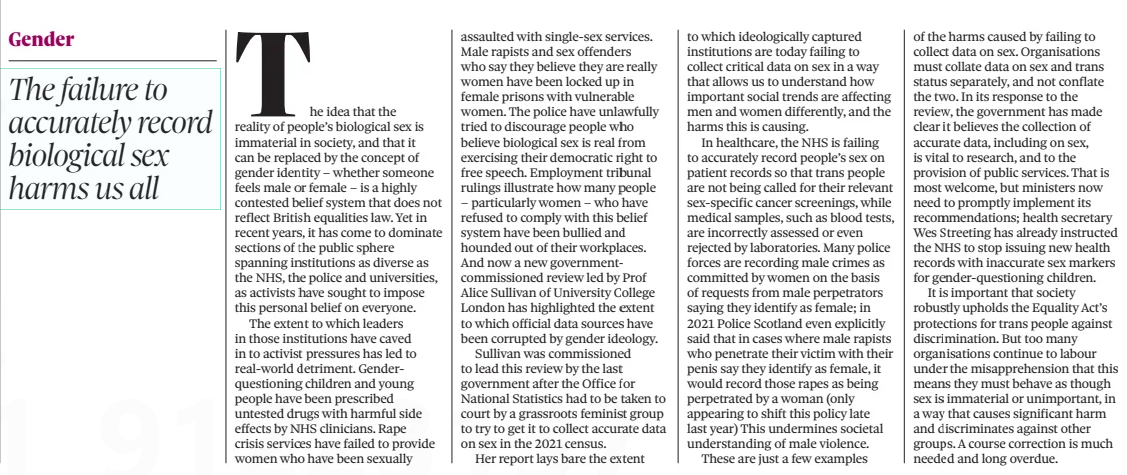
The failure to accurately record biological sex harms us all
Nurse branded danger to public – for calling racist transgender paedophile ‘Mr’ – so guess who was investigated by the NHS and labelled a danger to the public”
Nurse branded ‘danger to public’ for calling trans paedophile ‘Mr’
Brianna Ghey’s mother urges under-16s ban on social media
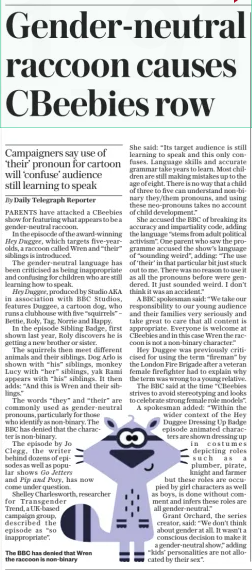
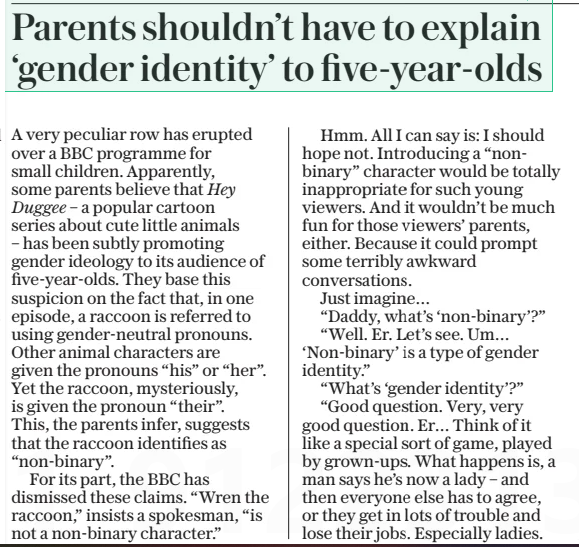
Gender-neutral raccoon causes Cbeebies row – Campaigners say use of ‘their’ pronoun for cartoon will ‘confuse’ audience still learning to speak”
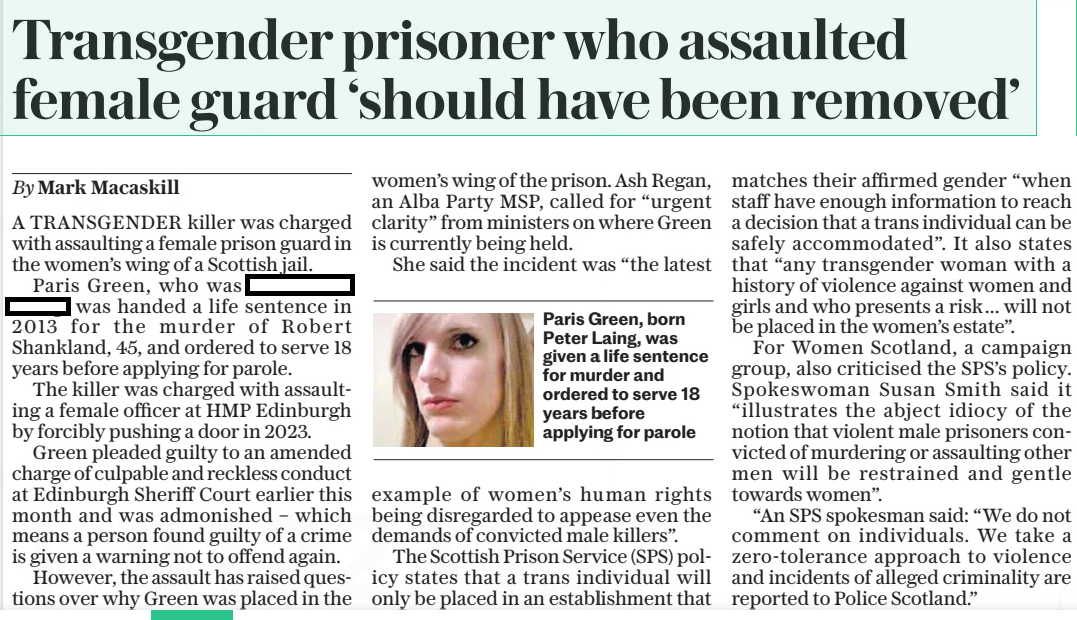
Transgender prisoner who assaulted female guard ‘should have been removed’
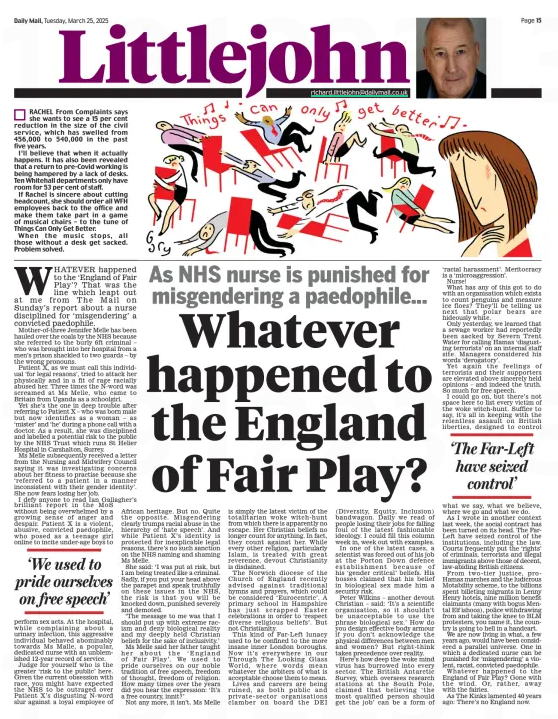
Whatever happened to the England of Fair Play?
As NHS nurse is punished for misgendering a paedophile”
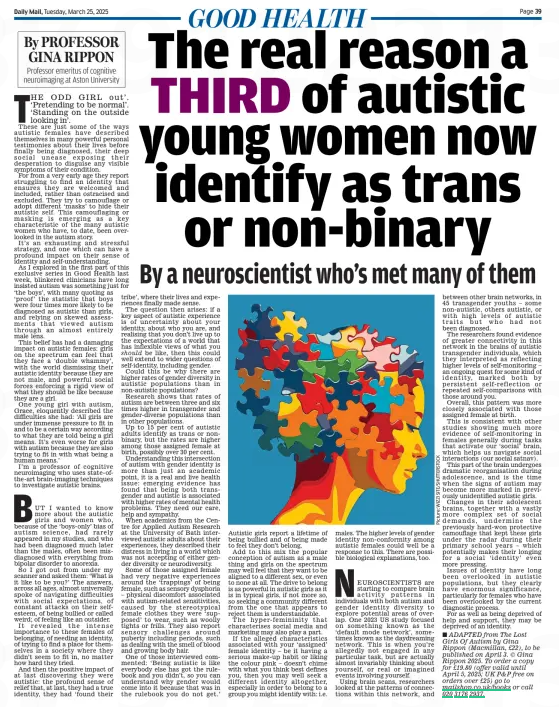
The real reason a THIRD of autistic young women now identify as trans or non-binary By a neuroscientist who’s met many of them
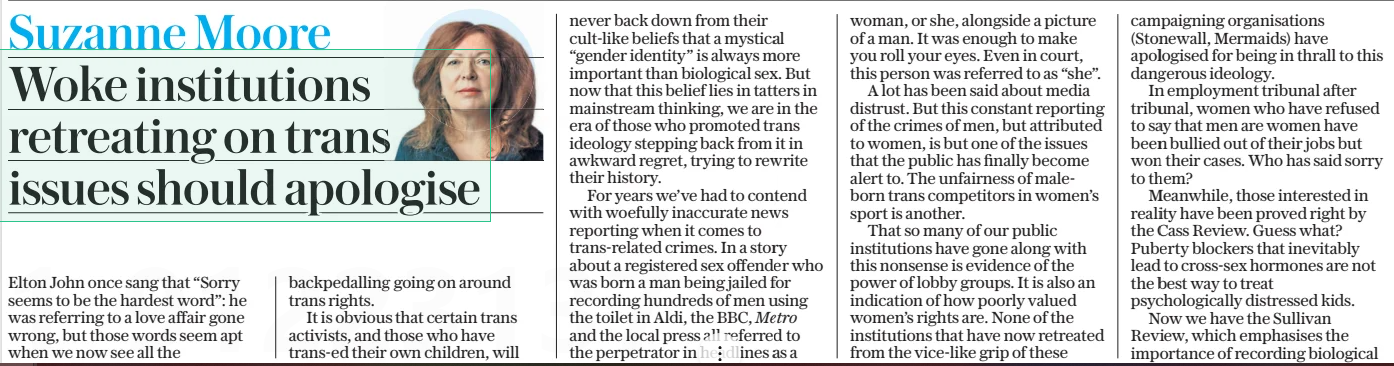
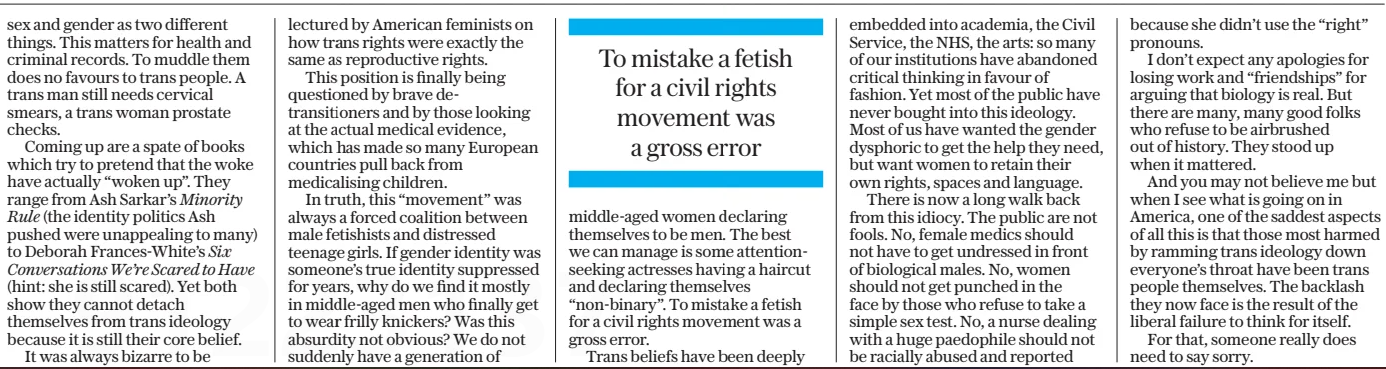
Woke institutions retreating on trans issues should apologise
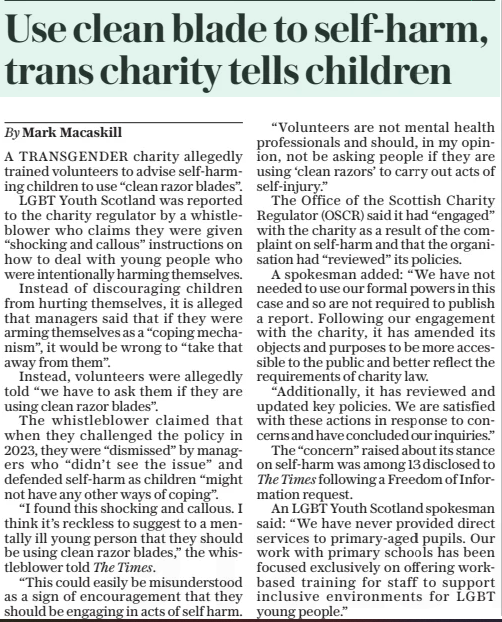
Use clean blade to self-harm, trans charity tells children
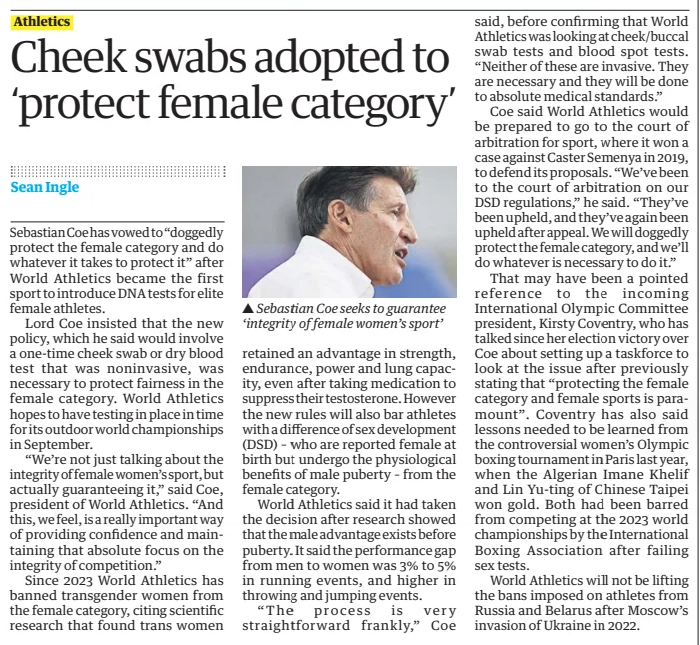
Cheek swabs adopted to ‘protect female category’
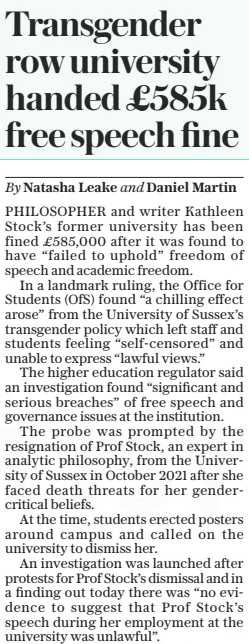
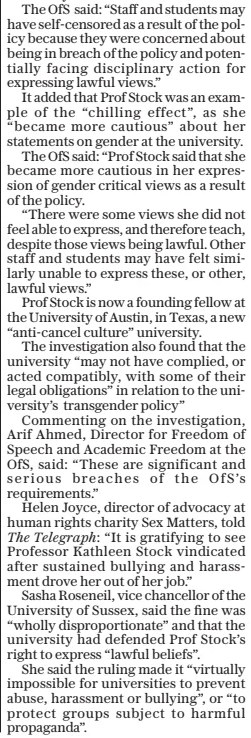
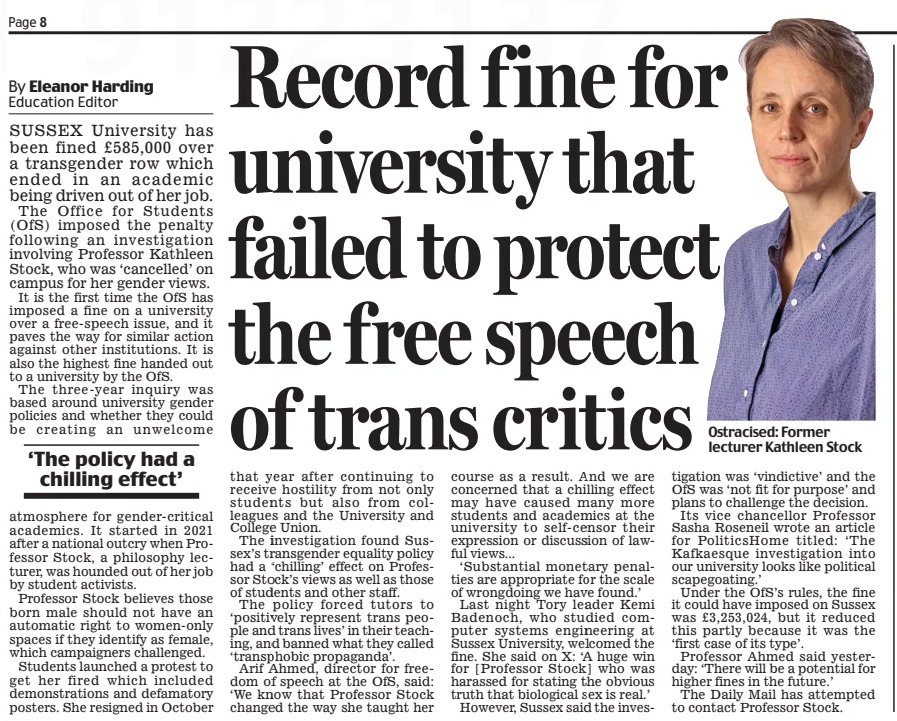
Transgender row university handed £585k free speech fine
Parents shouldn’t have to explain ‘gender identity’ to five-year-olds
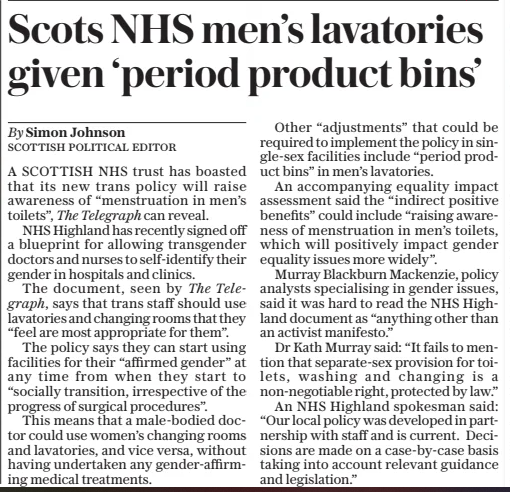
Scots NHS men’s lavatories given ‘period product bins’
Record fine for university that failed to protect the free speech of trans critics
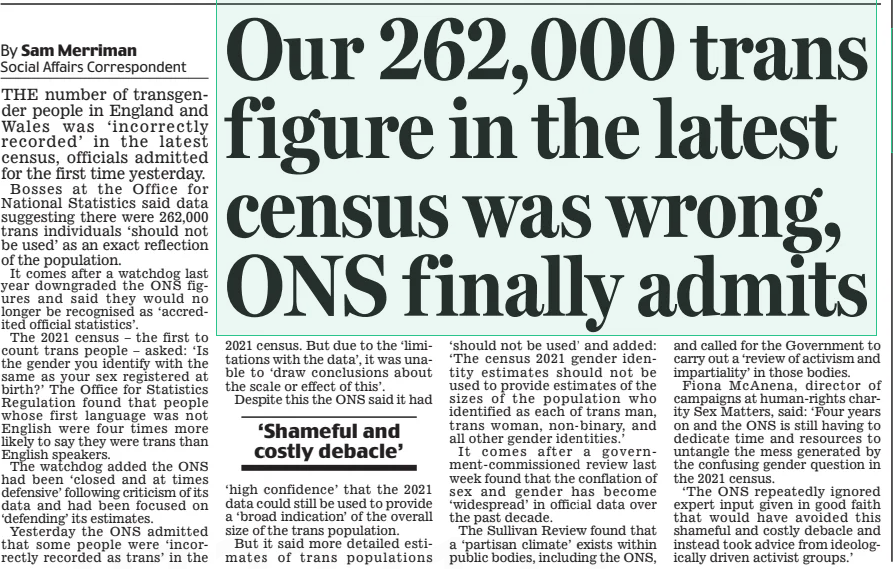
Our 262,000 trans figure in the latest census was wrong, ONS finally admits
Don’t rely on census for trans data, ONS advises
Universities failing on free speech are warned of seven-figure fines
Professor endured smears and ostracism in ‘medieval’ ordeal
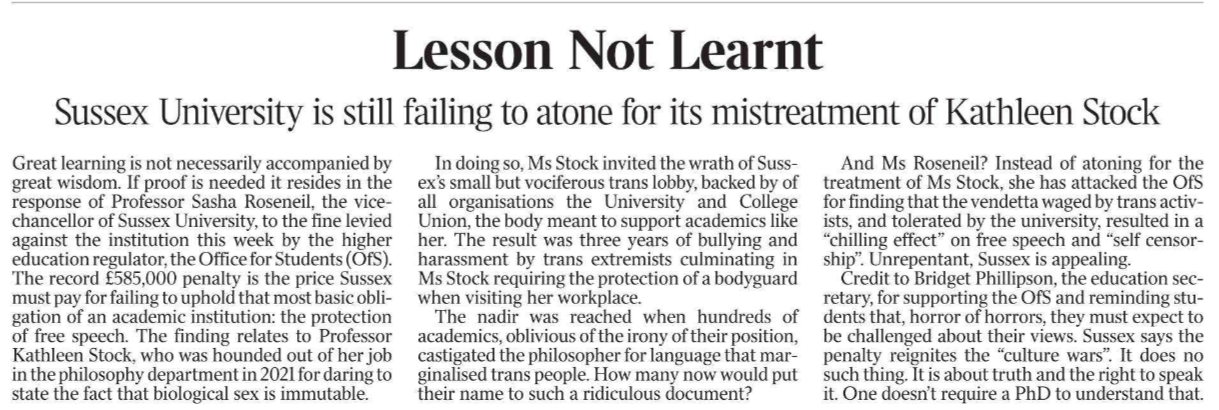
Lesson Not Learnt – Sussex University is still failing to atone for its mistreatment of Kathleen Stock
How dim-witted!
Academic in free speech row gives her withering verdict on trans policies stifling UK’s universities”
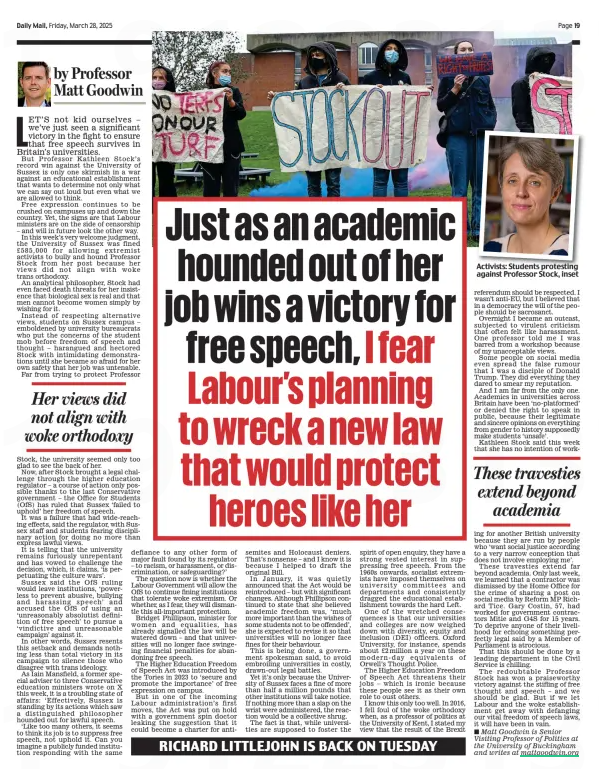
Just as an academic hounded out of her job wins a victory for free speech, I fear Labour’s planning to wreck a new law that would protect heroes like her
University taking legal action over free speech fine
A mother’s strength after an unbearable loss
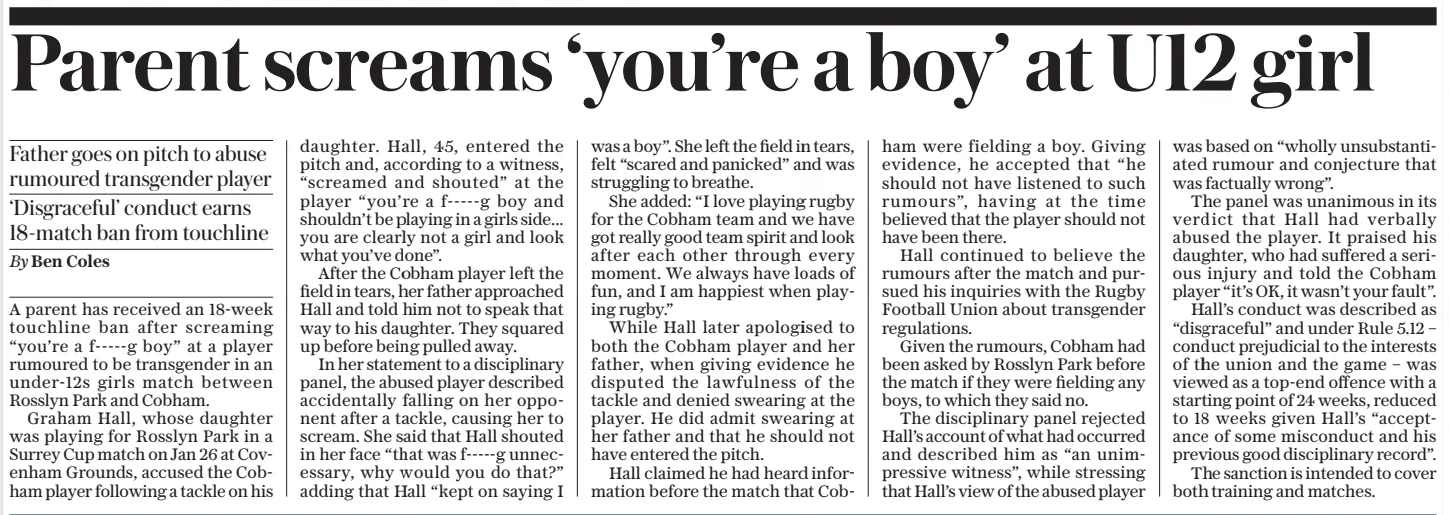
Parent screams ‘you’re a boy’ at U12 girl – Father goes on pitch to abuse rumoured transgender player ‘Disgraceful’ conduct earns 18-match ban from touchline”
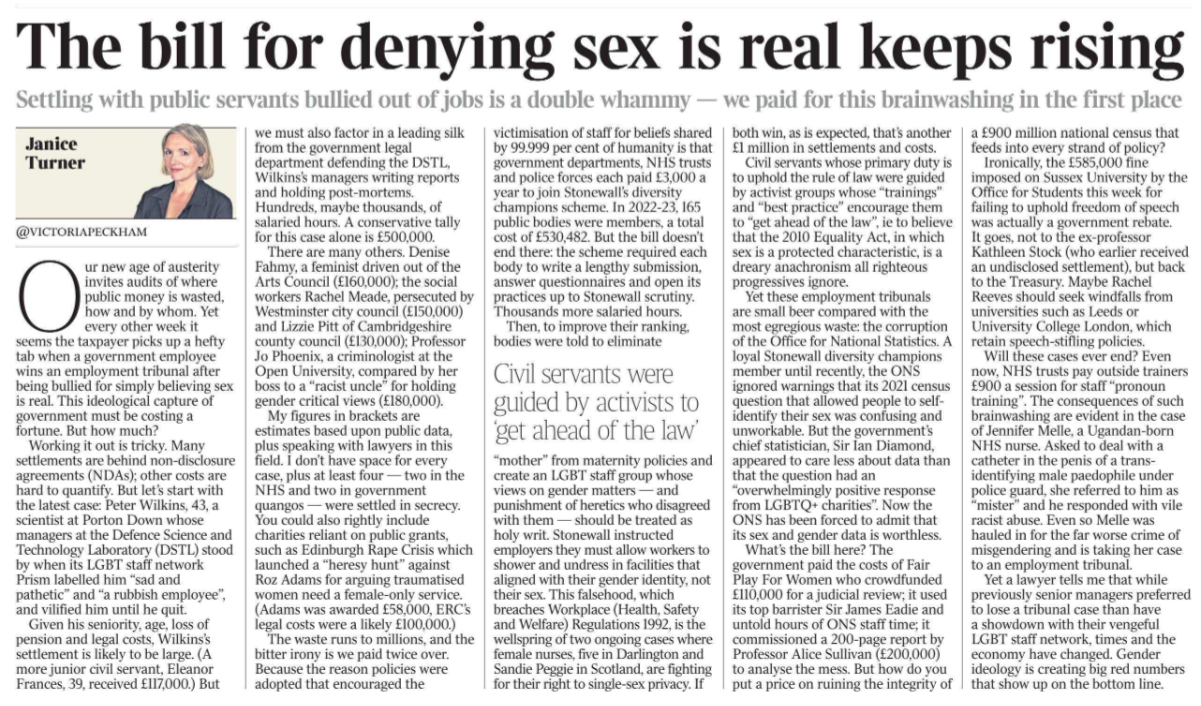
The bill for denying sex is real keeps rising – Settling with public servants bullied out of jobs is a double whammy — we paid for this brainwashing in the first place
This is the year of JK Rowling’s triumph and it is such a joy to watch
GPs stand their ground over prescribing trans hormones
It’s uncomfortable to admit, but Trump is right on trans issues Alice Sullivan scientist and author of a review on sex and gender talks to Judith Woods about academic groupthink, the ideological capture of the NHS, and Wes Streeting’s response.
A uni protest that ended in disaster
In all, there were 44 different bylines on these articles.
Whose bylines were on all these articles? Alex Shulman, anon (2), Anya Fielding, Ben Cole, Benedict Smith, Carol Midgley, comment (3), Craig Simpson, Daily Telegraph Reporter, Daniel Martin (2), Dominic Penna, Eleanor Harding (2), Fiona Hamilton, Geraldine Scott, Hayley Dixon, Ian Gallagher, India McTaggart, Janice Turner, Jonathan Ames, Judith Woods (2), Liz Harris, Marianka Swain, Mark Brown, Mark Macaskill (3), Matt Goodwin, Michael Deacon (2), Michael Searles, Natasha Leake, Nicola Woolcock (2), Prof Alice Sullivan, Professor Gina Rippon, Richard Adams, Richard Littlejohn, Sam Ashworth-Hayes, Sam Merrriman (3), Sanchez Manning, Sarah Ditum, Sean Ingle, Seb Coe, Shaun Wooller, Simon Johnson (2), Sonia Sodha, Suzanne Moore, Zoe Strimpel
Quoted, mentioned or featured this week: Andrea Williams (2), Ash Regan, Candace Owens, Christian Legal Centre (2), Darlington Nurses, Dr Kath Murray, Fair Play for Women, Fiona McAnena, For Women Scotland (2), Helen Joyce (2), Jennifer Melle (4), JK Rowling (2), Kathleen Stock (9), Keira Bell, Kemi Badenoch, Lord Seb Coe, Maya Forstater (3), Melanie Newman, Mike Dixon, Murray Blackburn Mackenzie, Natalie Bird, Peter Wilkins (2), Prof Alice Sullivan (10), Republican State Senator Holly Schepisi, Royal College of GPs, Sandie Peggie (4), Sex Matters (5), Shelley Charlesworth, Susan Smith (2), Transgender Trend, Tucker Carlson, Wes Streeting (2)
Spotted or know something you think I should include in the Trans Agenda?
THE PAPERS Monday 17 March – 30 March
17 Monday Total: 1
Telegraph [1]

18 Tuesday Total: 1
Telegraph [1]
19 Wednesday Total: 3
The Times [1]
Telegraph [2]
20 Thursday Total: 4
The Times [1]
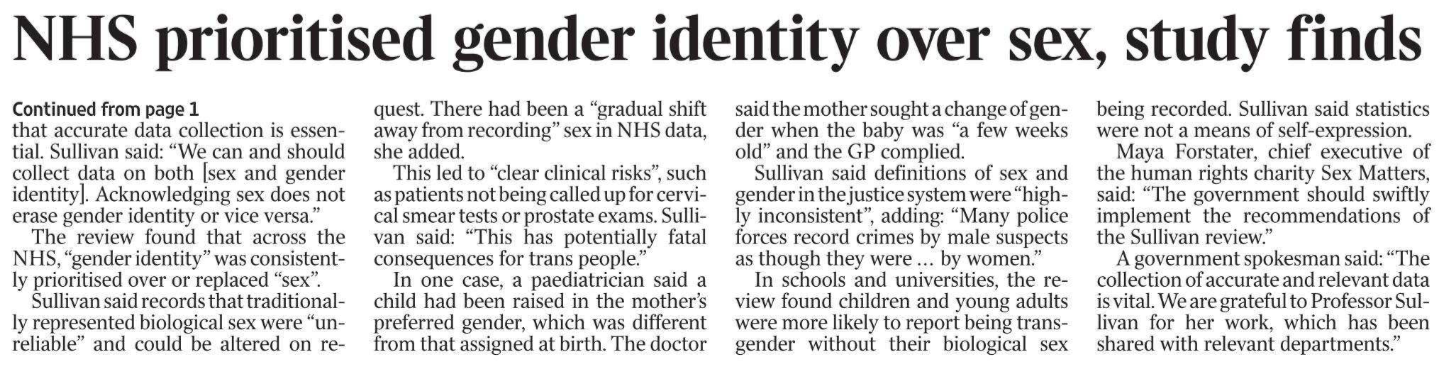
![Civil service ‘activism’ erasing sex data Geraldine Scott - Senior Political Correspondent Cancer referrals have been missed and convictions overlooked because references to biological sex have been erased from data on health, crime and education, a review has found. A report commissioned by the last government and released yesterday found the word “gender” began to replace “sex” in details collected in the 1990s. For the past decade “robust” data on biological sex had been lost, it said. The study, led by Professor Alice Sullivan of University College London, investigated all public bodies and found “the meaning of sex is no longer stable in administrative or major survey data”. The review found inconsistencies in the way sex and gender were recorded. Some surveys removed sex altogether and collected only information on gender identity, it found. This included a Royal Navy sexual harassment survey, which asked how respondents identified rather than their sex, “despite its obvious relevance”. In another case, a children’s camping programme raised safeguarding concerns through collecting data on gender identity, with male, female and “other” response options. Some of those interviewed for the study said there was a “hostile environment” when raising the issues in their organisations. Sullivan said ministers should “consider the vulnerability of government and public bodies to internal activism that seeks to influence outward-facing policy”. She said the Office for National Statistics (ONS) had “radically changed” how it viewed sex when collecting data. Sullivan recommended that the UK Statistics Authority — which oversees the ONS — should consider a review of activism and impartiality within the civil service. It is understood that Peter Kyle, the technology secretary, has had the review circulated to all government departments, with an acknowledgment that accurate data collection is essential. Sullivan said: “We can and should collect data on both [sex and gender identity]. Acknowledging sex does not erase gender identity or vice versa.” The review found that across the NHS, “gender identity” was consistently prioritised over or replaced “sex”. Sullivan said records that traditionally represented biological sex were “unreliable” and could be altered on request. There had been a “gradual shift away from recording” sex in NHS data, she added. This led to “clear clinical risks”, such as patients not being called up for cervical smear tests or prostate exams. Sullivan said: “This has potentially fatal consequences for trans people.” In one case, a paediatrician said a child had been raised in the mother’s preferred gender, which was different from that assigned at birth. The doctor said the mother sought a change of gender when the baby was “a few weeks old” and the GP complied. Sullivan said definitions of sex and gender in the justice system were “highly inconsistent”, adding: “Many police forces record crimes by male suspects as though they were ... by women.” In schools and universities, the review found children and young adults were more likely to report being transgender without their biological sex being recorded. Sullivan said statistics were not a means of self-expression. Maya Forstater, chief executive of the human rights charity Sex Matters, said: “The government should swiftly implement the recommendations of the Sullivan review.” A government spokesman said: “The collection of accurate and relevant data is vital. We are grateful to Professor Sullivan for her work, which has been shared with relevant departments.”](https://substack-post-media.s3.amazonaws.com/public/images/a3a3d59f-637c-4eba-8b17-8fd99c2dfe52_1740x807.png)
Daily Mail [1]
Telegraph [2]
21 Friday Total: 8
The Guardian [0]
The Times [1]
![End to the changing of children’s gender on NHS medical records Geraldine Scott - Senior Political Correspondent Doctors will be banned from giving transgender children a new NHS record after it emerged that biological sex had been erased from official data. Wes Streeting, the health secretary, said it was wrong that doctors were changing the NHS numbers of children if they changed gender. He has told the health service to stop giving out new NHS numbers to under-18s. The news comes after a review commissioned by the last government and released on Wednesday found that the word “gender” started to replace “sex” in the collection of data in the 1990s and that for the past ten years “robust and accurate data on biological sex” had been lost. Cancer referrals were missed and previous convictions were overlooked because biological sex had been erased from official data on health, crime and education. In medicine, adults and children have been able to request their gender is changed on their medical record. When this happens, a new NHS number and, therefore, medical record would be created. The review, led by Professor Alice Sullivan of University College London, reported how in one case a paediatrician said that a child had been brought up in the preferred gender of the mother, which was different to their birth-assigned gender. “[The mother] had gone to the GP and requested a change of gender/NHS number when the baby was a few weeks old and the GP complied. Children’s social care did not perceive this as a child protection issue,” the doctor reported. The health secretary said yesterday: “It’s completely wrong that children’s NHS numbers can be changed if they change gender. “I’ve made it clear this must not happen. We must deliver safe and holistic care for adults and children when it comes to gender, and that also means accurately recording biological sex. I have always made it clear that doing so does not stop us from recording, recognising and respecting people’s gender identity.” It is not known how many cases there have been where a child’s sex marker has been changed by the NHS or whether it is something that could be tracked. Sullivan said she welcomed Streeting’s “decisive action to implement the recommendations of the review” and that she hoped “other ministers will follow suit”. Maya Forstater, chief executive of the charity Sex Matters, said Streeting’s decision was “a welcome return to common sense”. Forstater said: “Changing sex markers on children’s medical records should never have been allowed. It was not just misguided but reckless. Sex matters in healthcare and no one can change sex. “Anyone who cares about patient safety should insist that every patient’s sex is recorded accurately. Medical records aren’t for validating people’s identities. This is just the first step in rooting this dangerous ideology out of the NHS.” In December Streeting announced an indefinite ban on puberty blockers being prescribed to children. Although puberty blockers had been banned on the NHS, outside of clinical trials, since last March, an order preventing the prescription of the medication from European or private prescribers since May had only been temporary. Streeting said he took advice from independent experts who warned that prescribing such medication to under- 18s for gender dysphoria presented “an unacceptable safety risk for children and young people”.](https://substack-post-media.s3.amazonaws.com/public/images/88c1037c-022f-43d4-82ea-2627bac13255_1284x711.png)
Daily Mail [2]
Telegraph [5]
22 Saturday Total: 2
The Times [2]
![Scientist pushed out over gender beliefs Porton Down expert said he was treated as if he had been showing support for al-Qaeda, Fiona Hamilton writes At Porton Down for 15 years. Next image › As a scientist at Porton Down developing technology to secure Britain’s defences, Peter Wilkins never imagined he would be considered a threat because of a belief in biology. But when he stated his gender-critical views and support for the concept of immutable sex, Wilkins was reported for his “ideology” and labelled by colleagues as transphobic, “sad and pathetic” and “a rubbish employee”. An employment tribunal has found there was a “clear hostile animus” towards gender-critical beliefs at the topsecret Defence Science and Technology Laboratory [DSTL]. It found that an intimidating atmosphere resulted in the harassment and discrimination of Wilkins, 43, who was forced to leave as a result. Senior officials failed to address the behaviour because of an “unblinking desire” to support the pro-trans lobby. Speaking after he won a two-year legal battle with DTSL, Wilkins still appears slightly bemused that he had to have the argument. “It’s a scientific organisation,” he said, “so it shouldn’t be unacceptable to use the phrase biological sex. I was never looking for DSTL to endorse my beliefs, or for anything to be said against people on the other side of the debate. But it just felt very one-sided. “And it was pretty hurtful, really, having spent 15 years working for DSTL on some things which were high-security, to be told that we think you’re a security risk because you have these fairly normal, run-of-the-mill, factual beliefs about sex and genders.” A panel led by the employment judge Gary Self, sitting at Southampton, warned that senior officials had lost sight of their obligation to be impartial despite high-profile legal rulings that gender-critical views are a protected right under the Equality Act. The case underlines how parts of the civil service have been affected by the debate, with abuse of gender-critical philosophy waged on an internal blog that DSTL employees would use to discuss the issue, often during work time. At least one other person has left the organisation over “spats” on the blog. Bryn Harris, chief legal counsel at the Free Speech Union, which supported Wilkins, said: “They’re meant to be fighting world wars not culture wars.” Wilkins had worked for DSTL for 15 years, including secondments to support operations in Afghanistan and a role attracting innovative technology into defence. In August 2021, when the neuroscientist Sophie Scott was awarded the Royal Society’s Faraday prize, a DSTL employee wrote on the internal blog that it was “pretty disheartening” given that Scott was “well known for her non-inclusive views on trans and non-binary people”. Another wrote that it emboldened transphobes. Wilkins complained to moderators that this was “deeply unfair” to Scott, who had simply applied her scientific expertise to her views. It left the implication, he warned, that anyone with gender-critical beliefs should not receive public recognition for their work. His concerns were not properly acted upon. In the following months a string of blog posts demeaned people with such views. One DSTL employee wrote that explicitly stating gender-critical beliefs was “abusive”. Another described gender criticism as bigotry and one said those who supported gender-critical views led “sad pathetic little lives”. After Wilkins liked a post on Linked- In by the gender-critical charity Sex Matters, a colleague suggested that “GC beliefs were an ideology” and that the matter should be referred to security and HR. They took no further action but Wilkins said it was astonishing that he was flagged “in the same way as if I was expressing support for the provisional IRA or al-Qaeda”. The judgment details how Wilkins, a Christian, repeatedly and calmly asked for management intervention, explaining to HR officials and other colleagues that his beliefs were protected after the Maya Forstater ruling. He did not believe that such posts would be tolerated if they were focused on any other protected belief or religion. Senior staff did not stop the harassment, the tribunal found. Management viewed PRISM, the DSTL sexual orientation and gender identity network, “as a powerful force within the organisation and were loath to do anything to go against [or] upset that body”. Paul Kealey, head of counterterrorism at Porton Down, was singled out for criticism. He told Wilkins that while staff were permitted to hold gendercritical beliefs, it was “not OK to express such views in the workplace”. The tribunal detailed how he created a “hostile and intimidatory environment” for Wilkins and encouraged staff to pick a side, including lobbying on the blog over the conversion therapy ban and to support reform of the Gender Recognition Act. Kealey, a finalist for Advocate of the Year at the LGBTQ+ Defence Awards in November, “lost sight of his obligation to be impartial in line with the Civil Service Code”. Wilkins resigned in November 2022, citing a hostile, intimidating and degrading environment. The tribunal concluded that he was constructively dismissed. Wilkins, who now works in the private sector, said he had spoken up not just because of the imbalance and unfairness of the gender debate but also because he was concerned about the impact it could have on important work at Porton Down. There were numerous examples where females had been disadvantaged in the military, including in the provision of body armour did not fit females as well as males: “To address those kinds of issues you’ve got to recognise the biological differences between the sexes,” he said. He was also concerned that the negative opinions of feminist scientists might cloud Porton Down’s assessment of their important research. Harris said that Wilkins has been resoundingly vindicated: “Peter was exquisitely patient in pointing out, again and again, that DSTL cannot demean employees for holding the ‘wrong’ view about sex and gender. DSTL’s response that it is ‘not OK’ to express gender-critical views in the workplace was a flagrantly unlawful suppression of our member’s freedom of speech. We expect DSTL now to put its house in order, and to respond accordingly to the tribunal’s finding of serious breach of the Civil Service Code by senior employees.” DSTL is expected to have to pay substantial damages. The tribunal dismissed claims of victimisation. A spokeswoman said: “We will review the judgment and following that we will look to take any appropriate actions. We cannot make any further comment on individual cases.”](https://substack-post-media.s3.amazonaws.com/public/images/6c5091b6-4d19-483b-ade1-ec4148e7e5ec_1081x682.png)
23 Sunday Total: 2
The Observer [1]
Mail on Sunday [1]
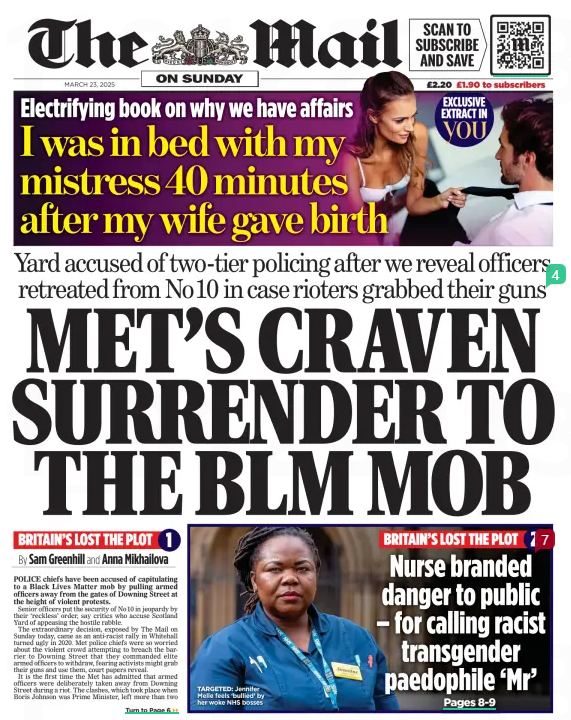
![Nurse branded danger to public – for calling racist transgender paedophile ‘Mr’ So guess who was investigated by the NHS and labelled a danger to the public The Mail on Sunday23 Mar 2025By IAN GALLAGHER CHIEF REPORTER TARGETED: Jennifer Melle feels ‘bullied’ by her woke NHS bosses LIKE all good nurses, Jennifer Melle projects a mixture of benevolence and calm authority. Patients greet her warmly as she glides around St Helier Hospital in Carshalton, Surrey, dispensing smiles and soothing words. For as long as she can remember, nursing was her chosen profession. As a schoolgirl newly arrived from Uganda, she was told by her father that Britain was a place where she could fulfil her dreams. Taking nothing for granted, she worked hard, gratefully seizing every opportunity. Now aged 40 and a mother of three, she is universally liked and respected. Not once in her 12-year career has she received a complaint. That, at least, was the case until one day last year when a burly 6ft-plus convicted paedophile, shackled to two prison escorts, shuffled into Ms Melle’s ward and loudly complained about a urinary problem. Legal reasons prevent Patient X’s identification, though why this person, who was jailed for grooming young boys, is afforded such protection will doubtless confound many. Not least because that night, in a fit of rage, Patient X screamed racist abuse at Ms Melle – calling her the N-word three times. She says: ‘It was terrifying. I’d never been called that word before. And I thought I was going to be attacked.’ At one point Patient X lunged towards her, straining against chains. ‘The whole thing – the terrible racial abuse, the aggression, which all happened in front of patients and staff – left me traumatised. And I was only trying to help.’ IT IS what happened next, though, that truly beggars belief. One might imagine that on hearing that one of its black employees was on the receiving end of possibly the most insulting and inflammatory slur in the English language, the diversity-obsessed NHS would back her to the hilt. Instead, her bosses decided she was in the wrong. In the eyes of Epsom and St Helier University Hospitals Trust, the greater sin was that Ms Melle had referred to Patient X – who was born male but now identifies as a woman – as ‘mister’ and ‘he’ during a phone call with a doctor. It was this which prompted Patient X’s aggressive outburst. Afterwards, Ms Melle was investigated and disciplined and, having been labelled a potential risk to the public, now fears losing her job. She wonders what happened to the ‘England of fair play’ of which her father once spoke. After being given a final warning by the trust, she received a letter from the Nursing and Midwifery Council (NMC) last month saying it was investigating concerns about her fitness to practise because she ‘referred to a patient in a manner inconsistent with their gender identity’. Yet it is one of the ironies of this case that Patient X had exploited gender identity by posing as a teenage girl online to incite under age boys to perform sex acts. Ms Melle says: ‘I was put at risk, but I am being treated like a criminal. Sadly, if you put your head above the parapet and speak truthfully on these issues in the NHS, the risk is that you will be knocked down, punished severely and demoted. The message to me during the investigation was that I should put up with extreme racism and deny biological reality and my deeply held Christian beliefs for the sake of inclusivity.’ Culture wars’ excesses abound and to some extent we have grown inured to them. But Ms Melle’s experience, say campaigners, is ‘on a whole new disturbing level’. Last night there were demands for urgent government intervention. In an unprecedented legal action, meanwhile, Ms Melle is suing the hospital trust for harassment, discrimination and human rights breaches. It is, of course, a case in which the NHS once again risks being accused of sacrificing common sense on the altar of gender ideology, and follows that of eight nurses from Darlington who took their trust to court after being forced to share a changing room with a biological man who identifies as a woman. There is also the ongoing case of the nurse suspended after complaining about a trans medic using her female changing room. Sandie Peggie was put under a disciplinary investigation for a year by bosses at Victoria Hospital, in Kirkcaldy, Fife, after she objected to sharing the facility with Dr Beth Upton. No doubt other battles lie ahead. With so many contradictory voices fighting to be heard, it is easy to see why many find the transgender debate difficult to navigate. Even judges were issued with official advice last month. They were warned it is now ‘extremely inappropriate’ to refer to male rapists who say they identify as women by their preferred pronouns. Yet as it stands criminals are free to pick their gender because the Government refuses to force police to record biological sex. ‘It is a muddle,’ says Ms Melle. ‘I just call people by their first names, that is my way round this.’ That is indeed how she planned to address Patient X whose preferred name – a girl’s name – was written on the white board above her hospital bed on May 22. That day Ms Melle was working a night shift. The previous day she and her colleagues learned that Patient X was arriving for treatment from a men’s prison. Ms Melle was shocked to learn of the patient’s crimes but resolved to deploy the same courtesy, professionalism and care as she would with anybody else. In the event, she wasn’t assigned to Patient X and the start of her shift proved uneventful. At 10pm however a colleague, in some distress, approached Ms Melle saying that Patient X wanted to self-discharge. ‘X was shouting and upsetting other elderly and vulnerable patients on the ward,’ says Ms Melle. A doctor was called for guidance but had not yet responded. As the senior nurse on the ward, Ms Melle decided to take charge. When her colleague finally got through to the doctor, Ms Melle asked to speak to him, taking the call in the corridor just outside Patient X’s room. Overhearing the conversation, Patient X began screaming in protest at Ms Melle’s use of the word ‘mister’. The prisoner shouted: ‘Do not call me mister, I am a woman!’ Ms Melle says the conversation with the doctor needs to be placed in context. Even if she was prepared to use alternative pronouns, she says it would have been absurd because the discussion related to a catheter – for a male – which needed to be removed. ‘This was a real-life medical scenario that required accurate terminology to avoid any doubt between medical professionals,’ she says. Finishing the call, she stepped inside X’s room and found the patient pacing up and down. Ms Melle politely said: ‘I am sorry I cannot refer to you as “her” or “she”, as it’s against my faith and Christian values but I can call you by your name.’ She then began to relay the doctor’s advice, but was met with escalating abuse. ‘Imagine if I called you n ***** ?’, Patient X screamed. ‘How about I call you n ***** ? Yes, black n ***** ’ Ms Melle warned that if the vile abuse persisted, she would have to call security. ‘X lunged at me, getting really close, a few feet away, before the guards intervened,’ she says. Patient X then tried to follow her, shouting: ‘I want your name and NHS number, and I am going to report you to the police for homophobia.’ Though profoundly distressed by the confrontation, Ms Melle, later forced herself to return to X’s room with painkillers which calmed the patient down. It is worth noting here that a white colleague had also referred to Patient X as a male but was not abused for doing so. At the end of her shift, Ms Melle found herself still shaking as she travelled home on the bus. As she replayed the incident in her mind, a colleague who had taken over her shift rang her mobile to say that Patient X had been shouting for her and threatening to make an official complaint. On her next shift, Ms Melle was taken aside by a ward manager and asked to make a statement. She explained she was still feeling traumatised. But the manager insisted that she still had to respect equality and diversity. Ms Melle said she had no issues with people’s sexuality but asked where the respect was for her Christian beliefs and said that she ‘could not deny biological reality’. But an investigation later concluded that ‘the [NMC] code of conduct outlines that in order to treat people as individuals and to uphold their dignity nurses should avoid making assumptions and should recognise diversity and individual choice.’ The code further states that nurses should ‘not express your personal beliefs (including political, religious or moral beliefs) in an inappropriate way. Therefore, although [Ms Melle] felt unable to identity Patient X using the preferred pronouns due to her religion... it could be perceived that [Ms Melle’s] actions could… be seen as a potential breach of the code’. She was accused of ‘not respecting the patient’s preferred identity’ and told her actions and behaviour had ‘fallen short of the trust’s value of respect’. Summoned to a disciplinary hearing in October, Ms Melle was given a final written warning and referred to the NMC. After the incident, she was denied overtime which has affected her financially. With her career, livelihood and reputation now at serious risk, she says she was faced with no alternative but to file a legal claim. She says that the NHS has unlawfully interfered with her rights under the European Convention on Human Rights to freedom of thought, conscience and religion. Ms Melle, who says she has never previously had any issues with transgender patients, says: ‘I am devastated by how I have been treated and believe I am being institutionally abused, harassed, bullied and racially discriminated against. Ever since I have expressed my Christian beliefs, I have been a marked woman. ‘I do not feel supported following the racial abuse and threat of physical violence I received from the patient. I remained professional throughout and always treat each and every individual with dignity and respect. My conduct throughout this incident and during my career has been fully compliant with the code.’ Andrea Williams, chief executive of the Christian Legal Centre, which is supporting her case said: ‘The NHS appears to remain captured by transgender ideology to the point it is prepared to back a convicted paedophile, who was clearly very disturbed and shouting racist comments, over the Christian nurse. ‘We thought we had seen it all when it comes to controversial legal cases on these issues, but what Jennifer is experiencing at the hands of this ideology is off the scale and on a whole new disturbing level. Jennifer loves Jesus and is a talented nurse who should be supported and protected, not investigated and silenced. The trust cannot force compelled speech on their staff and an urgent U-turn and apology is needed. ‘We would ask Wes Streeting, as Health Secretary, to investigate what is happening here. ‘He is already involved in the Darlington nurses’ case, and has previously said he is “horrified” by how they are being treated. It’s time for Government intervention on this matter. ‘It’s time for the Government to stop equality and diversity policies being weaponised in the NHS to punish innocent nurses just doing their job. ‘We will stand with Jennifer for as long as it takes for her to receive justice and with any other nurses who are discriminated against due to this dangerous ideology.’ An Epsom and St Helier University Hospitals NHS Trust spokesperson said: ‘These matters are still subject to ongoing internal proceedings, so it wouldn’t be right for us to comment further.’ I’m being abused, bullied and face racial discrimination It’s time to stop equality policies being weaponised Article Name:Nurse branded danger to public – for calling racist transgender paedophile ‘Mr’ Publication:The Mail on Sunday Author:By IAN GALLAGHER CHIEF REPORTER Start Page:8 End Page:8](https://substack-post-media.s3.amazonaws.com/public/images/832944e7-6ae7-4278-970f-07ecb1171957_1224x780.png)
24 Monday Total: 2
The Guardian [1]

Telegraph [1]
![Nurse branded ‘danger to public’ for calling trans paedophile ‘Mr’ The Daily Telegraph24 Mar 2025By Anya Fielding Jennifer Melle had been repeatedly called a n----- by the patient who was a trans prisoner AN NHS nurse was punished after accidentally addressing a transgender paedophile as “Mr”. The paedophile, a patient from a high-security men’s prison, called Jennifer Melle, 40, a “n-----” three times during an aggressive tirade at St Helier Hospital in Carshalton, Surrey. But it was Ms Melle who was investigated and disciplined by the hospital in October 2024, with a final warning and a referral to the Nursing and Midwifery Council. Now she is filing a legal claim against the Epsom and St Helier University Hospitals Trust for harassment, discrimination and human rights breaches. Ms Melle said: “Ever since I have expressed my Christian beliefs under extreme pressure, I have been a marked woman.” Last year, the patient, known only as Patient X, arrived from a men’s prison at Ms Melle’s ward to receive treatment for a urinary problem. During the evening shift, a colleague told Ms Melle, the senior nurse on staff, that the patient wanted to self-discharge and a doctor was called for guidance. Ms Melle spoke to the doctor on the phone outside the patient’s room, during which Ms Melle referred to the patient as “Mister” and “he”. She said she was discussing a catheter, for a male person, which needed to be removed, adding: “This was a reallife medical scenario that required accurate terminology to avoid any doubt between medical professionals.” Overhearing Ms Melle, the patient who was born a man but identified as a woman, took issue with the male pronoun and title. The nurse replied that she was “sorry I cannot refer to you as ‘her’ or ‘she’, as it’s against my faith and Christian values but I can call you by your name.” The patient began to verbally abuse the nurse, saying: “Imagine if I called you n-----? How about I call you n-----? Yes, black n------.” The patient also lunged at her despite being restrained and threatened to make a complaint, she said. Ms Melle said: “It was terrifying. I’d never been called that word before. And I thought I was going to be attacked.” Last month, Ms Melle received a letter from the Nursing and Midwifery Council, which is assessing her ability to practise. It says its code of conduct states nurses should “not express your personal beliefs (including political, religious or moral beliefs) in an inappropriate way. Therefore, although [Ms Melle] felt unable to identify Patient X using the preferred pronouns due to her religion... it could be perceived that [Ms Melle’s] actions could…be seen as a potential breach of the code”. Ms Melle has denied there was any breach of the code and said that a white colleague also referred to the patient as a male but suffered no abuse or investigation. She said: “My conduct throughout this incident and during my career has been fully compliant with the code. “I have been put at risk, but I am being treated like a criminal. Sadly, if you put your head above the parapet and speak truthfully on these issues in the NHS, the risk is that you will be knocked down, punished severely and demoted.” Christian Legal Centre is supporting Ms Melle’s legal claim. Andrea Williams, the centre’s chief executive, said: “The NHS appears to remain captured by transgender ideology to the point it is prepared to back a convicted paedophile, who was clearly very disturbed ‘The NHS appears to be prepared to back a convicted paedophile over the Christian nurse’ and shouting racist comments, over the Christian nurse. “Jennifer Melle was genuinely doing her best while not wanting to deny her Christian faith and biological reality. “We would ask Wes Streeting, as Health Secretary, to investigate what is happening here. He is already involved in the Darlington nurses’ case, and has previously said he is ‘horrified’ by how they are being treated. It’s time for government intervention on this matter.” Eight nurses at Darlington Memorial Hospital are suing the County Durham and Darlington NHS Foundation Trust, their employer, for sexual discrimination and sexual harassment after Rose Henderson, a transgender nurse, was allowed to use a female changing room. A spokesman for Epsom and St Helier University Hospitals NHS Trust said: “These matters are still subject to ongoing internal proceedings.” Article Name:Nurse branded ‘danger to public’ for calling trans paedophile ‘Mr’ Publication:The Daily Telegraph Author:By Anya Fielding Start Page:6 End Page:6](https://substack-post-media.s3.amazonaws.com/public/images/0233432d-e03d-4382-a0ff-db5f69bdbbcb_1519x445.png)
25 Tuesday Total: 4
Daily Mail [2]
Telegraph [2]
26 Wednesday Total: 4
The Guardian [1]
Telegraph [3]
27 Thursday Total: 8
The Times [4]
![Professor endured smears and ostracism in ‘medieval’ ordeal Sanchez Manning, Nicola Woolcock Kathleen Stock quit after aggressive behaviour from students who labelled her transphobic. Police were so alarmed she was advised to employ security guards Next image › Vindication, elation and relief are perhaps just a few of the feelings that washed over Kathleen Stock when she received the news that the University of Sussex had been fined almost £600,000 for failing to uphold freedom of speech. The journey to this ruling handed down by the Office for Students has, however, come at significant personal cost for the philosophy professor. Stock resigned from the university more than three years ago after a sustained campaign of bullying and harassment over her views on transgender issues. Her battle to express opinions that some might disagree with but which others regarded as entirely reasonable had been long and traumatic. Her tribulations began as far back as 2018 when she decided to question in an online article the government’s proposed policy to allow transgender people to legally self-identify as their chosen gender. She soon found herself on the receiving end of angry accusations of transphobia and bigotry, as have so many others since who have challenged the notion of men being able to simply declare themselves to be women. Stock has been clear that she is not in any way against transgender women or indeed the Gender Recognition Act, the law that allows people to be legally classified as the opposite sex to the one they were born. However, she does believe there should be some form of “gatekeeping” in this process. She also believes that society should be free to examine the effects that prioritising the concept of “gender identity” over biological sex may have, particularly in terms of the costs to the rights of women and the health of children who say they wish to change gender. In December 2019 Stock cemented her reputation as a sceptic of certain tenets of trans activism by co-signing a letter, along with more than 20 other academics, accusing the charity Stonewall of suppressing academic freedom by encouraging a “censorious” approach to gender identity. After going public with her views, she quickly became enemy number one on the campus where she was lecturing. There were soon students brandishing placards declaring “Transphobia now in STOCK at Sussex”, condemnations from the students’ union over tolerating “hate”, and attempts to have her sacked, along with a steady stream of online abuse. The smears and ostracism, from both students and her colleagues, continued until October 2021 when she was informed by police that matters had deteriorated to the point where she might need to have security guards on campus. Officers alerted her to stickers being put around the university’s buildings bearing aggressive messages such as “transphobic s*** that comes out of Kathleen Stock’s mouth”. The police advised that it could be time to take precautions to avoid potentially more serious attacks from students. “The police have advised me to have cameras on my front door,” Stock said in an interview. “They have put a marker on my phone, if I phone 999 there is an automatic callout to my house. I am vulnerable on campus. The police implied that I would need security guards accompanying me to go back on campus.” It emerged that an anonymous group had been formed with the express aim of getting Stock fired. Every time she walked on campus an increasingly disturbed Stock was faced with dozens of posters plastered across the walls, carrying messages such as “Kathleen Stock makes trans students feel unsafe” and “we’re not paying £9,250 a year for transphobia”. On other occasions masked protesters held up banners under burning flares saying “Stock Out”, as a deluge of critics lambasted her online under the hashtag #ShameOnSussexUni. Months later, hundreds of her fellow academics signed an open letter criticising the decision to award Stock an OBE for her services to education. The missive, which garnered more than 600 signatures, concluded that her contribution to the gender debate had been “transphobic fearmongering” rather than “valuable scholarship”. Stock announced, in the same month she was advised to employ security, that she was stepping down from her post. She tweeted: “This has been an absolutely horrible time for me and my family. I’m putting it behind me now.” However, speaking later about her experience, the academic told Radio 4’s Woman’s Hour: “I don’t know if I can explain it but you have to imagine yourself at your workplace — all eyes are on you, all fingers seem to be pointing at you, it’s like a medieval experience. At that point I wasn’t scared so much as incredibly distressed.” After the fallout around Stock’s resignation, Sussex’s vice-chancellor, Adam Tickell, wrote to staff saying that the university had “vigorously” defended her right to “exercise her academic freedom and lawful freedom of speech, free from bullying and harassment of any kind”. Those words ring somewhat hollow now in light of the regulator’s decision to impose the £585,000 penalty — the highest yet recorded — on the University of Sussex for its “serious and significant” failings relating to free speech and equality in Stock’s case. There has been a more than three-year wait for this outcome. Universities failing on free speech are warned of seven-figure fines Nicola Woolcock - Education Editor Universities could face fines of millions of pounds for free speech breaches, the higher education regulator has warned. The University of Sussex has been fined more than half a million pounds for failing to uphold free speech in the wake of the departure of the philosophy professor Kathleen Stock — a record amount. But the university was given a significant discount because it was the first infraction of its kind, the Office for Students (OfS) said. Instead it could have been asked to pay more than £3 million. Other universities are likely to incur much higher fines if they fall foul of the regulator in a similar way. Stock said that many more universities had policies that included the clauses that the OfS had ruled against. However, Sussex’s vice-chancellor, Professor Sasha Roseneil, said the OfS inquiry had been flawed, politically motivated and “Kafkaesque”, adding that university staff had been forbidden to talk about the case until the ruling, affecting their own free speech. She said this meant that she could not give evidence to the House of Lords on the issue. In a briefing, the OfS was unclear about whether it had spoken in person to anyone at the university, other than Stock, who was accused of transphobia because of her views on sex and gender and left the university in 2021 after a three-year campaign of harassment. The OfS said that there had been “serious” failings and defended its investigation, which was conducted mostly in writing. Arif Ahmed, the regulator’s first director of free speech, said: “We have found that the University of Sussex’s trans and non-binary equality policy statement meant that students or staff wishing to express or discuss lawful views, including gender-critical views, could have been concerned about breaching that policy and facing potential disciplinary action.” The OfS spent three and a half years investigating the university. It said that the university’s governing documents did not uphold freedom of speech and academic freedom. It also found failings in the university’s management and governance processes. These constituted two breaches of the conditions of registration set out by the OfS. Stock said: “I’m very pleased to see [the ruling],” adding that “there is no doubt in my mind that these policies chill lawful speech”. However, the university described the regulator’s findings as “egregious” and said that the ruling would prevent universities from tackling harassment. Arguing that the OfS was “perpetuating the culture wars”, Sussex said it would mount a legal challenge. Don’t rely on census for trans data, ONS advises The latest census should not be used to estimate the size of the trans population in England and Wales, the official statistics body has said. The Office for National Statistics (ONS) has for the first time advised against using some figures published as part of the 2021 census regarding gender identity, amid concerns some respondents had not understood what they were being asked. The ONS first acknowledged in 2023 there might have been some confusion among people answering the gender identity question and last year confirmed a downgrading of the data. The statistics body said last September it had requested that the estimates from the 2021 survey be reclassified from being official statistics to “official statistics in development”. That census was the first time the voluntary question on gender identity was included in the wide-ranging survey, which takes place every ten years. The question asked: “Is the gender you identify with the same as your sex registered at birth?” It showed that 262,000 people in England and Wales, 0.5 per cent of the population aged 16 and over, reported that their gender identity was different from their sex registered at birth. In the latest update, the ONS divided its advice on using the gender figures into three categories related to how much confidence it had in the statistics. In its first category, it said the 2021 estimates could be used to provide a “broad indication” of the overall size of the trans population across England and Wales. However, in its second category it said there was a “high level of uncertainty” if using the estimates to make geographical comparisons of the proportions of trans people between local authorities, regions and at country level for England and Wales. It also urged caution when estimating the proportion of the trans populations in different ethnicities and religious groups. But in its strictest category, the ONS said the 2021 estimates “should not be used” to estimate the numbers of trans populations in local areas. It added that these estimates should not be used to provide insights into the relationship between identifying as trans and having a lower level of English language proficiency or different qualification levels. The ONS said it was engaging in work across the UK “to build a robust and detailed understanding of user and respondent needs on the topics of sex and gender identity”. It added that those findings would be published later this year.](https://substack-post-media.s3.amazonaws.com/public/images/7da7fb67-ea70-4a44-80cb-f57beda7ad7f_671x851.png)
Daily Mail [2]
Telegraph [2]
28 Friday Total: 4
The Guardian [1]
![University taking legal action over free speech fine The Guardian28 Mar 2025Richard Adams Education editor PHOTOGRAPH: STUART ROBINSON/ UNIVERSITY OF SUSSEX Sasha Roseneil, the vice-chancellor of the University of Sussex, told the Guardian the Office for Students has ‘just wanted to prosecute, even persecute us’ The University of Sussex is taking legal action to overturn the record fine levied by England’s higher education regulator, with Sussex accusing the regulator of seeking to “persecute” it rather than solve problems. This week the Office for Students said it would fine Sussex £585,000 for two breaches of its regulations related to freedom of speech and governance. This was after a three-and-ahalf-year investigation into the resignation of Prof Kathleen Stock, the target of protests at Sussex over her views on gender identification and transgender rights. Sasha Roseneil, who joined Sussex as vice-chancellor a year after the investigation began, said she was initially shocked by the OfS’s judgment but is confident that the courts will find in Sussex’s favour. “I think our position is extremely strong, and I think they will lose a judicial review,” Roseneil said. Sussex intends to challenge the size of the fine – 15 times larger than any previous penalty levied by the OfS – through a tribunal, and also seek a judicial review of the OfS’s judgment. Roseneil revealed to the Guardian that Sussex had substantially overturned sections of the OfS’s interim judgment, delivered last year, which would have fined the university £1m for a string of additional allegations. Roseneil said: “The provisional decision was much, much worse, and we rebutted it … We sent back a 2,000-page response, and they have reduced the fine from the provisional decision. They haven’t explained why they’ve dropped any of it but one has to imagine they realised that they weren’t on strong legal grounds.” An OfS spokesperson said: “We are confident in the decisions made in this case and will vigorously defend any legal action.” Roseneil said the OfS had refused to meet with Sussex’s leadership or interview those involved, with the exception of Stock. Instead the OfS relied on tens of thousands of documents and papers. Roseneil said that when she arrived at Sussex in 2022 she sought a meeting with OfS executives to discuss the investigation but was turned down. Arif Ahmed, the OfS’s director for freedom of speech, defended the regulator: “There may have been occasions where [Sussex] wanted to see somebody, and in fact that was done in writing instead, I’m quite sure that could well have happened. But the engagement would nevertheless have happened in the sense that we communicated with them and they communicated with us.” But Roseneil said the OfS has refused to tell Sussex if its amended policies meet its conditions: “We have been up for working with the OfS on these difficult issues but they have just wanted to prosecute us, even persecute us, on this. It’s a very sorry state for a regulator to be doing this rather than actually trying to help the sector work better.” The OfS’s final ruling focuses on a trans and non-binary equality policy statement passed in 2018, which the regulator argued had “a chilling effect” that could result in self-censorship by staff and students. Stock wrote yesterday that the “most egregious” part of the policy statement had been a clause that said “any materials within relevant courses and modules will positively represent trans people and trans lives”. Stock wrote: “Over time, my teaching about sex and gender in feminist philosophy grew increasingly cautious.” Roseneil said: “Obviously she left long before I arrived but it is deeply regrettable that Kathleen [Stock] wasn’t supported to the extent that she felt able to stay working at Sussex. I regret that.” But she said the OfS had erred by inflating the statement into a “governing document”. Roseneil said the OfS policy was a “sort of libertarian, free speech absolutism” that meant universities were unable to apply rules for anything other than unlawful behaviour or speech. “We can’t now say that we will remove or take down antisemitic or anti-Muslim propaganda because not all such propaganda is illegal,” she said. Article Name:University taking legal action over free speech fine Publication:The Guardian Author:Richard Adams Education editor Start Page:9 End Page:9](https://substack-post-media.s3.amazonaws.com/public/images/73d7c1bf-41f9-43f6-942a-f37ca154a27f_1163x604.png)
The Times [1]
![A mother’s strength after an unbearable loss TV review Carol Midgley Esther Ghey, mother of murdered Brianna, was inspirational Next image › Brianna: A Mother’s Story ITV1, 9pm ★★★★☆ What an impressive woman Esther Ghey is. How many of us would find the strength and dignity to carry ourselves as she has done after the sadistic murder of a child? Not to mention the empathy she has for the mother of one of her daughter’s killers, with whom she has formed a relationship, speaking to her most weeks. Remarkable. But I’m glad that the excellent, inspiring Brianna: A Mother’s Story, in which her intelligence and compassion shone through the bleakness, did not spare us any of the horror of what two barbarous killers, aged just 15, did to Brianna. Let us never, ever forget that. Everyone is talking about Adolescence, which they should be because it’s brilliant, the story of how a child is stabbed to death by another child and the terrifying, malign impact of the internet, especially influencers and social media, on immature minds. But it is a drama. What happened to Brianna is devastatingly real. The story within Adolescence is different, tackling the effect of toxic masculinity and online bullying on children, but here, with Brianna’s murder, we saw how online torture videos normalised violence and desensitised one of her killers, Scarlett Jenkinson, to the savagery she went on to inflict. That her accomplice Eddie Ratcliffe coldly texted about the plan to kill Brianna, who was trans, “I want to see if it screams like a man or a girl”, is the stuff of nightmares. As is Jenkinson saying that she wanted to keep one of Brianna’s eyes as a trophy. “They have pretty eyes.” You may recall those CCTV images of Brianna getting off the bus, meeting Jenkinson, who she thought was her friend, outfit for the day chosen, make-up done. I kept thinking what it must be like for Ghey to see those pictures repeatedly, her daughter at that point still safe, walking trustingly into those woods to be stabbed 28 times with a hunting knife. But what a gargantuan act of strength to channel this pain into helping lessen the risks for other people’s children, partly by campaigning for meditation practice in schools, something she says “saved me”. “I have a massive hole in my heart. Everything I’m doing is not necessarily filling that hole but in a way I feel like it’s bringing Brianna on the journey with me,” she said, which made me cry because it’s her way of continuing to mother her child. Brianna had seen websites encouraging self-harm and disordered eating. I’m not sure why the film needed to switch to the Bronx in New York to show the consequences of young knife crime. There are, tragically, plenty of examples of this at home. But Ghey saw how mindfulness was being used in schools there and met Arturo Béjar, a former employee of Meta, which owns Facebook and Instagram, who blew the whistle on the company, saying it turned a blind eye to the harm it causes. What he said was spot on. Letting them roam the internet is “like sending your kids into the worst neighbourhood, where [they are] going to be sold drugs, sexually harassed, see things that [are] going to scar them’’. And yet we seem helpless to stop it. That Esther Ghey, after all the pain she has suffered, wants to help your children by “planting seeds of resilience and empathy” is humbling.](https://substack-post-media.s3.amazonaws.com/public/images/e4b33173-dad7-4c0f-9e57-926ff3d91814_1045x611.png)
Daily Mail [2]
![How dim-witted! Academic in free speech row gives her withering verdict on trans policies stifling UK’s universities Daily Mail28 Mar 2025By Eleanor Harding Education Editor THE feminist academic at the centre of a free speech row at Sussex University has hit out at ‘dim-witted’ trans policies in the higher education sector. Kathleen Stock, who was forced by bosses to censor her gender-critical views and was eventually hounded out of her job, said the same is happening on campuses ‘across the land’. She said she is now ‘disgusted’ by academia and accused university managements of pandering to ‘moronic campaigners’. Sussex was fined £585,000 this week by the Office for Students for failing to uphold free speech during the furore. The OfS criticised the university’s transgender equality policy, which forced tutors to ‘positively represent trans people and trans lives’ in their teaching, and banned ‘transphobic propaganda’. It said this had a ‘chilling’ effect on Professor Stock, who taught philosophy there until 2021, and other staff and students. Students took against Professor Stock because she believes biological males should not have an automatic right to women-only spaces if they identify as female. Writing in a blog for website UnHerd yesterday, she described the trans policy as ‘egregious’. She said: ‘This seemed to me more like an instruction from a client to an advertising agency than a serious pedagogical commitment... [It] set the tone for nearly everything that would then happen to me over the next few years, emboldening those at the university who were already against me, and enfeebling the morale of the rest.’ Professor Stock added: ‘Many of these dim-witted, claustrophobic policies are still in place in universities across the land, right now’. Guidance on University College London’s website states: ‘If a trans person informs a staff member that a word or phrasing is inappropriate or offensive, then that staff member should take their word for it, and adjust their phraseology accordingly.’ A policy on Leeds University’s website says: ‘The university will strive to ensure that its curriculum does not rely on or reinforce stereotypical assumptions about trans people and that it contains material that positively represents trans people and trans lives.’ The OfS has warned similar action could be taken against other universities, with higher fines. Sussex has vowed to legally challenge the OfS’s decision. A university spokesman said it had in 2022 removed the phrase criticised by the OfS from their trans policy statement, and claimed it had ‘consistently and publicly defended [Professor Stock’s] right... to express her gender critical beliefs’. UCL said its guidance ‘does not impact on [its] deep commitment to freedom of speech’. Leeds was contacted for comment. Article Name:How dim-witted! Publication:Daily Mail Author:By Eleanor Harding Education Editor Start Page:10 End Page:10](https://substack-post-media.s3.amazonaws.com/public/images/c0231bd7-17d9-40df-a44f-dbc2c175bf56_908x732.png)
29 Saturday Total: 2
The Times [1]
Telegraph [1]
30 Sunday Total: 5
The Sunday Times [1]
![The girls with their banners, where are they now? Academic Kathleen Stock quit after being accused of transphobia. Now that her former university has been fined £585,000, she wants a public conversation with her critics, not a public shaming Rosamund Urwin Kathleen Stock resigned after students at Sussex University demanded her removal Next image › Kathleen Stock wants to speak to the students who once tried to get her sacked. The philosopher and writer, who resigned from the University of Sussex in 2021 after being accused of transphobia and harassed for her views on gender, was vindicated last week when her former employer was fined £585,000 for failing to uphold freedom of speech. “I’d love to know what those protesting against me think now,” she says in her first interview since the ruling. “I wouldn’t shame them — I’d have a public conversation with them. Well, not the dicks who threatened me, but the girls with their banners — where are they now?” I meet Stock, 52, in her Sussex home. Born in Scotland, she studied French and philosophy at Oxford, before joining the University of Sussex in 2003. There, she toiled in academic obscurity, writing about aesthetics and imagination, until the gender wars came to campus, turning her into a leading light of the gender-critical movement: a heroine to many feminists but a heretic to transgender ideologues. Stock is measured in her language, emphasising that she doesn’t see herself as a victim in this story. It began in 2018, when she wrote an article questioning the government’s proposed policy to allow transgender people to self-identify as their chosen gender; Stock was accused by students of “transphobia”. When her book about gender identity, Material Girls, was published in 2021, students demanded her removal and some claimed they felt “unsafe” on campus. It took considerable courage for her to speak out then. “I feel braver than I used to feel,” she says. “I’ve tested myself.” Stock describes her treatment by colleagues and students in the months preceding her resignation as “primitive”: pointing, whispering, ostracism and threats. She was advised to install CCTV outside her home. While this was happening, bouquets flooded into the Sussex post room from supporters. One colleague publicly backed her: a military historian she has never spoken to. He put a sign on his door which read: “I stand with Kathleen Stock.” When she left, she asked that the flowers be given to him. I feel braver than I used to feel Now, her former employer is again in the spotlight after it was fined by the higher education regulator, the Office for Students (OfS), which criticised its policy statement on “trans and non-binary equality”. The OfS said Sussex’s assertion that “transphobic propaganda ... will not be tolerated” could have a “chilling effect” and lead staff to “self-censor”. Sussex is the first university to be fined under new powers given to the OfS in January. It has vowed to challenge the size of the fine and the OfS’s findings. Stock is “surprised” by its combative response. She now calls herself a “recovering academic” and makes her living from writing. What made her so sure in her opposition to gender self-ID? In part she says it was being a lesbian, which meant she knew biological sex mattered to sexual orientation, and that she felt immune to the “bewitching” power of gender nonconformity. But her background in philosophy played a role too. “I didn’t believe in the power of words utterly to change reality,” she says. Universities were once bastions of free speech — how did they become places of censorship and moral cowardice? “Some disciplines in the humanities and social sciences became extremely ideological in the 1970s,” she replies. “When I was trying to raise the alarm about this to philosophers, I was stuck between the ideologues attacking me and a bunch of others who thought, ‘Why are you wasting your time with this when it’s clearly stupid?’ But I could see it would have massive implications if we didn’t stop it.” Stock emphasises this is not unique to Sussex: “I think there’s contempt in universities for ordinary people’s attitudes ... on race, immigration or feminism.” But she also sees signs this is improving on campuses, with academics setting up groups to promote free speech. The other side of the gender debate has “gone to ground”, she adds, a shift she attributes in part to the work of grassroots campaigners — Fair Play for Women, Sex Matters and Transgender Trend. But there’s a second, more immediate catalyst too. Boys aren’t just naughty girls Stock predicts there will be medical negligence cases in other countries, and possibly action against the NHS. At the Tavistock, the clinic for children with gender dysphoria that closed last year, Stock feels warning signs were overlooked. “[The clinicians] recognised things that were red flags: that lots of the [female] patients were responding to the demands of femininity, that it’s not science, that they were doing irrevocable things to kids’ bodies. But they just thought, ‘Oh, well’.” Hilary Cass’s critical report into what happened at the Tavistock also recommended a controlled trial for puberty blockers. Does Stock think it should go ahead? “No,” she says. “It’s like asking whether there should be controlled research on trepanning [drilling a hole in the skull to expose the brain]. There’s animal trials you can do that don’t involve experiments on live adolescents.” She thinks the trans movement peaked with millennials, that teenagers now are “just not into it in the same way”, and that in a decade it will be out of fashion. While she believes there are people who suffer from gender dysphoria, she thinks others experienced social contagion. “Gender dysphoria covers an enormous range of phenomena, from extreme mental health difficulties to narcissistic adolescent obsession,” she says. “On that end of the spectrum, [changing attitudes] might just chivvy people out of it, like, ‘This isn’t cool any more’.” Among her female students, she remembers widespread self-harming in the early 2010s, and thinks that a similar type of student would later identify as trans. “They would have scars down their arms,” she recalls. Stock is unpredictable in her views. She differs from many mainstream feminists and thinks that there are “hardwired differences” between male and female brains. “It’s a middle-class fantasy that we can just soft-power boys into being versions of girls, but boys aren’t just naughty versions of girls that need to read more books,” she says. “On average, they’re quite aggressive. They have bursts of testosterone.” While many feminists have no time for Jordan Peterson, Stock — who has two sons and a daughter — almost defends him. “He was quite good for boys — an acceptable father figure,” she says. “The progressive establishment acted like he was Andrew Tate. He got terribly condescended to by establishment liberal feminists, who made clear their dripping contempt for him.” More generally, she believes we inflate the influence of these figures, even Tate. “The media and academics act as though the ordinary person is stupid, ripe for the plucking. I know boys who are into Tate because he tells them that they can make money. We should understand the motives for people engaging this stuff, and not always panic.” She would like feminists eventually to move on from the trans fight into issues such as surrogacy or prostitution. Stock has moved on now too. Her next book will be opposing assisted dying. “It’s going to be a disaster,” she says of Kim Leadbeater’s bill. “You just know. Half the time [its supporters] are the same people as the gender stuff: rich liberals living in north London going, ‘It’d be nice to have a service that can off me in my penthouse.’ It’s the same basic impulse: hyper-liberalism and control of the body.” The bill’s implementation is now likely to be pushed back until at least 2029, reducing the chances of assisted dying becoming practice. “It’ll be back,” she says. “The campaigners will say to themselves that they can do better, because that’s the hubris of progressives.” Stock, no doubt, will be there to fight it.](https://substack-post-media.s3.amazonaws.com/public/images/bde47763-94f1-4be0-a671-29f10d883935_876x833.png)
Mail on Sunday [1]
Sunday Telegraph [3]
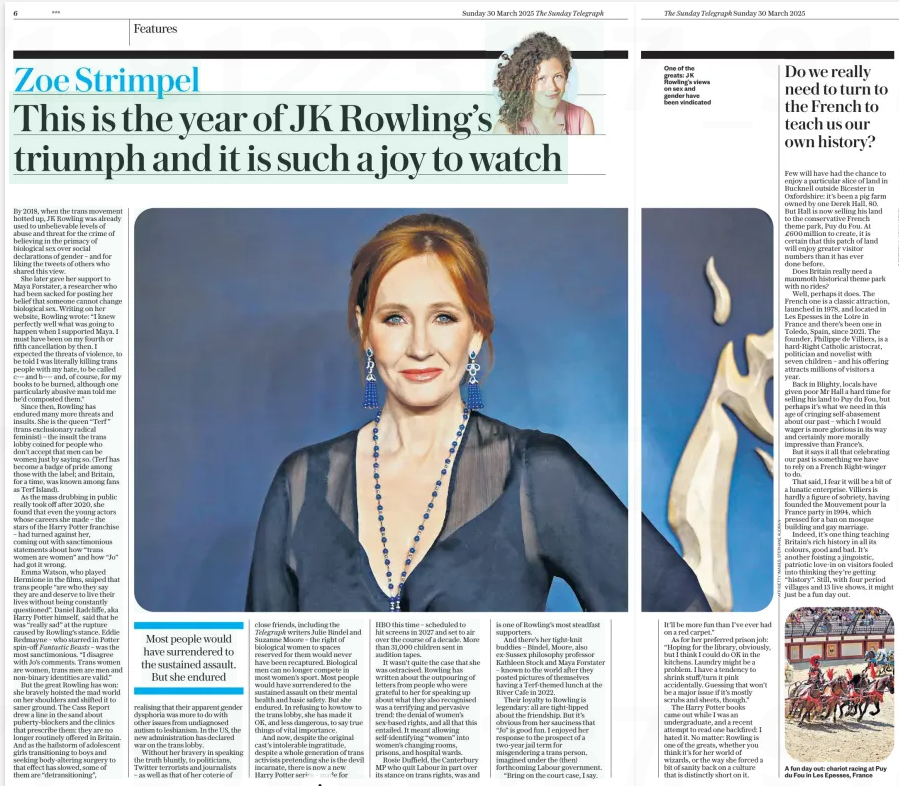
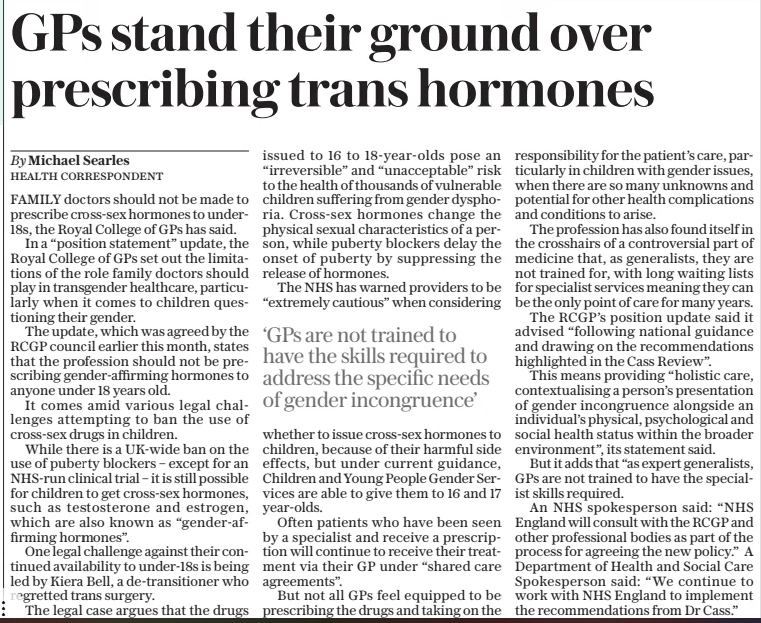
![It’s uncomfortable to admit, but Trump is right on trans issues The data scientist and author of a review on sex and gender talks to Judith Woods about academic groupthink, the ideological capture of the NHS, and Wes Streeting’s response The Sunday Telegraph30 Mar 2025Alice Sullivan On my way to meet Prof Alice Sullivan it occurs to me that if Marvel were dreaming up a new franchise, it probably wouldn’t alight on a quantitative data scientist as its new superhero. And that would be a terrible miscalculation. Her recently published Sullivan Review reveals that when it comes to liberating public bodies from “institutional capture” by trans activists and highlighting the dangerous lunacy of conflating sex with gender, our doughtiest defence is data. Sullivan, a professor of sociology and a quantitative data scientist at University College London, was commissioned by the previous Conservative government to investigate how data on biological sex is collected by public bodies after serious concerns were raised about the stranglehold of gender ideology in our key organisations. She was chosen to lead the review because of her specialist work on the topic and well publicised views on the need to record accurate data on sex. “Sex and gender identity are distinct characteristics and not interchangeable,” has always been her message. “But unfortunately people in a great many organisations don’t understand data collection as a discipline and have been taking advice from other people who don’t understand it either; the result is a mess. We need – we have a responsibility – to record both sex and gender identity.” She and her team carried out interviews, collated evidence and heard from whistleblowers too fearful of reprisals to speak out. What they uncovered was shocking; across other key organisations like the NHS, schools, the police and the Civil Service, factual information on biological sex has been replaced by subjective (and highly contested) feedback on gender identity since 2015. As a consequence “robust accurate data” has been lost, the review concluded. Criminals – including sex offenders – are being permitted to choose a self-identified “gender” rather than their biological sex and the police and courts are complying. Then there are the schools that immediately change children’s “gender” on IT systems if they self-identify as the opposite sex – often without consulting the parents. Civil servants have been hounded out for perfectly ordinary opinions on biological sex. Enter the Sullivan Review. For those longing to turn the tide on aggressive gender politics, this detailed 226-page document has drawn a long-overdue line in the sand. Maya Forstater, chief executive of pressure group Sex Matters, welcomed its findings: “This review is devastatingly clear about the harms caused by carelessness with sex data and a decade-long failure of the Civil Service to maintain impartiality and uphold data standards. The destruction of data about sex has caused real harm to individuals and research, and undermined the integrity of policymaking. Conflating sex and gender identity is not a harmless act of kindness but a damaging dereliction of duty.” Or, as transgender lobby group TransActual put it on its website: “This Review is providing an academic gloss on what is a political call to strip trans people of our hard-won rights to privacy, dignity, and respect in public spaces.” It’s the sort of binary response that has landed Britain in such a nonsensical quagmire in the first place. Sullivan has, in fact, called on organisations to record gender preference as well as sex when gathering data – but nuance has gone the same way as common sense. Thankfully, cometh the hour, cometh the quantitative data scientist in the shape of Prof Alice Sullivan, who is as far from a Gradgrindian number-cruncher as you can imagine. To my mind it all feels terribly bleak. But when we meet, in her corner of north London, where the magnolia trees are in full creamy bloom and the local coffee shop is so vegan I almost cause a riot when I unwittingly ask for “real milk”, Sullivan is in surprisingly high spirits. “I’m optimistic. I think this review marks a watershed. It has taken a long time but I really do believe we are beyond the point where we can be silenced. It’s the beginning of the end for no debate.” Wouldn’t that be nice? I can’t help suggesting that Donald Trump of all people may have had a part to play in changing the proverbial mood music surrounding gender issues. “As a life-long Leftie, it feels uncomfortable to be put in the position of agreeing with Donald Trump. But the fact is that he is simply saying that there are two sexes and that this matters, for example in prisons and sports. If Donald Trump says that the earth is round, should Leftists claim it is flat just to avoid being on the same side as him? This kind of tribal thinking has been horribly damaging to the Left. The idiotic positions that the Democrats took on these issues helped to gift the election to Trump. Mainstream politicians of all stripes need to learn from this that denying observable facts about the world is dangerous.” For years now Sullivan has refused to be silenced by gender militants who have bullied and threatened her online. Instead she has continued to focus on “biological truth” and has striven – not always successfully – to staunch the tide of “ideological capture”, which has seen LGBTQ+ networks within our key organisations mount successful, sustained campaigns to change the culture within them. “As a result, an atmosphere of fear has been created making people scared to speak out against or even discuss issues surrounding gender,” she says. “Bad decisions have been made by management because they have erroneously assumed these highly vocal activists represent far greater numbers than they do.” Later Sullivan happily confides she hasn’t had any death threats recently, which tells us everything we need to know about the toxic tactics employed by some trans militants who have somehow managed to weaponise “hurt feelings” and bully public servants into accepting a parallel reality. We meet in the week that the University of Sussex was handed a record fine of £585,000 by the Office for Students for failing to uphold freedom of speech. It came following a lengthy investigation into the university’s handling of the case of Kathleen Stock, a philosophy professor who resigned after being targeted by protests over her views on gender. “Kathleen Stock had a horrific level of abuse, and I’ve received nothing like that. By and large my peers have been very supportive but there have been exceptions and it is totally unacceptable that women are being horribly intimidated just for believing in biological sex.” But back to Sullivan. Five feet tall with bleached pixie-cut hair, when we meet at her north London home she is wearing a teal-coloured dress that matches the extravagant Designer’s Guild wallpaper in her straight-fromthe-pages-of-Living dining room. She takes me through the hallway hung with interesting art, to the bold modernist kitchen where on the breakfast table there are two lovely patterned plates and a recipe for linguine with fresh crab is open on a book stand – and it’s not even midweek! She laughs at my chippy indignation. But it later transpires she’s half Spanish (hence the good food) and has never wanted children (hence the glossy colour supplement interiors) so I am forced to retract my remarks about her being “a member of the metropolitan elite”. Sullivan, who lives with her mathematician husband John Armstrong, an academic at King’s College London, laughs a surprising amount. I find myself wondering aloud if that’s because it’s physically, or indeed metaphysically, impossible to be cancelled twice? She was famously no-platformed in late 2019 when a research methods seminar where she was due to speak, held by the National Centre for Social Research, was axed on the grounds “the topic was of too much public interest”. Sullivan rolls her eyes at the ridiculousness. “That is what I was initially told, although I’d never heard of something being called off because it was deemed too interesting,” she says. Her perceived misdemeanour was that of having “anti-trans views” because she had raised her head above the parapet and criticised the Office for National Statistics for failing to collect data on biological sex. When she was bluntly told she was the reason for the cancellation she broke down. “I cried,” she says. “I’m normally Captain Calm but I felt utterly bewildered that this was happening in my world, a world of sober data science. Data is about trust and once you lose trust, democracy itself is at risk. That way lies authoritarianism.” Sullivan was born and raised in Bristol. Her late Glaswegian father left school at 14 but became involved in the Trades Union movement. He took opportunities offered by the Workers’ Educational Association and moved to London, where he took five A-levels – he had no idea that three was the norm – and later completed a degree and then a PhD as a mature student, during which time he met Sullivan’s mother, who was from the Basque region. “My parents were both socialists,” she says. “But my dad, who died 20 years ago, also had a built-in bull---t detector which I think he passed on to me. He also had a mischievous sense of humour and there have been times when I would really have appreciated him being around so he could help me find the funny side of the more stressful things that have happened.” After reading PPE at Balliol College, Oxford, Sullivan undertook a Masters in sociology and then a PhD in the sociology of education. She took a job at the Institute of Education which became part of University College London and worked her way up from research officer to professor. And from 2010 to 2020 she was also director of the hugely important ongoing 1970 British Cohort Study, which followed the lives of around 17,000 people born in England, Scotland and Wales in a single week of 1970. Her involvement with gender issues began, as is so often the case, on a personal note. Both she and her husband are keen runners and often use the track at Hampstead Heath. In 2018 Sullivan discovered that moves were afoot to allow individuals to access areas such as the Ladies’ Pond and other facilities based on self-identification which gave her pause. “I use the changing rooms there and I thought, ‘That’s a bit much, you can’t just ID yourself into a woman’s space’. Then I saw the consultation document which was a really badly written questionnaire – and I care a lot about questionnaires.” Having thought long and hard about going public, she felt it was important so she contacted the local paper in Camden, which ran a story. But despite her best efforts, self-identification was introduced, giving transgender women the right to use the Ladies’ Pond and other facilities, a policy that still persists today. Meanwhile, as she became more familiar with grassroots feminist movements who were taking a stance against the eradication of sex in officialdom, the Office for National Statistics announced that it was rolling out a new, “inclusive” version of the sex question on the 2021 national census. This would allow respondents to answer according to their self-identified gender rather than their physical sex – thereby making a nonsense of its data collection. Sullivan took a stand – and garnered hate mail – when she criticised this bias in an open letter she organised in 2019. It was signed by more than 80 eminent academics from Oxbridge and Russell Group universities, pointing out that it would “undermine data reliability on a key demographic variable and damage our ability to capture and remedy sex-based discrimination and inequality”. The ONS refused to back down and in 2021 was taken to court by the feminist group Fair Play for Women and the judge found in the group’s favour, ordering changes to the census – only this week the ONS admitted that the number of trans people was “incorrectly recorded” in the latest census. The case highlighted just how tightly gender ideology had taken hold. “I was so young and naive,” Sullivan laughs, ruefully. “I genuinely thought that getting eminent data scientists and academics to sign an open letter would sort everything out. Surely everyone would agree? Then came the backlash.” Cue a volley of unpleasant messages on what was then Twitter, intimations of violence and death threats on Facebook. “It’s easy to ignore random strangers online but when it’s someone from the academic world, or professional people who should know better amplifying the voices of abusive trolls, it’s disappointing.” Throughout all this, Sullivan had no regrets. In 2023 she co-edited a book, Sex and Gender: A Contemporary Reader with the Oxford historian Selina Todd and has organised events on the subject – which other academics have sought to cancel, giving a lie to notions of free speech. But her commitment is undiminished. As a sociologist she is fascinated by, among other aspects, the sex divide when it comes to gender identity; at present there seems to be a spike in the number of biological girls choosing to identify as male. But without accurate data this can’t be understood. Similarly without reliable data on sex the world would have no idea about the gender imbalances in some societies where female babies are aborted. “One of the recommendations in the review is that the nonsensical expression ‘assigned at birth’ should no longer be used,” she says, which will have a great many punching the air in jubilation, myself included. “It’s a term that comes from the postmodern philosophical idea that sex is a purely social construct and is not real but assigned at birth. This is just bonkers. Sex is determined at conception and the fact it is observable in utero is why there were so many sex-selective abortions in China under the one-child policy.” But here in the West there are those who stubbornly insist on denying biology. Of all the outrageous instances of gender gerrymandering, one in particular stands out for Sullivan. During research for her eponymous review a paediatrician cited a mother who “changed” the sex of her child when it was still a baby. Within weeks of the birth she decided she wanted to bring up her newborn as the opposite sex and went to her GP to request a new NHS number and have it officially recognised in the sex she had chosen. The GP complied. When children’s social care was alerted, it denied there was any safeguarding issue. “When I heard about that case, I felt physically sick,” admits Sullivan. “I was appalled that an infant could simply be erased from NHS records and given a new identity with a new NHS number. It’s unbelievable, but it happened. The vast majority of parents are loving and responsible but it’s inevitable there will always be some who are attentionseeking and abusive – the scandal is that our institutions are not protecting children, because somewhere along the line it became taboo to challenge gender-identity theory.” Sullivan wasn’t the only one to react with visceral horror. The day after her review’s publication, Health Secretary Wes Streeting announced that from now on, no one under the age of 18 will be given a new NHS record. “It’s completely wrong that children’s NHS numbers can be changed if they change gender, and I’ve made it clear this must not happen,” he said. He acted swiftly but many commentators feel the rest of the Government has a long way to go when it comes to stamping out this extraordinary bias towards gender self-identification. “I’m delighted with the strong leadership Wes Streeting has shown,” says Sullivan. “It’s important that the Government as a whole tackles this issue systematically, as the need for accurate data doesn’t only apply to health.” But damningly – disappointingly – Home Secretary Yvette Cooper has refused to issue an order compelling all police forces in England and Wales to collect data specifically on sex. “Sex is a powerful predictor of both offending and victimisation,” urges Sullivan. “It’s vital that the Home Secretary acts to issue a mandatory requirement for all police forces to record data on sex.” Sullivan won’t be drawn on whether a Tory government would have adopted all her review recommendations wholesale. “The fact is that this problem was apparent under the previous Conservative government, and the likes of Theresa May and Boris Johnson facilitated it. Michelle Donelan [former secretary of state for science, innovation and technology] deserves great credit for commissioning the review, but this isn’t a Left-Right issue, it’s a matter of common sense. Accurate data benefits us all.” How many times will she have to say it? A great many more, I expect. But the mere fact the Sullivan Review was commissioned spurs her on. “I’ve been working in this area for years so being given the opportunity to undertake research in this way was almost like an answer to a prayer; I’ve been over the moon with the reception for it. It was even written about in The Sun.” For now, her focus is on the forthcoming second part of her review which looks at barriers to research on sex and gender, primarily in universities. The quantitative data scientists may not inherit the earth, but it seems we desperately need them to make sense of it. ‘Our institutions are not protecting children; it’s become taboo to challenge gender-identity theory’ Article Name:It’s uncomfortable to admit, but Trump is right on trans issues Publication:The Sunday Telegraph Author:Alice Sullivan Start Page:22 End Page:22](https://substack-post-media.s3.amazonaws.com/public/images/d139c658-5cf2-4b17-802c-5960f04fb3d6_511x817.png)
TRANSWRITES YOU MIGHT HAVE MISSED
Judge Tinnion should be ashamed of allowing tribunal to become a circus of harassment, by Gemma Stone
Calls for boycott as Oxford Literary Festival continually promotes bigotry, by Gemma Stone
My doctor emailed me back, by Abigail Thorn
The Rainbow Laces campaign isn’t enough, by Arthur Webber
How Erika Hilton – a Black travesti trans woman – is changing Brasil, by Lis Welch
When was the T added to LGBT? A quick history, by Sarah Clarke
Trans people are the greatest assault on women in JK Rowling’s life time, apparently, by Gemma Stone
NHS & puberty blockers: Former GIDS patients reflect on long wait times, invasive assessments, by Sasha Baker.
SUPPORT THE TRANS AGENDA
Tired of the same old news narratives? Get ‘The Trans Agenda’ delivered right to your inbox – news with the trans community at the forefront. Subscribe now!
The Trans Agenda also needs your help. Your donation powers my reporting efforts, amplifying trans voices and keeps you in the know. Support independent trans journalism. Help keep in-depth reporting in ‘The Trans Agenda’ available and accessible by donating today!
CALL FOR STORIES
Seen something newsworthy related to the trans community in the UK? Send me a tip! I’m always looking for leads and underreported stories.